Supreme Court to Hear Pleas Seeking CBI Probe into Ayodhya Ram Mandir Donation Theft on July 13
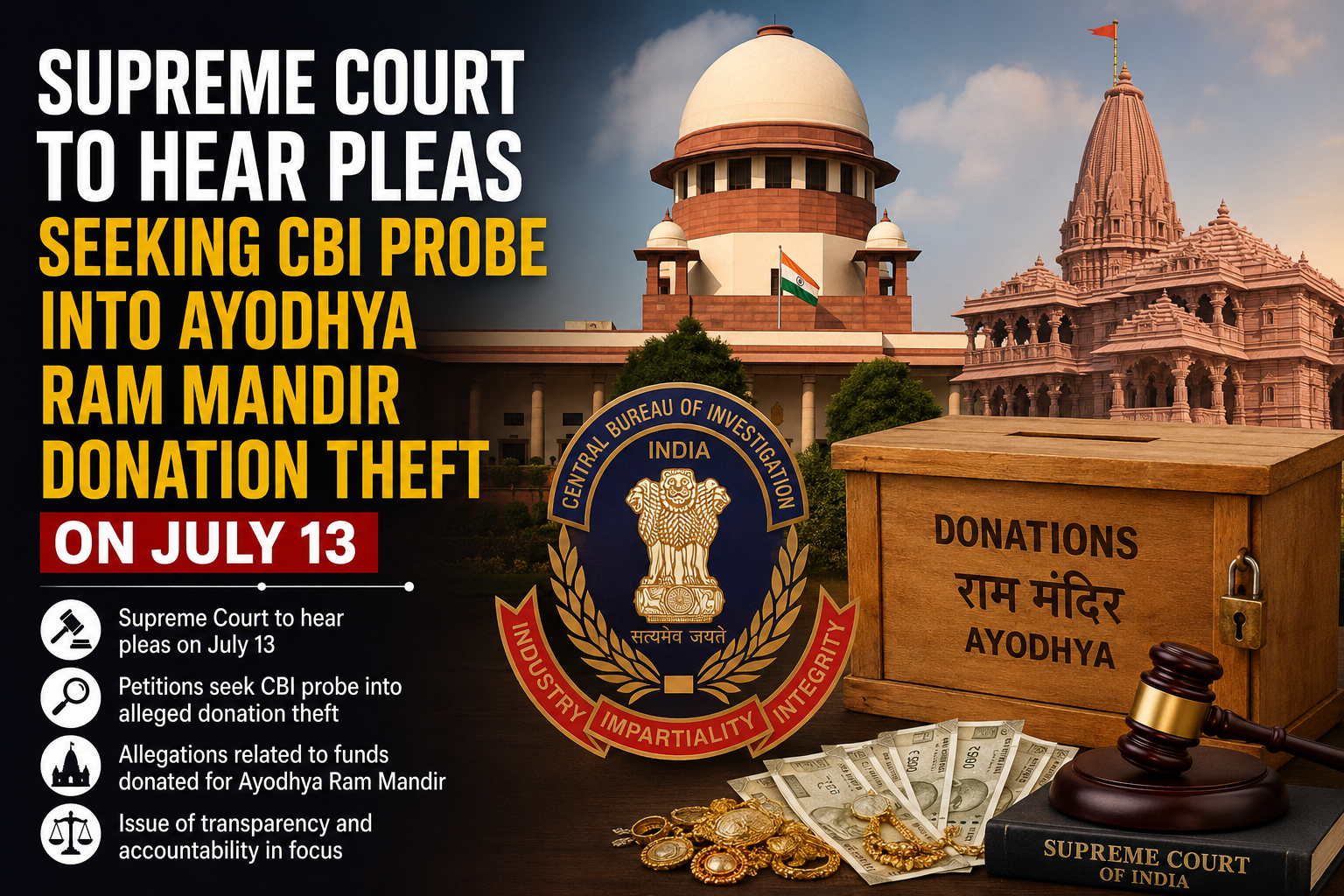
The Supreme Court of India is scheduled to hear a batch of petitions on July 13 seeking a Central Bureau of Investigation (CBI) probe into the alleged theft and misappropriation of donations collected for the Ayodhya Ram Mandir. The matter has attracted nationwide attention due to the religious significance of the Ram Mandir and the serious allegations involving funds donated by millions of devotees across India and abroad. According to recent reports, the petitions seek an independent investigation, alleging that a fair and transparent inquiry is necessary to maintain public confidence in the administration of temple donations.
Background of the Allegations
The controversy relates to allegations that donations offered by devotees at the Ram Mandir were improperly handled or misappropriated. Following the emergence of these allegations, local authorities initiated investigations, and several arrests were reportedly made. Petitioners before the Supreme Court have argued that, considering the national importance of the temple and the scale of public donations involved, an independent investigation by the CBI would inspire greater confidence than a state-level inquiry.
The petitions also seek judicial oversight to ensure transparency and accountability in the handling of public charitable funds.
Why Has the Matter Reached the Supreme Court?
The petitions before the Supreme Court request several important directions, including:
Registration of a comprehensive investigation into the alleged donation theft.
Transfer of the investigation to the Central Bureau of Investigation (CBI).
Independent monitoring of the investigation.
Measures to ensure transparency in the collection, accounting, and management of temple donations.
Earlier, the Supreme Court had declined requests for an urgent hearing, observing that there was no extraordinary urgency warranting immediate intervention. Subsequently, the matter was listed for hearing on July 13, where the Court is expected to consider the maintainability of the petitions and the reliefs sought.
Legal Issues Before the Supreme Court
The hearing is expected to raise several important constitutional and legal questions, including:
1. Whether a CBI Investigation is Necessary
The Court will examine whether the circumstances justify transferring the investigation to the CBI. Generally, the Supreme Court exercises this power only in exceptional cases involving significant public interest or where an independent investigation is considered necessary.
2. Public Trust and Accountability
Since donations to religious institutions involve public faith, transparency in their management becomes a matter of considerable importance. The Court may examine whether existing mechanisms are sufficient to protect the interests of devotees.
3. Judicial Oversight
The petitions also seek judicial supervision over the investigation. The Court may consider whether such monitoring is warranted at the present stage.
Importance of the Case
The Ayodhya Ram Mandir is not merely a religious structure but also an institution of immense national importance. Following the Supreme Court’s landmark judgment in the Ayodhya title dispute, the temple has become one of India’s most significant places of worship, attracting millions of devotees and substantial charitable contributions. Any allegation concerning the misuse of donated funds naturally attracts public concern and demands a transparent legal response.
The outcome of the July 13 hearing may influence how courts approach allegations involving charitable and religious institutions in the future.
Previous Developments
Reports indicate that similar petitions were also filed before the Allahabad High Court. However, the High Court declined to entertain the plea, noting that substantially similar issues were already pending before the Supreme Court.
Meanwhile, investigations by local authorities have continued, with reports of arrests, recovery of assets, and examination of financial transactions allegedly linked to the case. These developments are likely to be relevant during the Supreme Court proceedings.
Possible Outcomes of the Hearing
While it is impossible to predict the Court’s final decision, several outcomes remain possible:
The Supreme Court may issue notice to the respondents.
It may seek detailed status reports from investigating authorities.
The Court may decide whether a CBI probe is warranted.
It may refuse to interfere if satisfied that the ongoing investigation is adequate.
It could issue broader directions regarding transparency in managing donations received by religious trusts.
The Court’s observations during the hearing are likely to have considerable significance for the administration of religious institutions across India.
Broader Legal Significance
The case goes beyond allegations of financial misconduct. It touches upon principles of public accountability, transparency in charitable institutions, judicial review of investigations, and the confidence of citizens in institutions managing public donations.
The Supreme Court’s approach may also clarify the legal standards governing requests for transfer of investigations to the CBI, particularly where matters involve public faith and national importance.
Conclusion
The Supreme Court’s hearing on July 13 represents an important development in the ongoing controversy surrounding the alleged Ayodhya Ram Mandir donation theft. While the allegations remain subject to investigation and judicial scrutiny, the Court’s consideration of the petitions will be closely watched across the country.
It is important to remember that the Supreme Court has not yet expressed any opinion on the merits of the allegations. The proceedings will focus on whether an independent investigation by the CBI is legally justified and necessary in the interest of justice. Until a final judicial determination is made, all allegations remain under investigation, and due process of law must be respected.
About AOR Tushar Garg – Supreme Court of India
AOR Tushar Garg is an Advocate-on-Record (AOR) at the Supreme Court of India, representing clients in constitutional, civil, criminal, commercial, arbitration, service, matrimonial, and public interest litigation matters. With extensive experience in Supreme Court practice, he provides strategic legal representation in Special Leave Petitions (SLPs), Writ Petitions, Civil Appeals, Criminal Appeals, Transfer Petitions, and review proceedings.
Website: https://advocateonrecordtushargarg.com/
Contact: +91-7206810681
For expert legal assistance before the Supreme Court of India, connect with AOR Tushar Garg for professional advice and effective representation.