
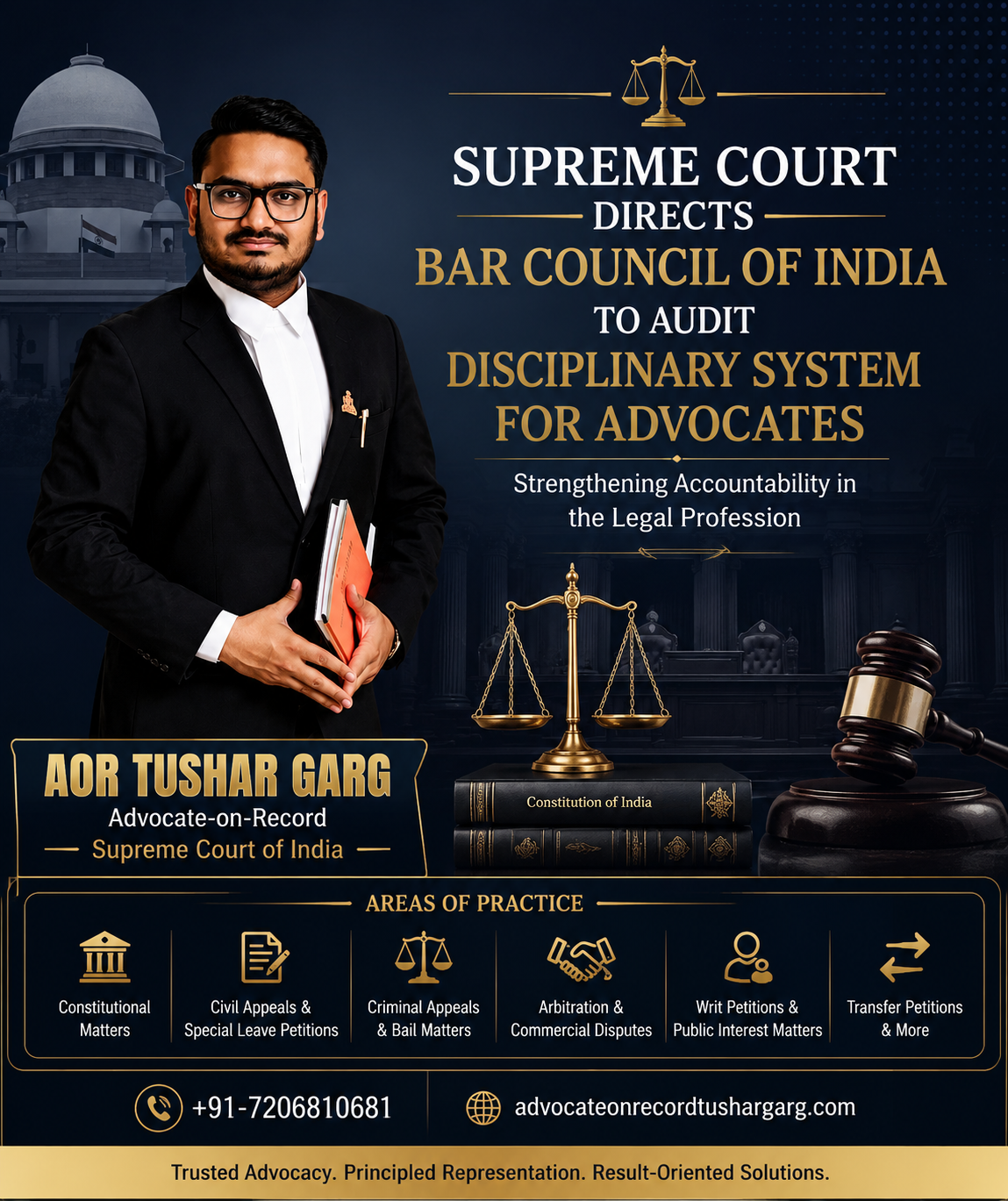
Supreme Court Directs Bar Council to Reform Advocate Disciplinary Process
The legal profession is built on the principles of integrity, ethics, and accountability. Advocates are not only representatives of their clients but also officers of the court who play a crucial role in upholding the rule of law. In a significant development aimed at strengthening professional standards, the Supreme Court of India has directed the Bar Council of India (BCI) to conduct a comprehensive audit of the disciplinary system governing advocates across the country. The Court emphasized that a transparent and efficient disciplinary mechanism is essential for maintaining public confidence in the legal profession.
This landmark direction reflects the judiciary’s continued commitment to ensuring that advocates adhere to the highest ethical standards while reinforcing accountability within the legal system.
Why Did the Supreme Court Issue This Direction?
The Supreme Court observed that disciplinary proceedings against advocates often face considerable delays, resulting in complaints remaining unresolved for years. Such delays not only affect complainants but also undermine public trust in the legal profession.
Recognizing these concerns, the Court directed the Bar Council of India to undertake a nationwide audit of the functioning of disciplinary committees constituted by State Bar Councils. The objective is to identify shortcomings, evaluate pending disciplinary matters, and recommend reforms that can make the disciplinary process more effective, transparent, and time-bound.
The Court reiterated that professional misconduct by advocates cannot be ignored, and timely action is necessary to preserve the dignity of the legal profession.
Importance of an Effective Disciplinary System
The disciplinary framework under the Advocates Act, 1961 is designed to regulate professional conduct and ensure that advocates maintain ethical standards. Complaints regarding professional misconduct are generally examined by the disciplinary committees of State Bar Councils, with appeals lying before the Bar Council of India and, in appropriate cases, the Supreme Court.
An efficient disciplinary mechanism serves several important purposes:
Protects the interests of litigants.
Maintains public confidence in the justice delivery system.
Upholds professional ethics among advocates.
Ensures accountability within the legal fraternity.
Preserves the dignity and credibility of courts.
The Supreme Court observed that delays or inaction in disciplinary proceedings defeat these objectives and weaken institutional accountability.
What Will the Audit Cover?
The audit directed by the Supreme Court is expected to examine several critical aspects of the disciplinary system, including:
Number of pending disciplinary complaints.
Average time taken to dispose of complaints.
Functioning of disciplinary committees.
Availability of infrastructure and administrative support.
Compliance with statutory procedures.
Reasons for delays in disciplinary proceedings.
Recommendations for improving efficiency.
The findings of this audit are expected to provide valuable insights into the functioning of disciplinary mechanisms across different State Bar Councils.
Strengthening Professional Ethics
Legal ethics form the foundation of the advocacy profession. Every advocate owes duties not only to clients but also to the court, fellow advocates, and society at large.
Professional misconduct can include:
Misrepresentation before the court.
Misappropriation of client funds.
Breach of confidentiality.
Conflict of interest.
Forgery or fraudulent conduct.
Improper professional behaviour.
The Supreme Court emphasized that effective disciplinary action against such misconduct is essential to preserve the reputation of the legal profession.
Accountability Enhances Public Confidence
The judiciary noted that public trust is one of the strongest pillars supporting the legal system. When disciplinary complaints remain unresolved for prolonged periods, confidence in regulatory institutions diminishes.
A transparent disciplinary mechanism demonstrates that advocates are held accountable for professional misconduct while ensuring fairness through due process. This balance between accountability and procedural fairness strengthens the credibility of both the Bar Councils and the justice delivery system.
Role of the Bar Council of India
The Bar Council of India serves as the apex statutory body regulating legal education and professional standards for advocates in India.
Its responsibilities include:
Framing professional conduct rules.
Supervising State Bar Councils.
Hearing disciplinary appeals.
Promoting legal education.
Safeguarding professional ethics.
Ensuring uniform standards across the country.
The Supreme Court’s direction reinforces the Bar Council’s responsibility to ensure that disciplinary mechanisms remain effective and responsive.
Impact on the Legal Profession
The audit is likely to have several long-term benefits:
Faster Disposal of Complaints
Identification of bottlenecks may help reduce delays in disciplinary proceedings.
Improved Transparency
Regular monitoring and reporting can enhance transparency in disciplinary processes.
Stronger Institutional Framework
Recommendations arising from the audit may lead to procedural reforms and better infrastructure.
Greater Public Trust
Efficient disciplinary systems reassure litigants that professional misconduct will be addressed promptly.
Higher Professional Standards
Advocates are likely to become even more conscious of ethical responsibilities when disciplinary systems function effectively.
A Positive Step Towards Judicial Reforms
This direction aligns with broader judicial reforms aimed at improving institutional efficiency and accountability. While advocates enjoy independence in representing clients, that independence carries corresponding responsibilities.
The Supreme Court has consistently emphasized that the legal profession is a noble profession founded upon public trust. Ethical conduct and accountability are indispensable to maintaining that trust.
By directing a nationwide audit, the Court seeks not merely to identify shortcomings but also to encourage systemic improvements that benefit advocates, litigants, courts, and society as a whole.
Conclusion
The Supreme Court’s directive to the Bar Council of India to audit the disciplinary system marks an important milestone in strengthening accountability within the legal profession. Timely and transparent disciplinary proceedings are essential to maintaining ethical standards, protecting litigants, and preserving public confidence in the justice system.
As reforms emerge from this audit, they are expected to contribute significantly to a more efficient, transparent, and accountable regulatory framework for advocates across India. Ultimately, such measures reinforce the dignity of the legal profession and uphold the rule of law.
About AOR Tushar Garg – Supreme Court of India
AOR Tushar Garg is an Advocate-on-Record (AOR), Supreme Court of India, representing clients in a wide range of matters before the apex court, including Special Leave Petitions (SLPs), Civil Appeals, Criminal Appeals, Constitutional Matters, Arbitration, Transfer Petitions, Writ Petitions, and other complex litigation.
Committed to professional excellence, ethical advocacy, and client-focused legal solutions, AOR Tushar Garg provides comprehensive legal representation before the Supreme Court of India while upholding the highest standards of integrity and accountability expected from the legal profession.