

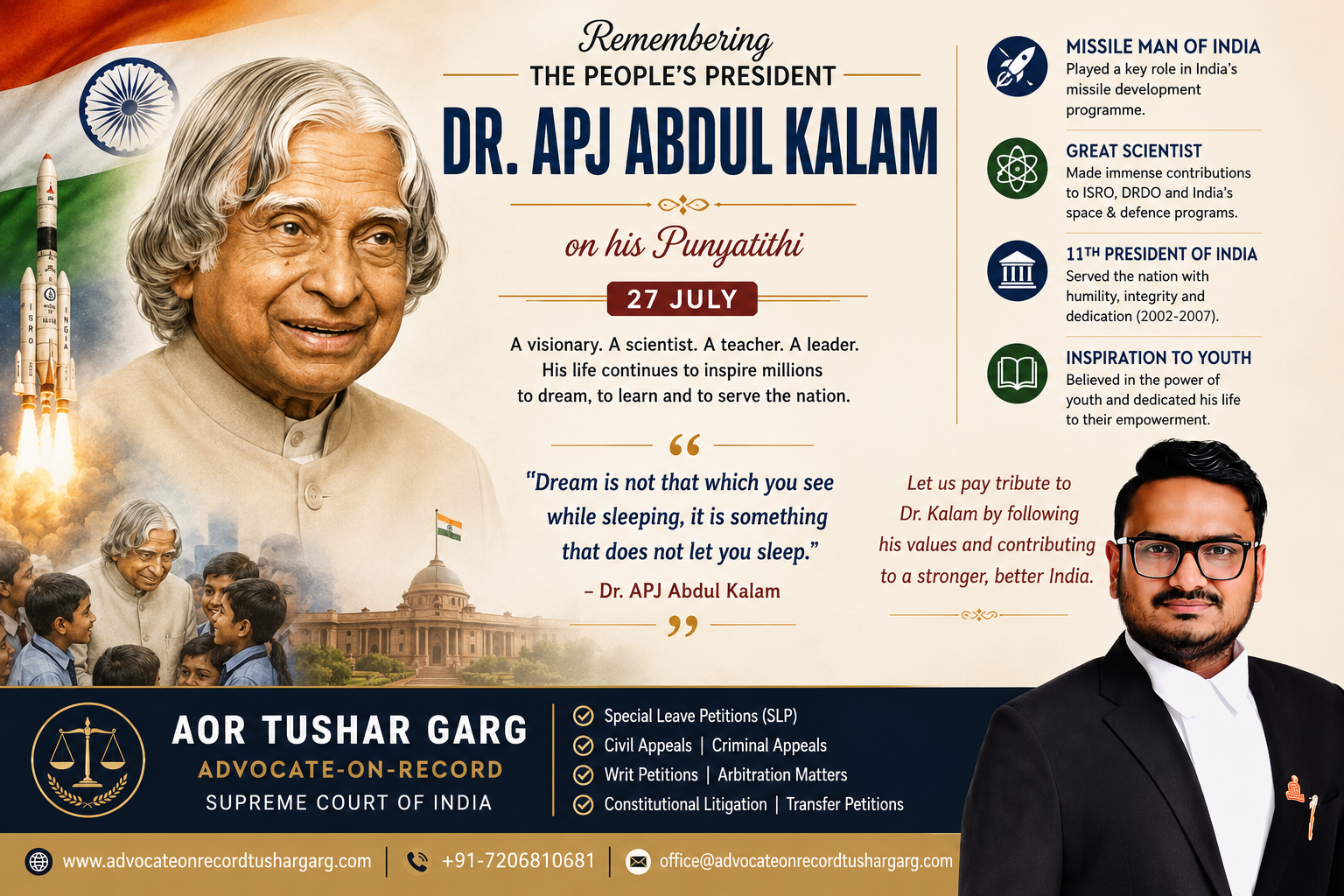
Dr. APJ Abdul Kalam Punyatithi: Honouring the People’s President and the Missile Man of India
Every year on 27 July, India remembers one of its greatest visionaries, Dr. A.P.J. Abdul Kalam, on his Punyatithi (Death Anniversary). Known as the “Missile Man of India” and the “People’s President,” Dr. Kalam devoted his entire life to science, education, innovation, and nation-building. His inspiring journey from a humble background to becoming the 11th President of India continues to motivate millions of people across the world.
Dr. Kalam believed that dreams have the power to transform lives. His famous words, “Dream is not that which you see while sleeping; it is something that does not let you sleep,” remain a source of inspiration for students, professionals, scientists, and entrepreneurs alike.
Early Life of Dr. APJ Abdul Kalam
Dr. Avul Pakir Jainulabdeen Abdul Kalam was born on 15 October 1931 in Rameswaram, Tamil Nadu, into a modest family. Despite financial hardships, he was an exceptionally hardworking and determined student.
To support his family, young Kalam sold newspapers while continuing his education. His dedication to learning and unwavering determination laid the foundation for an extraordinary career in science and public service.
He graduated in Physics from St. Joseph’s College and later pursued Aeronautical Engineering from the Madras Institute of Technology (MIT).
Career in Science and Space Research
Dr. Kalam began his career at the Defence Research and Development Organisation (DRDO) before joining the Indian Space Research Organisation (ISRO).
One of his most remarkable achievements was serving as the Project Director of India’s first Satellite Launch Vehicle (SLV-III), which successfully deployed the Rohini satellite into orbit in 1980.
His contribution to India’s missile development programme earned him the title “Missile Man of India.”
Under his leadership, India successfully developed strategic missile systems, including:
Agni Missile
Prithvi Missile
Akash Missile
Trishul Missile
Nag Missile
His work significantly strengthened India’s defence capabilities and established the country as a technologically advanced nation.
Contribution to India’s Nuclear Programme
Dr. Kalam played a vital role in Pokhran-II Nuclear Tests conducted in 1998. Working closely with scientists and policymakers, he helped demonstrate India’s scientific and strategic capabilities on the global stage.
The successful nuclear tests marked a significant milestone in India’s defence and technological advancement.
The People’s President
In 2002, Dr. APJ Abdul Kalam became the 11th President of India and served until 2007.
Unlike many political leaders, Dr. Kalam was admired for his simplicity, humility, and accessibility. He interacted regularly with students and young innovators, encouraging them to dream big and work tirelessly for the nation.
His presidency was characterized by integrity, transparency, and a strong commitment to education and youth empowerment.
A Passion for Education
Even after completing his presidential term, Dr. Kalam continued travelling across India to interact with students.
He believed that “The youth of today are the leaders of tomorrow.”
His lectures focused on:
Innovation
Scientific thinking
Leadership
Ethics
National development
Entrepreneurship
Quality education
Dr. Kalam considered teachers as nation-builders and always encouraged students to develop curiosity, creativity, and confidence.
Vision 2020
One of Dr. Kalam’s greatest contributions was his vision of transforming India into a developed nation by 2020.
His Vision 2020 emphasized:
Technological advancement
Self-reliance
Rural development
Quality healthcare
Sustainable agriculture
Economic growth
Scientific innovation
Education for all
Although the target year has passed, his vision continues to inspire policymakers, entrepreneurs, educators, and young citizens.
Awards and Honours
Dr. APJ Abdul Kalam received numerous prestigious awards, including:
Bharat Ratna (1997) – India’s highest civilian honour
Padma Vibhushan
Padma Bhushan
Multiple honorary doctorates from universities around the world
These recognitions reflected his extraordinary contributions to science, technology, education, and public service.
The Final Journey
On 27 July 2015, while delivering a lecture at the Indian Institute of Management (IIM), Shillong, Dr. Kalam collapsed due to cardiac arrest.
He passed away doing what he loved most—teaching and inspiring students.
His final moments symbolized his lifelong dedication to education and nation-building.
Lessons from Dr. Kalam’s Life
Dr. APJ Abdul Kalam’s life teaches us several timeless values:
Dream big and work hard.
Never stop learning.
Success comes through perseverance.
Knowledge should serve society.
Leadership begins with integrity.
Failures are stepping stones to success.
Youth are the greatest strength of a nation.
His life demonstrates that determination, honesty, and dedication can overcome even the greatest challenges.
Why We Observe Dr. APJ Abdul Kalam Punyatithi
Dr. Kalam’s Punyatithi is observed to honour:
His remarkable contribution to India’s defence and space programmes.
His vision for a developed India.
His commitment to education and youth empowerment.
His simple lifestyle and ethical leadership.
His lifelong service to the nation.
Across schools, colleges, universities, and institutions, seminars, speeches, and educational programs are organized to remember his extraordinary legacy.
Conclusion
Dr. APJ Abdul Kalam was much more than a scientist or President—he was a visionary leader, an inspiring teacher, and a true patriot. His ideas continue to guide India toward innovation, self-reliance, and inclusive development.
On his Punyatithi, let us pay tribute to the People’s President by embracing his values of honesty, hard work, education, and service to the nation. The greatest tribute we can offer Dr. Kalam is to keep dreaming, continue learning, and contribute positively to society.
As Dr. Kalam beautifully said:
“You have to dream before your dreams can come true.”
May his life and legacy continue to inspire generations to build a stronger, smarter, and more prosperous India.