

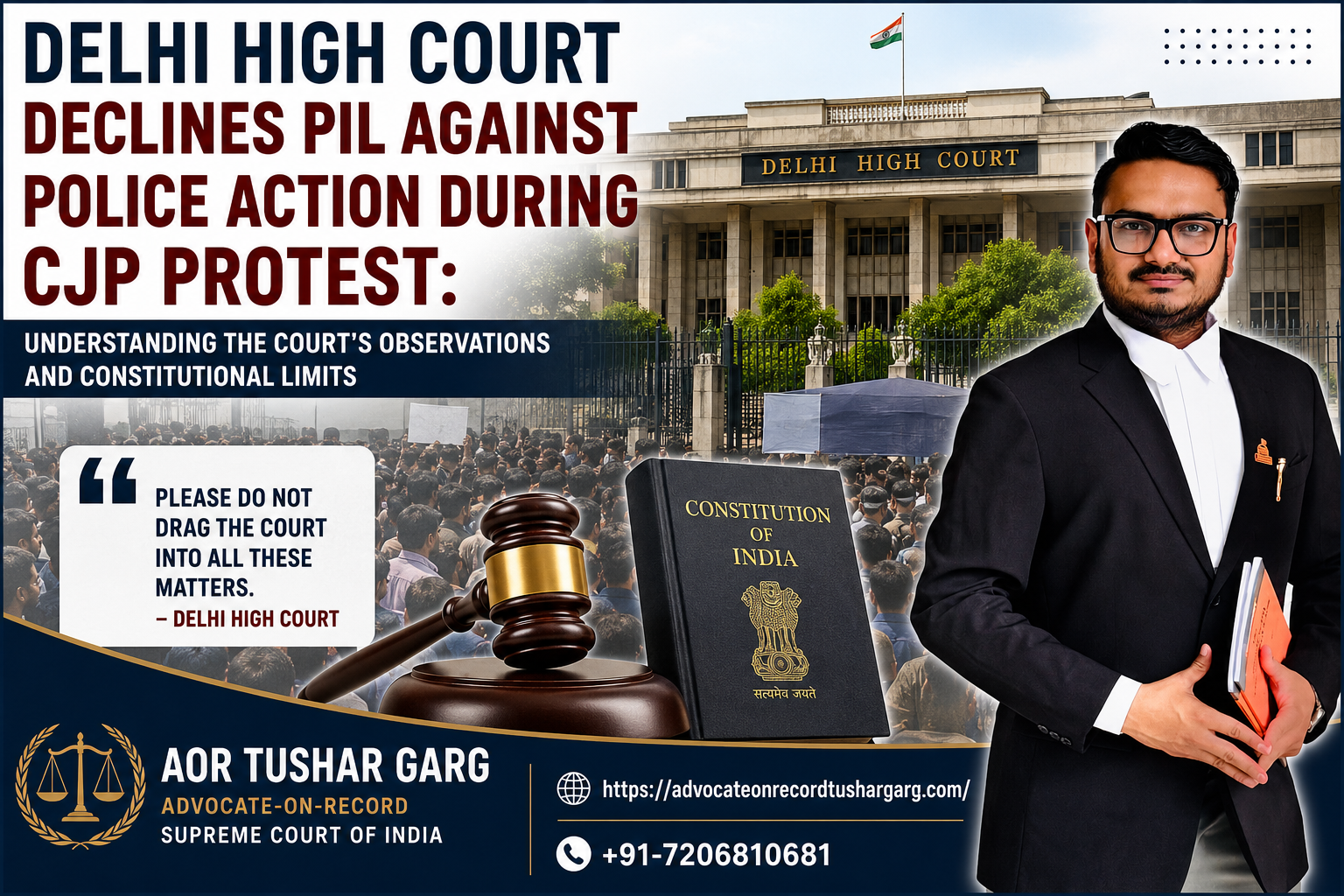
Delhi High Court Declines PIL Against Police Action During CJP Protest: Understanding the Court’s Observations and Constitutional Limits
By AOR Tushar Garg | Advocate-on-Record, Supreme Court of India
The Delhi High Court recently heard a Public Interest Litigation (PIL) challenging alleged police action during a protest organized by the Citizens for Justice and Peace (CJP). During the hearing, the Court made a significant observation, stating that “Please do not drag the Court into all these matters,” indicating its reluctance to entertain a PIL in the absence of a clear legal basis requiring judicial intervention.
The case has once again brought into focus the delicate balance between the right to protest, police powers to maintain public order, and judicial restraint. While citizens possess fundamental rights under the Constitution, courts also exercise caution before stepping into matters involving executive discretion unless there is a clear violation of constitutional or statutory rights.
This article explains the legal background, the Delhi High Court’s observations, and what the matter means from a constitutional law perspective.
Background of the PIL
The Public Interest Litigation was filed questioning the police’s handling of a protest reportedly organized by Citizens for Justice and Peace (CJP). The petitioner alleged that police authorities acted unfairly while managing the demonstration and sought judicial intervention regarding the conduct of law enforcement agencies.
The petition also requested directions concerning the protection of the protesters’ constitutional rights and questioned the manner in which police exercised their authority during the event.
However, during the hearing, the Delhi High Court appeared unconvinced that the matter warranted extraordinary jurisdiction under Article 226 of the Constitution.
Delhi High Court’s Strong Observation
During the proceedings, the Bench remarked that the judiciary cannot be expected to intervene in every dispute involving executive action.
The Court reportedly observed:
“Please do not drag the Court into all these matters.”
The observation reflects an important constitutional principle—that courts should not substitute themselves for administrative authorities unless there is clear illegality, arbitrariness, mala fide action, or violation of fundamental rights.
Judicial review is an extraordinary constitutional remedy, not a substitute for routine administrative oversight.
Constitutional Right to Protest
India’s Constitution guarantees several fundamental rights that collectively protect peaceful demonstrations.
Article 19(1)(a)
Provides citizens the freedom of speech and expression.
Article 19(1)(b)
Guarantees the right to assemble peacefully and without arms.
Article 19(1)(c)
Protects the right to form associations or unions.
These rights are essential pillars of a democratic society.
However, they are not absolute.
Reasonable Restrictions Under the Constitution
The Constitution also empowers the State to impose reasonable restrictions in the interests of:
Public order
Security of the State
Sovereignty and integrity of India
Morality
Decency
Prevention of offences
Therefore, while peaceful protests enjoy constitutional protection, authorities may regulate demonstrations to ensure public safety and prevent law-and-order disturbances.
The legality of such restrictions depends upon whether they are reasonable, proportionate, and non-arbitrary.
Scope of Judicial Review
One of the important principles emerging from this hearing is the doctrine of judicial restraint.
Indian constitutional courts generally interfere only where there is:
Violation of fundamental rights
Abuse of power
Mala fide exercise of authority
Arbitrary administrative action
Violation of statutory procedures
Lack of jurisdiction
Courts generally avoid supervising day-to-day administrative decisions unless these thresholds are crossed.
This approach preserves the constitutional separation of powers among the legislature, executive, and judiciary.
Why the Court Was Cautious
The Delhi High Court’s remarks suggest that every allegation regarding police conduct cannot automatically become a constitutional issue requiring PIL jurisdiction.
The Court appears to have emphasized that:
Administrative authorities have primary responsibility for maintaining public order.
Every operational decision of police cannot be judicially reviewed.
Courts must avoid becoming supervisory bodies for executive functions.
PIL jurisdiction must remain reserved for genuine public interest matters involving substantial constitutional questions.
This reflects the judiciary’s consistent effort to prevent misuse of Public Interest Litigation.
Importance of Public Interest Litigation
Public Interest Litigation has played a transformative role in India.
It has helped address:
Environmental protection
Prison reforms
Human rights violations
Women’s rights
Child protection
Labour rights
Access to justice
However, the Supreme Court and various High Courts have repeatedly cautioned against converting PIL into a platform for political or publicity-oriented litigation.
Courts carefully examine whether:
The petitioner has genuine public interest.
There exists a legal injury.
Judicial intervention is necessary.
Alternative remedies are available.
Police Powers During Public Demonstrations
Police authorities are empowered under various laws to regulate public assemblies.
Their responsibilities include:
Preventing violence
Managing traffic
Ensuring public safety
Protecting protesters
Preventing damage to public property
At the same time, police actions remain subject to constitutional scrutiny if they are excessive, arbitrary, or violate fundamental rights.
Finding the correct balance remains one of the most challenging aspects of constitutional governance.
Broader Constitutional Significance
The Delhi High Court’s observation serves as a reminder that constitutional courts exercise limited but powerful jurisdiction.
Judicial review is intended to protect constitutional rights—not to oversee every executive decision.
The hearing also reinforces the principle that democratic institutions have distinct constitutional roles:
The Legislature makes laws.
The Executive implements them.
The Judiciary ensures constitutional compliance.
Maintaining these institutional boundaries strengthens constitutional democracy.
Lessons for Future PILs
The matter highlights several practical lessons for litigants:
PIL should involve genuine public interest.
Constitutional violations must be clearly demonstrated.
Adequate factual foundation is essential.
Courts discourage speculative or generalized allegations.
Judicial intervention remains an exceptional constitutional remedy.
This ensures that judicial resources remain available for cases involving serious constitutional or public interest concerns.
Conclusion
The Delhi High Court’s response to the PIL challenging police action during the CJP protest underscores the judiciary’s commitment to maintaining constitutional balance. While the right to protest remains a cherished fundamental freedom under the Constitution, courts also recognize the executive’s responsibility to maintain public order and the need to exercise judicial restraint.
The observations made during the hearing should not be viewed as diminishing the importance of civil liberties. Rather, they reaffirm that constitutional courts intervene when there is a demonstrable legal or constitutional violation, not merely because an administrative decision is disputed.
As India’s constitutional jurisprudence continues to evolve, the principles of rule of law, judicial restraint, accountability, and protection of fundamental rights will remain central to preserving the balance between individual freedoms and effective governance.