

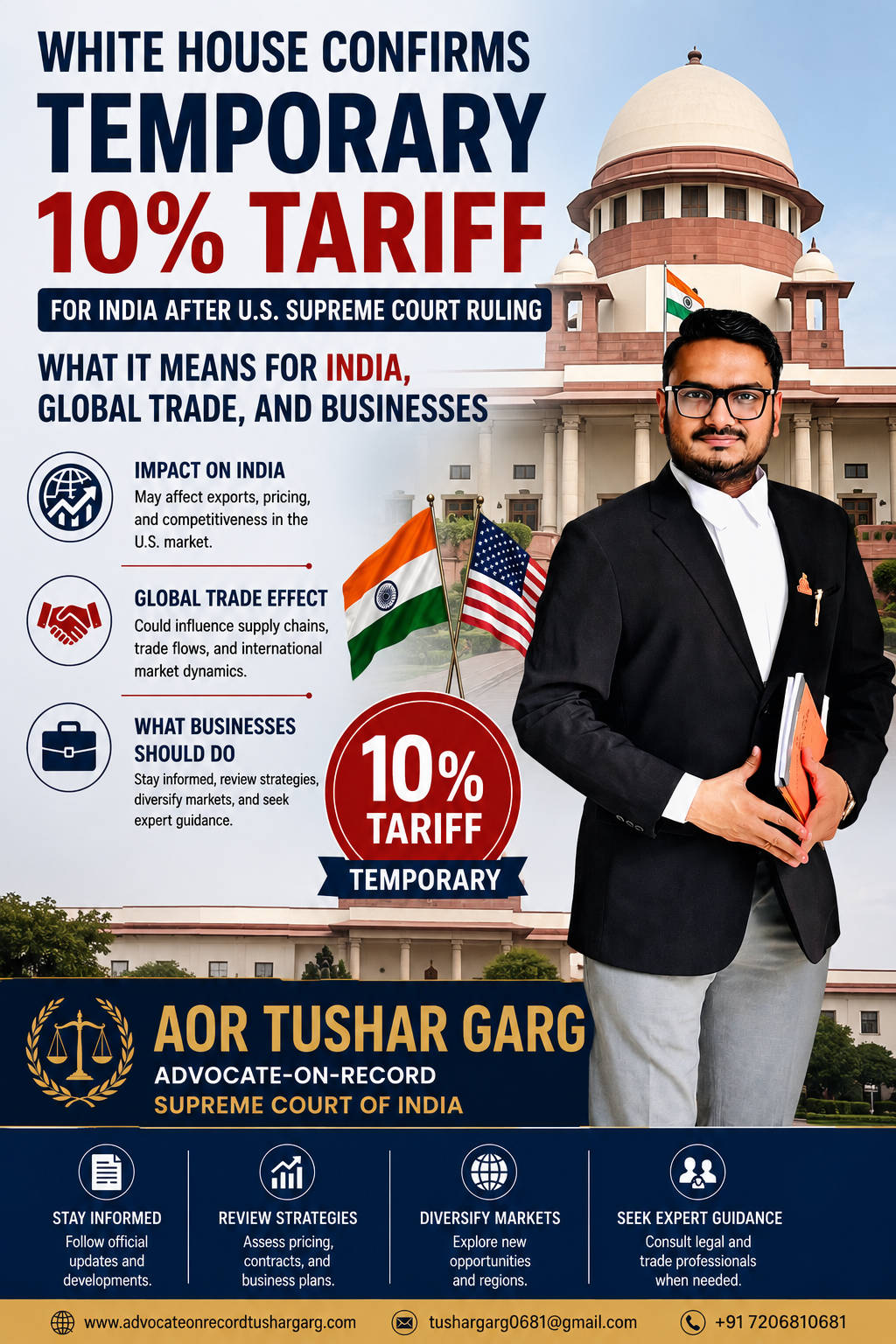
White House Confirms Temporary 10% Tariff for India After U.S. Supreme Court Ruling: What It Means for India, Global Trade, and Businesses
The White House has confirmed that a temporary 10% tariff on certain Indian imports into the United States will remain in effect following a recent U.S. Supreme Court ruling. The decision has attracted significant attention from policymakers, exporters, economists, and businesses across the globe. While the ruling does not permanently settle the issue, it allows the U.S. administration to continue implementing the tariff until the legal proceedings are fully resolved.
For India, one of the United States’ largest trading partners, the development raises important questions regarding exports, bilateral trade, manufacturing, and future diplomatic negotiations. Businesses engaged in international trade should closely monitor these developments as they may influence pricing, competitiveness, and supply chains.
Understanding the Temporary 10% Tariff
A tariff is a tax imposed by one country on goods imported from another country. Governments often use tariffs to protect domestic industries, address trade imbalances, or pursue broader economic and strategic objectives.
According to the White House, the 10% tariff applicable to certain imports from India will remain temporarily enforceable after the U.S. Supreme Court declined to immediately block the administration’s trade measures. This means importers must continue paying the tariff unless a future court decision or government policy changes the current position.
It is important to note that this is a temporary legal arrangement, and the underlying legal dispute is expected to continue before the U.S. courts.
What Did the U.S. Supreme Court Decide?
The U.S. Supreme Court’s recent action does not represent a final judgment on the legality of the tariff itself. Instead, the Court allowed the tariff measures to remain in place while litigation proceeds through the judicial process.
Such interim decisions are common in constitutional and administrative law, particularly where courts believe maintaining the existing position temporarily serves the public interest until all legal arguments are fully examined.
As a result, businesses should understand that the current tariff remains enforceable, but its long-term future may depend on subsequent judicial rulings.
Impact on Indian Exports
India exports a wide variety of products to the United States, including:
Pharmaceuticals
Engineering goods
Textiles and garments
Chemicals
Jewellery
Auto components
Information technology-related products
If products covered by the tariff become more expensive in the U.S. market, exporters may face increased competition from suppliers in other countries. Higher import costs can reduce demand, affect pricing strategies, and influence profit margins.
However, experienced exporters often adapt by improving efficiency, renegotiating contracts, or diversifying export destinations.
Economic Implications for India
Although a temporary tariff may create short-term challenges, India’s overall economic fundamentals remain strong.
Several factors continue to support India’s export sector:
Growing manufacturing capabilities
Expansion under the “Make in India” initiative
Increasing global demand for diversified supply chains
Strong services exports
Continued foreign investment
Trade experts generally believe that while tariffs may affect specific sectors, India’s diversified economy is capable of adjusting through policy support and market expansion.
Bilateral Trade Relations
India and the United States maintain one of the world’s most significant strategic and economic partnerships. Beyond trade, the two countries cooperate in areas including:
Defence
Technology
Clean energy
Artificial Intelligence
Healthcare
Semiconductor manufacturing
Education
Temporary trade disagreements are not uncommon between major economies. Historically, India and the United States have resolved many commercial disputes through negotiations, diplomatic engagement, and international trade mechanisms.
Most analysts expect both governments to continue discussions aimed at strengthening long-term economic cooperation despite temporary tariff issues.
What Should Indian Businesses Do?
Indian exporters and businesses should consider proactive measures, including:
Monitoring official trade notifications.
Reviewing export contracts for pricing implications.
Diversifying international markets.
Strengthening supply-chain resilience.
Seeking professional legal and trade advice where necessary.
Businesses involved in cross-border commerce should remain informed about evolving legal developments in the United States, as judicial decisions may directly affect import duties and compliance requirements.
Legal Perspective
International trade measures often involve complex interactions between domestic legislation, constitutional principles, executive authority, and international trade agreements.
Judicial review plays a crucial role in ensuring that executive actions remain consistent with applicable law. The present matter illustrates how courts can permit temporary enforcement while examining broader legal questions.
The final outcome may influence future trade policy, executive powers, and international commercial relations.
Looking Ahead
The continuation of the temporary tariff does not necessarily indicate a permanent shift in U.S.-India trade relations. Future negotiations, court decisions, and policy developments may significantly alter the current position.
Businesses should avoid making long-term assumptions based solely on the temporary order. Instead, they should remain flexible, informed, and prepared to respond to future developments.
As global supply chains continue to evolve, India remains an important manufacturing and export hub. Long-term trade relations between India and the United States are expected to continue growing despite occasional legal and policy challenges.
Conclusion
The White House’s confirmation that the temporary 10% tariff on certain Indian imports will remain in effect following the U.S. Supreme Court’s interim ruling marks an important development in international trade law. While the decision may create short-term uncertainty for exporters and importers, it does not represent the final legal outcome.
For businesses, the key priorities should be staying informed, evaluating commercial risks, and adapting to changing trade conditions. At the same time, continued diplomatic engagement between India and the United States is likely to play a significant role in shaping the future of bilateral trade.
Disclaimer: This article is intended for general informational purposes only and should not be construed as legal advice. Readers are advised to consult qualified legal and trade professionals for guidance relating to specific commercial or legal matters.
Author:
AOR Tushar Garg
Advocate-on-Record, Supreme Court of India
Website: https://advocateonrecordtushargarg.com/