
New Bar Council of India Guidelines on the Use of Social Media by Lawyers: A Complete Guide for the Legal Profession
By AOR Tushar Garg | Advocate-on-Record, Supreme Court of India
The rapid growth of social media has transformed the way professionals communicate, educate, and interact with the public. Lawyers, too, have increasingly embraced platforms such as LinkedIn, X (formerly Twitter), Facebook, Instagram, and YouTube to share legal knowledge, discuss landmark judgments, and build their professional presence.
Recognizing both the opportunities and the ethical challenges posed by digital platforms, the Bar Council of India (BCI) has introduced new guidelines regulating the use of social media by advocates. These guidelines aim to balance freedom of expression with the dignity, ethics, and professional standards expected from members of the legal profession.
The objective is not to prevent advocates from using social media but to ensure that online conduct upholds the integrity of the justice system and maintains public confidence in the legal profession.
Why Were New Guidelines Needed?
Social media has become an influential medium for sharing legal updates, networking, client engagement, and public education. However, concerns have also emerged regarding:
Misleading advertisements by advocates
Solicitation of clients through digital platforms
Publication of confidential client information
Public criticism of courts and judges
Dissemination of inaccurate legal advice
Misrepresentation of professional achievements
Paid promotions and influencer-style legal marketing
To address these issues, the Bar Council of India has framed guidelines that clarify what advocates may and may not do online while remaining compliant with the Advocates Act, 1961 and the Bar Council of India Rules.
Objectives of the BCI Social Media Guidelines
The primary objectives include:
Preserving the dignity of the legal profession.
Preventing unethical solicitation and advertising.
Promoting responsible use of digital platforms.
Protecting client confidentiality.
Encouraging accurate legal awareness.
Maintaining public trust in advocates and the judiciary.
Lawyers Can Maintain Professional Social Media Profiles
The guidelines recognize that advocates may maintain professional accounts on platforms such as:
LinkedIn
X (Twitter)
Facebook
Instagram
YouTube
Professional websites
Legal blogs
These platforms may be used to share professional information, educational content, legal developments, and academic discussions.
Sharing Legal Knowledge Is Encouraged
Advocates are encouraged to contribute to public legal awareness by sharing:
Supreme Court judgments
High Court decisions
Constitutional developments
Legislative updates
Legal research
Academic articles
Educational videos
Legal seminars and webinars
Such content should be accurate, balanced, and educational in nature.
Advertising and Client Solicitation Remain Prohibited
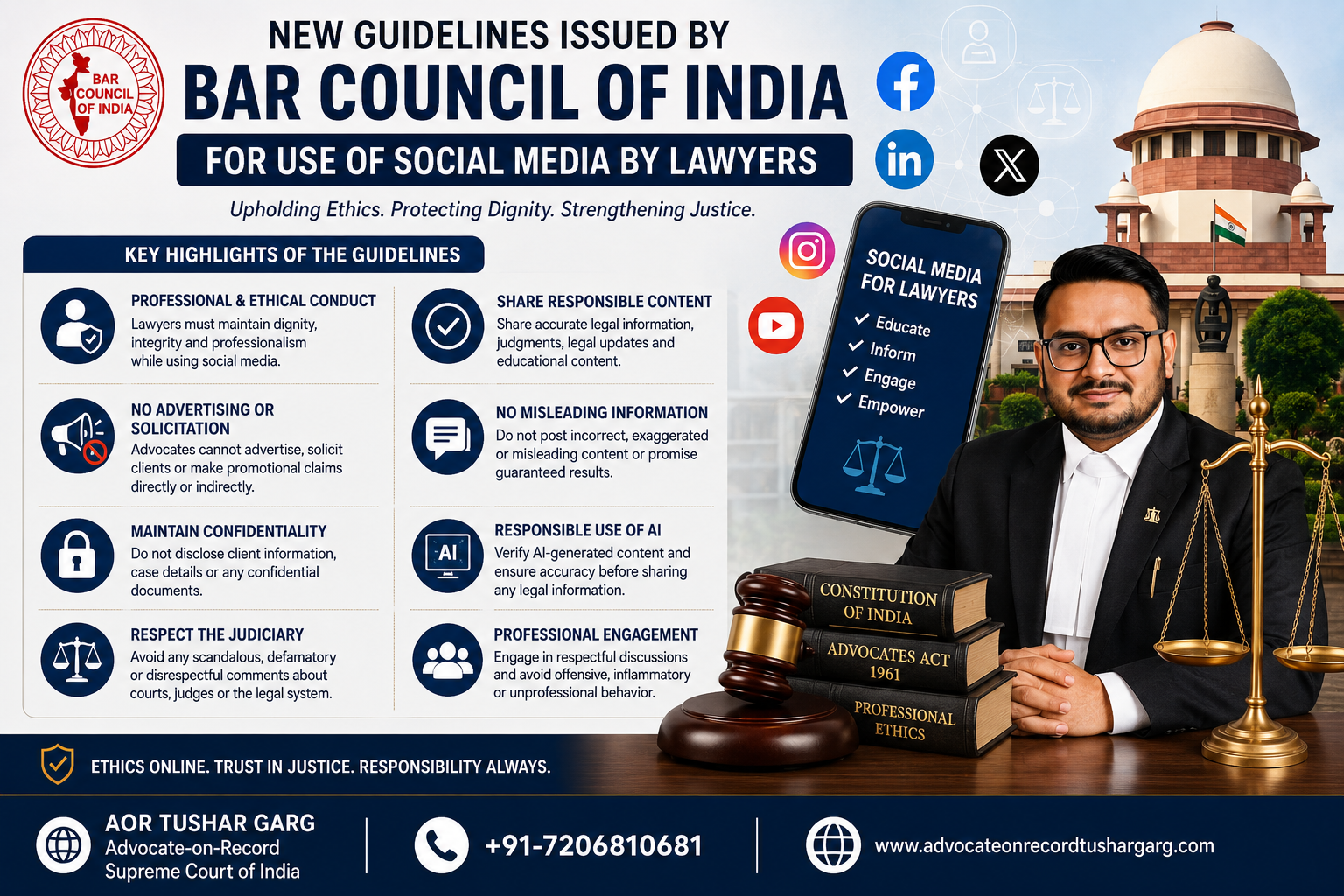
One of the most significant aspects of the new guidelines is that advocates cannot advertise or solicit clients, either directly or indirectly.
Examples of prohibited practices include:
Claiming to be the “best lawyer” or “number one advocate.”
Promising guaranteed success in litigation.
Posting client testimonials to attract business.
Running paid advertisements for legal services.
Offering discounts or promotional schemes.
Using influencer-style marketing for legal practice.
These restrictions are intended to preserve professional ethics and ensure that legal representation is chosen based on merit rather than commercial promotion.
Accuracy of Information Is Essential
Advocates must ensure that all information shared online is truthful and verifiable.
Lawyers should avoid:
Misleading legal advice.
Incorrect interpretation of judgments.
Fake legal news.
Exaggerated claims about experience or achievements.
False designation or specialization.
Any inaccurate information may mislead the public and damage the credibility of the legal profession.
Confidentiality Must Be Maintained
The advocate-client relationship is built on trust.
Lawyers should never disclose:
Client identity without consent.
Confidential case documents.
Sensitive legal strategy.
Private communications.
Court records not meant for public disclosure.
Even after the conclusion of a case, advocates remain bound by professional obligations relating to confidentiality.
Respect for the Judiciary
The Bar Council emphasizes that advocates should maintain respect for:
Courts
Judges
Judicial institutions
Opposing counsel
Fellow advocates
While fair legal criticism is permissible, abusive, defamatory, or scandalous comments against judges or the judiciary are inconsistent with professional ethics.
Responsible Use of Artificial Intelligence
As AI tools become increasingly common in legal practice, advocates should exercise caution while using AI-generated legal content.
Lawyers should:
Verify legal accuracy before publication.
Ensure compliance with applicable laws.
Avoid publishing incorrect AI-generated legal opinions.
Maintain professional responsibility for all content shared under their name.
Technology is a valuable tool, but it cannot replace professional legal judgment.
Educational Content vs. Legal Advice
The guidelines distinguish between general legal education and personalized legal advice.
Advocates may publish articles, videos, and explanatory posts for public awareness. However, they should avoid treating social media as a substitute for formal legal consultation or giving advice on specific cases without proper engagement.
Professional Conduct on Digital Platforms
Advocates should maintain the same standards of professionalism online as they do in court.
This includes:
Polite and respectful communication.
Avoiding offensive or inflammatory language.
Maintaining decorum in public discussions.
Refraining from spreading misinformation.
Protecting the reputation of the legal profession.
Consequences of Violating the Guidelines
Failure to comply with the BCI Rules and professional ethics may expose an advocate to disciplinary proceedings under the Advocates Act, 1961.
Possible consequences include:
Professional misconduct proceedings.
Warning or reprimand.
Suspension from practice.
Other disciplinary measures as provided under law.
The seriousness of the action depends on the nature and gravity of the violation.
Best Practices for Lawyers Using Social Media
Advocates should consider the following practices:
Share legal awareness content rather than promotional material.
Verify legal information before posting.
Respect client confidentiality at all times.
Avoid commenting on sub judice matters in a manner that may interfere with justice.
Use professional language and maintain decorum.
Keep professional profiles updated with factual information.
Avoid misleading claims or guarantees of legal success.
Focus on educating the public and contributing to legal discourse.
Importance of the New Guidelines
These guidelines represent an important step in modernizing the legal profession while preserving its ethical foundations. They recognize that digital platforms are now an integral part of professional communication but reaffirm that advocates remain officers of the court, bound by duties of integrity, independence, and responsibility.
By encouraging educational engagement while prohibiting unethical advertising and solicitation, the Bar Council seeks to strike a balance between technological advancement and the timeless values of the legal profession.
Conclusion
The Bar Council of India’s new social media guidelines provide much-needed clarity for advocates navigating the digital age. Lawyers can now confidently use social media to educate the public, participate in legal discussions, and strengthen professional engagement, provided they adhere to ethical standards and avoid conduct that undermines the dignity of the profession.
Responsible use of social media will enhance public legal awareness, reinforce confidence in the justice system, and ensure that the legal profession continues to uphold the highest standards of ethics and professionalism in both physical and digital spaces.
About the Author
AOR Tushar Garg
Advocate-on-Record, Supreme Court of India
AOR Tushar Garg regularly appears before the Supreme Court of India in matters relating to Constitutional Law, Civil Appeals, Criminal Appeals, Special Leave Petitions (SLPs), Writ Petitions, Arbitration, Service Law, Matrimonial Matters, and other complex litigation. He writes on important legal developments, Supreme Court judgments, and issues concerning legal ethics and professional responsibility.