

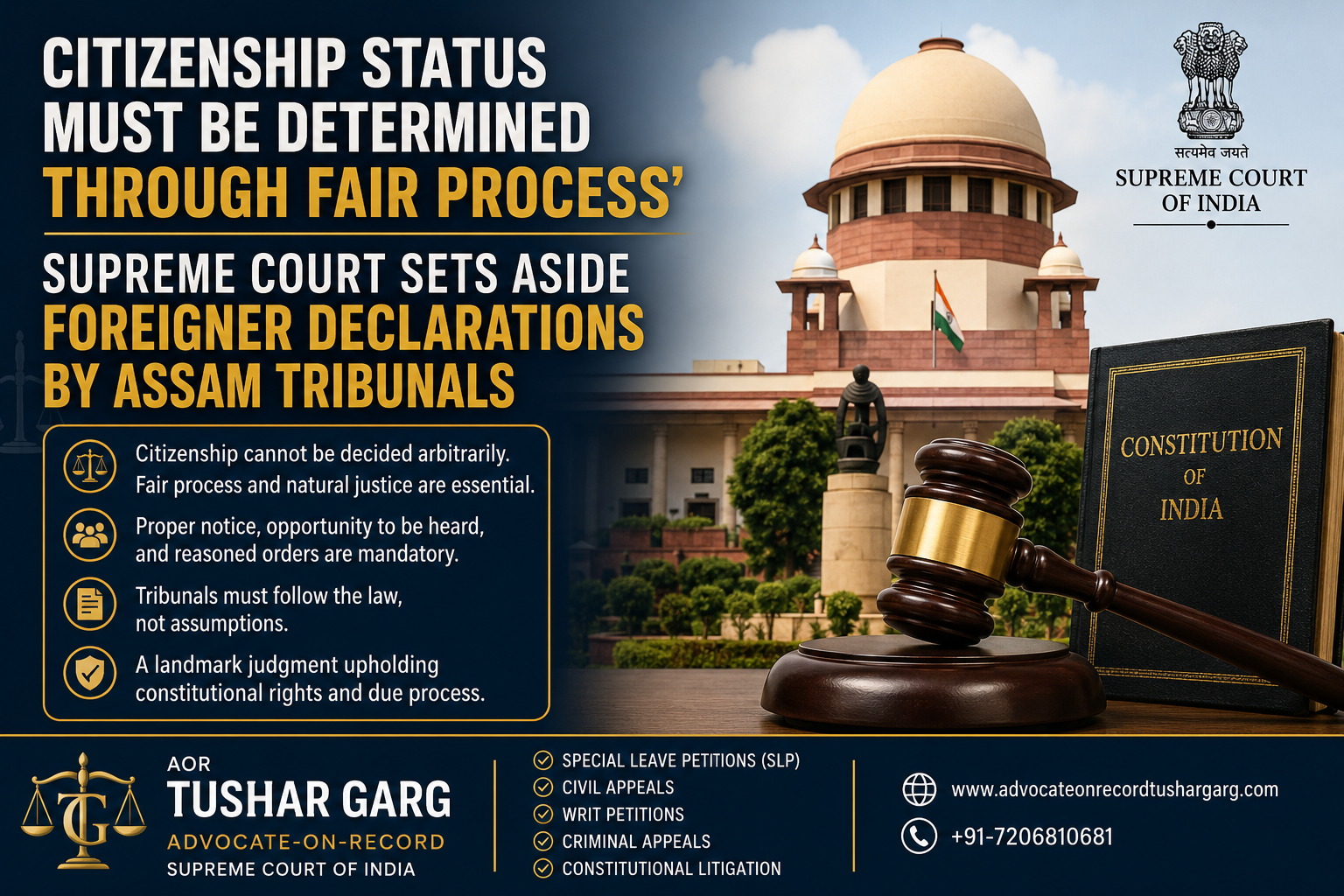
Supreme Court Rules Citizenship Cannot Be Decided Without Due Process, Sets Aside Assam Tribunal Foreigner Declarations
A Landmark Supreme Court Judgment Reinforcing Due Process and Natural Justice
The Supreme Court of India has once again emphasized that citizenship cannot be decided arbitrarily and that every individual is entitled to a fair, transparent, and legally compliant process before being declared a foreigner. In a significant judgment, the Court set aside orders passed by certain Foreigners Tribunals in Assam, observing that the declaration of an individual as a foreigner without following proper legal procedures violates the principles of natural justice and constitutional safeguards.
This ruling is an important reminder that citizenship disputes affect fundamental rights, including the right to life, liberty, dignity, and equality under the Constitution of India. The judgment also strengthens the judicial scrutiny of decisions made by Foreigners Tribunals, ensuring that procedural fairness remains at the heart of every citizenship determination.
Advocate-on-Record (AOR) Tushar Garg, practicing before the Supreme Court of India, closely follows constitutional and citizenship-related matters, assisting litigants in navigating complex legal issues before the Apex Court.
Background of the Case
The case involved individuals who had been declared foreigners by Foreigners Tribunals in Assam. These tribunals are constituted under the Foreigners Act, 1946, and the Foreigners (Tribunals) Order, 1964, to determine whether a person is an Indian citizen or an illegal migrant.
The petitioners challenged the tribunal orders before the Supreme Court, arguing that:
Proper notice was not effectively served.
They were denied a meaningful opportunity to present evidence.
The tribunals relied upon inadequate or incomplete materials.
The principles of natural justice were violated.
After examining the records, the Supreme Court found serious procedural deficiencies and concluded that the declarations could not be sustained in law.
Supreme Court’s Observations
The Supreme Court reiterated that citizenship is one of the most valuable legal statuses an individual possesses. Therefore, before depriving someone of such status, authorities must strictly follow the law.
The Court observed that:
Fair hearing is an essential requirement.
Every person must receive adequate notice.
Individuals should be given sufficient opportunity to produce documentary evidence.
Tribunal proceedings must remain impartial and reasoned.
Orders cannot be based on assumptions or procedural shortcuts.
The Court emphasized that due process is not a mere formality but a constitutional requirement.
Importance of Natural Justice
The judgment is rooted in the well-established principles of natural justice:
1. Right to Notice
A person facing proceedings must receive proper notice explaining the allegations and hearing dates.
2. Right to Be Heard
Every individual has the right to defend themselves before an adverse order is passed.
3. Reasoned Decision
Tribunals must pass speaking orders based on evidence and legal reasoning rather than assumptions.
4. Fair Opportunity
Citizenship disputes often involve old records, family documents, electoral rolls, land records, and birth certificates. Individuals should receive adequate time and opportunity to produce such evidence.
Why This Judgment Matters
Citizenship disputes have enormous consequences. A declaration as a foreigner may result in:
Detention proceedings
Loss of voting rights
Deportation proceedings
Denial of government benefits
Social stigma
Separation from family members
Recognizing these serious consequences, the Supreme Court held that procedural safeguards cannot be compromised.
Constitutional Protection
The judgment reflects the constitutional values enshrined under:
Article 14
Guarantees equality before law and equal protection of laws.
Article 21
Protects life and personal liberty except according to procedure established by law.
The Supreme Court has consistently interpreted Article 21 to include fair, just, and reasonable procedure.
Foreigners Tribunals in Assam
Foreigners Tribunals play a critical role in determining citizenship issues, particularly in Assam. However, the Supreme Court clarified that these tribunals must function within the framework of law.
Tribunal proceedings should never become mechanical exercises. Instead, each case must be examined independently based on:
Documentary evidence
Witness testimony
Electoral records
Family lineage documents
Government records
Every order should demonstrate application of judicial mind.
Burden of Proof
Although proceedings before Foreigners Tribunals involve specific statutory provisions regarding burden of proof, the Supreme Court clarified that procedural fairness cannot be sacrificed.
Even where an individual is required to establish citizenship, authorities must ensure:
Proper hearing
Fair appreciation of evidence
Reasoned findings
Compliance with statutory procedure
Failure to observe these safeguards renders the proceedings vulnerable to judicial review.
Impact on Future Cases
This judgment is expected to influence numerous pending citizenship disputes by reaffirming that:
Foreigners Tribunals must strictly follow legal procedure.
Orders lacking adequate reasoning may be challenged.
Courts will closely examine procedural irregularities.
Individual rights cannot be overridden through defective proceedings.
The decision reinforces confidence in the judicial system and ensures that citizenship determinations remain fair and transparent.
Role of the Supreme Court
The Supreme Court continues to act as the guardian of constitutional rights by ensuring that administrative and quasi-judicial authorities function within legal boundaries.
In citizenship matters, judicial oversight becomes particularly important because the consequences directly affect an individual’s identity, liberty, and constitutional protections.
This judgment once again demonstrates the Court’s commitment to balancing sovereign interests with individual rights under the Constitution.
How an Advocate-on-Record Assists in Citizenship and Constitutional Matters
Proceedings involving citizenship, constitutional rights, and challenges to tribunal orders often require representation before the Supreme Court of India.
Advocate-on-Record (AOR) Tushar Garg regularly handles matters before the Supreme Court involving:
Special Leave Petitions (SLPs)
Constitutional Litigation
Writ Petitions
Civil Appeals
Criminal Appeals
Public Interest Litigation
Tribunal-related challenges
Fundamental Rights matters
An Advocate-on-Record plays a crucial role in ensuring that petitions comply with Supreme Court Rules and are presented effectively before the Apex Court.
Conclusion
The Supreme Court’s decision setting aside foreigner declarations issued by certain Assam Foreigners Tribunals underscores a fundamental constitutional principle: citizenship status must be determined through a fair, transparent, and legally compliant process.
By reaffirming the importance of natural justice, due process, and reasoned adjudication, the Court has strengthened the protection of individual rights while preserving the integrity of citizenship determination proceedings.
For individuals facing complex constitutional or Supreme Court litigation, experienced legal representation is essential. Advocate-on-Record Tushar Garg, practicing before the Supreme Court of India, provides professional legal assistance in constitutional matters, appellate litigation, and proceedings requiring representation before the Apex Court.
Keywords: Citizenship Status, Supreme Court of India, Assam Foreigners Tribunal, Advocate-on-Record Tushar Garg, AOR Tushar Garg, Citizenship Law India, Foreigners Act 1946, Natural Justice, Constitutional Rights, Supreme Court Lawyer India, Citizenship Dispute, Assam Tribunal Judgment.