

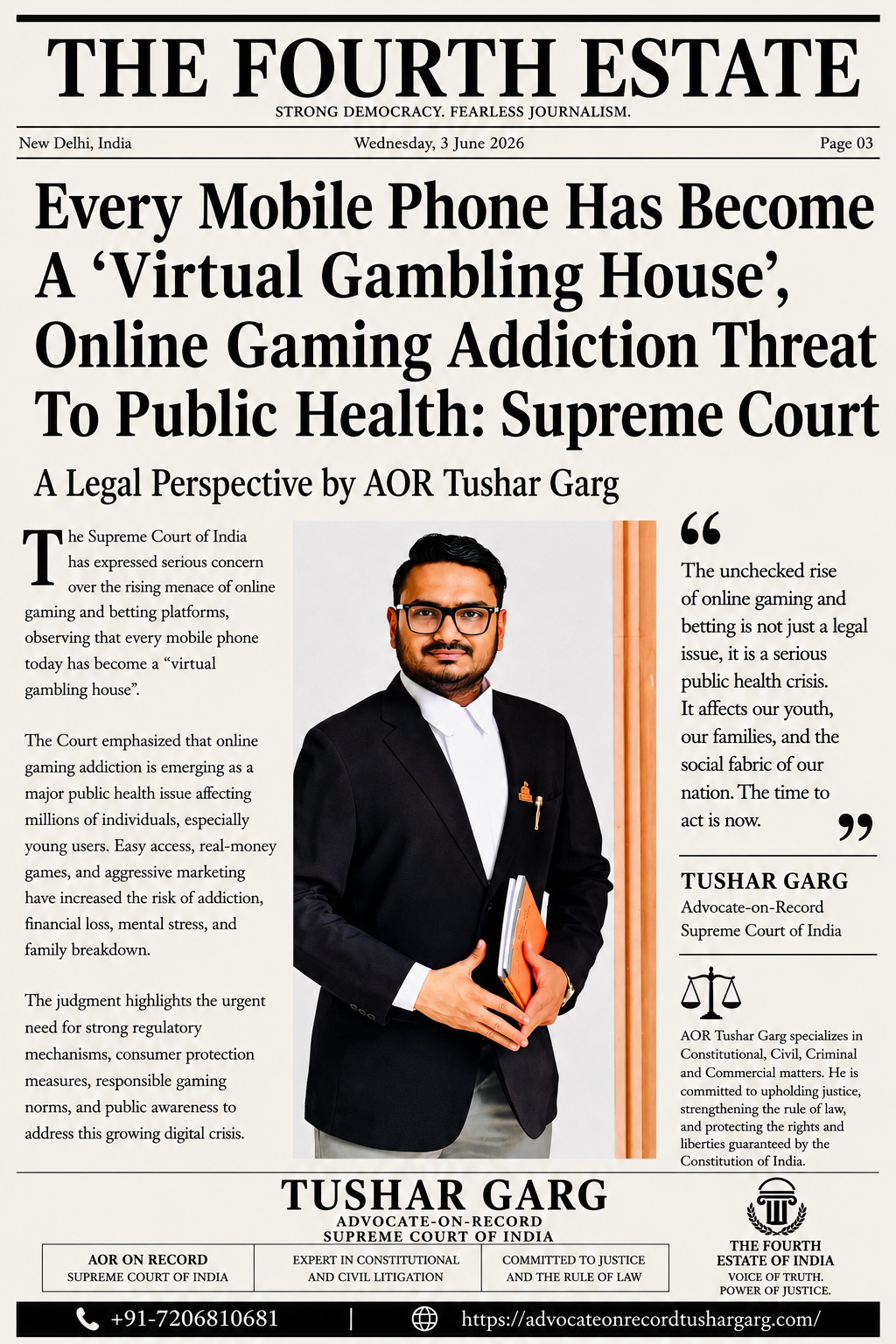
Digital Betting Crisis: Supreme Court Flags Online Gaming Addiction as a Serious Public Health Concern
A Legal Perspective by AOR Tushar Garg, Supreme Court of India
The Supreme Court of India has recently expressed deep concern over the growing menace of online gaming and betting platforms, observing that almost every mobile phone today has transformed into a “virtual gambling house.” The Court’s remarks come at a time when India is witnessing an unprecedented rise in online gaming applications, fantasy sports platforms, and digital betting networks that are increasingly attracting young users.
The observation highlights a critical issue that extends beyond financial loss and touches upon mental health, family welfare, social stability, and public policy. As technology becomes more accessible, the legal system is being called upon to address the challenges posed by digital gambling and gaming addiction.
Supreme Court’s Concern Over Online Gaming Addiction
During recent proceedings, the Supreme Court emphasized that online gaming addiction has emerged as a serious public health concern. The Court noted that smartphones and internet accessibility have made gambling-like activities available to millions of users at the touch of a button.
Unlike traditional gambling establishments, online platforms operate round the clock and can be accessed from homes, workplaces, and educational institutions. This unrestricted access has significantly increased the risk of addiction, particularly among young adults and teenagers.
The Court’s observations reflect growing concerns about the impact of excessive online gaming on mental health, financial well-being, and social relationships.
The Rise of Digital Gambling in India
India has witnessed rapid growth in the online gaming industry over the past decade. While many platforms offer skill-based games, several applications blur the line between gaming and gambling by incorporating real-money rewards, betting mechanisms, and chance-based outcomes.
The widespread use of smartphones, digital payment systems, and high-speed internet has accelerated participation in these activities. For many users, online gaming begins as a form of entertainment but gradually develops into compulsive behavior resulting in significant financial and emotional consequences.
The Supreme Court’s remarks underline the need for stronger regulatory frameworks to address this evolving challenge.
Public Health Implications
One of the most significant aspects of the Court’s observation is its recognition of gaming addiction as a public health issue rather than merely a personal choice.
Medical experts across the world have increasingly recognized gaming addiction as a behavioral disorder that can affect mental health. Excessive gaming may lead to:
Anxiety and depression
Sleep disturbances
Reduced academic performance
Financial distress
Social isolation
Family conflicts
Impaired decision-making abilities
When millions of users are exposed to addictive gaming environments, the issue becomes a matter of public concern requiring governmental intervention and regulatory oversight.
Legal Challenges in Regulating Online Gaming
The regulation of online gaming in India remains a complex legal issue. Different states have adopted varying approaches regarding online betting and gambling activities.
Traditionally, gambling laws in India were designed to regulate physical gambling houses and betting establishments. However, digital platforms have introduced new challenges that existing legal frameworks often struggle to address.
Questions frequently arise regarding:
Skill-based versus chance-based games
Jurisdiction of state laws
Consumer protection measures
Data privacy concerns
Financial fraud risks
Advertising regulations
The Supreme Court’s observations may influence future legislative and regulatory developments aimed at creating a more comprehensive framework for online gaming.
Protection of Young Users
A major concern highlighted by policymakers and legal experts is the vulnerability of young users.
Online gaming applications often use reward systems, bonuses, notifications, and competitive features that encourage prolonged engagement. Young individuals may not fully understand the financial and psychological risks associated with these platforms.
The Court’s remarks serve as a reminder that protecting children and young adults from harmful digital practices is an essential constitutional and societal responsibility.
Enhanced age-verification systems, parental controls, responsible gaming measures, and stricter advertising standards may become increasingly important in the coming years.
Need for Strong Regulatory Oversight
The rapid expansion of online gaming has outpaced existing regulatory mechanisms. Experts believe that India requires a balanced regulatory approach that encourages innovation while protecting consumers from harmful practices.
Potential regulatory measures may include:
Licensing requirements for gaming platforms
Transparency in game mechanics
Limits on betting and spending
Responsible gaming obligations
Consumer grievance mechanisms
Public awareness campaigns
Mental health support initiatives
Such measures can help create a safer digital environment while preserving legitimate gaming activities.
AOR Tushar Garg’s Perspective
According to Advocate-on-Record Tushar Garg, the Supreme Court’s observations represent an important recognition of the broader social consequences of digital gambling and gaming addiction.
The legal system must adapt to technological advancements while ensuring that constitutional values, consumer rights, and public welfare remain protected. The challenge lies in striking a balance between individual freedom, business innovation, and societal interests.
The Court’s remarks highlight the need for policymakers, regulators, technology companies, and legal institutions to work collaboratively in addressing the risks associated with online gaming addiction.
Conclusion
The Supreme Court’s observation that every mobile phone has effectively become a “virtual gambling house” reflects the growing urgency of regulating online gaming and betting activities in India. As digital platforms continue to expand, concerns relating to addiction, mental health, financial loss, and consumer protection are likely to gain greater prominence.
Recognizing online gaming addiction as a public health issue marks a significant step toward developing a comprehensive regulatory framework. The challenge ahead is to ensure that technological innovation proceeds responsibly while safeguarding the well-being of citizens.
As India continues its digital transformation, the legal and regulatory response to online gaming addiction will play a crucial role in protecting individuals, families, and society at large.