Supreme Court’s Landmark Directions on SCBA Elections and Voter Eligibility: A New Era of Transparency and Inclusivity
The legal fraternity witnessed a significant development on 29 May 2026 when the Supreme Court of India issued important directions concerning the elections of the Supreme Court Bar Association (SCBA) and voter eligibility criteria. The objective behind these reforms is to ensure greater transparency, inclusiveness, fairness, and alignment with the evolving realities of legal practice in India.
The decision reflects the Court’s commitment to strengthening democratic participation within one of the country’s most prestigious legal institutions. By recognizing modern modes of legal practice, including hybrid and virtual appearances, and by introducing more inclusive voting criteria, the Supreme Court has taken a progressive step toward creating a more representative Bar.
Key Objectives of the Reforms
The newly issued directions aim to:
Promote transparency in the electoral process.
Encourage broader participation from various sections of the legal profession.
Recognize changing professional practices, including virtual court appearances.
Provide special considerations for women advocates, advocates with disabilities, and mediators.
Eliminate outdated eligibility criteria that no longer reflect contemporary legal practice.
These reforms are designed to strengthen institutional democracy while ensuring that deserving members of the legal fraternity have a fair opportunity to participate in SCBA governance.
Who Can Vote in SCBA Elections?
1. Regular Advocates
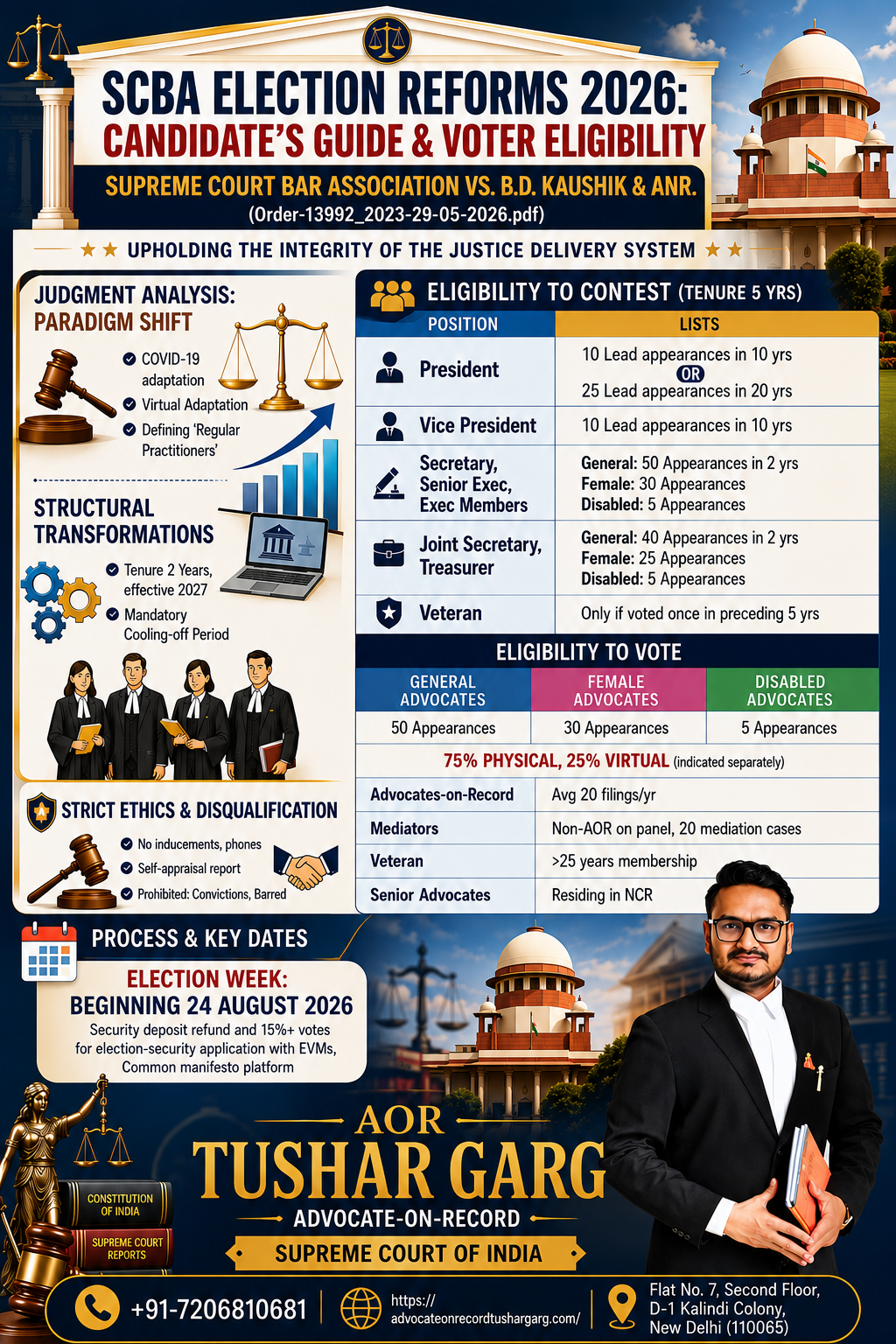
Regular advocates remain eligible to vote if they have made at least 50 appearances before the Supreme Court during the preceding two years.
A notable feature of the new criteria is the recognition of hybrid and virtual appearances. While at least 75% of appearances should be physical, up to 25% virtual appearances may be counted. Such appearances must be substantiated through Records of Proceedings (RoP) or court orders.
This recognition acknowledges the growing role of technology in legal practice and reflects the post-pandemic evolution of court functioning.
2. Women Advocates
To encourage greater participation of women in legal governance, the threshold for eligibility has been reduced.
Women advocates can now qualify with 30 appearances before the Supreme Court in the preceding two years. This relaxation seeks to address structural challenges and promote inclusivity within the legal profession.
3. Advocates with Disabilities
Advocates with disabilities are eligible with only 5 appearances before the Supreme Court in the preceding two years.
This special provision demonstrates the judiciary’s commitment to ensuring equal access and representation for differently-abled legal professionals.
4. Advocates-on-Record (AORs)
Advocates-on-Record occupy a unique position in Supreme Court practice. Under the revised eligibility norms, an AOR must have an average of 20 filings per year in the Supreme Court during the preceding two years.
Since AORs play a crucial role in filing and conducting matters before the Court, this criterion appropriately reflects their contribution to the institution.
4A. AORs with Disabilities
Recognizing the need for greater accessibility, AORs with disabilities are eligible with an average of only 5 filings per year during the preceding two years.
This relaxation ensures that talented legal professionals are not excluded because of physical challenges.
5. Mediators
Members serving on the Supreme Court Mediation Centre panel may also participate in SCBA elections, provided they have been empanelled for at least two years and have conducted a minimum of 20 mediation cases during that period.
This inclusion highlights the increasing importance of alternative dispute resolution mechanisms within India’s justice delivery system.
5A. Mediators with Disabilities
Special relaxation has also been provided for mediators with disabilities, who may qualify with only 5 mediation cases in the preceding two years.
6. Veteran Members
Long-standing members of the legal community have also been recognized.
Members with more than 25 years of SCBA membership are eligible to vote. However, to contest elections, such members must have voted at least once during the preceding five years.
This provision seeks to balance experience with active participation in Bar affairs.
7. Senior Advocates
Senior Advocates continue to remain eligible under the revised framework.
The category includes:
Senior Advocates residing in Delhi, Gurugram, Noida, Faridabad, and Ghaziabad.
Senior Advocates designated by the Supreme Court of India.
Their continued inclusion acknowledges their experience, leadership, and valuable contribution to the legal profession.
Criteria No Longer Considered Relevant
One of the most important aspects of the Supreme Court’s directions is the removal of several outdated criteria that were previously linked to eligibility.
The following factors will no longer determine voter eligibility:
Chamber allotment in the Supreme Court.
Placement on the waiting list for chamber allotment.
Special category status for Government Counsel.
Use of proximity cards for a specified number of days.
Membership on Amicus Curiae panels (for non-AOR advocates).
The removal of these conditions represents a shift toward merit-based and participation-oriented eligibility standards rather than administrative or infrastructural privileges.
A Step Toward a More Representative Bar
The Supreme Court’s directions mark a transformative moment for the SCBA. By expanding participation, recognizing virtual legal practice, and introducing special provisions for women, persons with disabilities, mediators, and veteran members, the Court has sought to create a more balanced and representative electoral framework.
These reforms are not merely procedural changes; they reflect a broader vision of institutional modernization and inclusivity. A democratic Bar is essential to a strong judiciary, and greater participation ensures that diverse voices contribute to shaping the future of the legal profession.
As the legal community prepares for future SCBA elections under these revised norms, the reforms offer an opportunity to build a stronger, fairer, and more transparent professional fraternity. The emphasis on justice, integrity, and inclusivity reinforces the foundational values of the legal system and strengthens confidence in the institutions that uphold the rule of law.
Author: AOR Tushar Garg
Advocate-on-Record, Supreme Court of India
Website: advocateonrecordtushargarg.com
Contact: +91-7206810681