Supreme Court Upholds Delhi High Court Ruling: Bar Associations Not Subject to Writ Jurisdiction
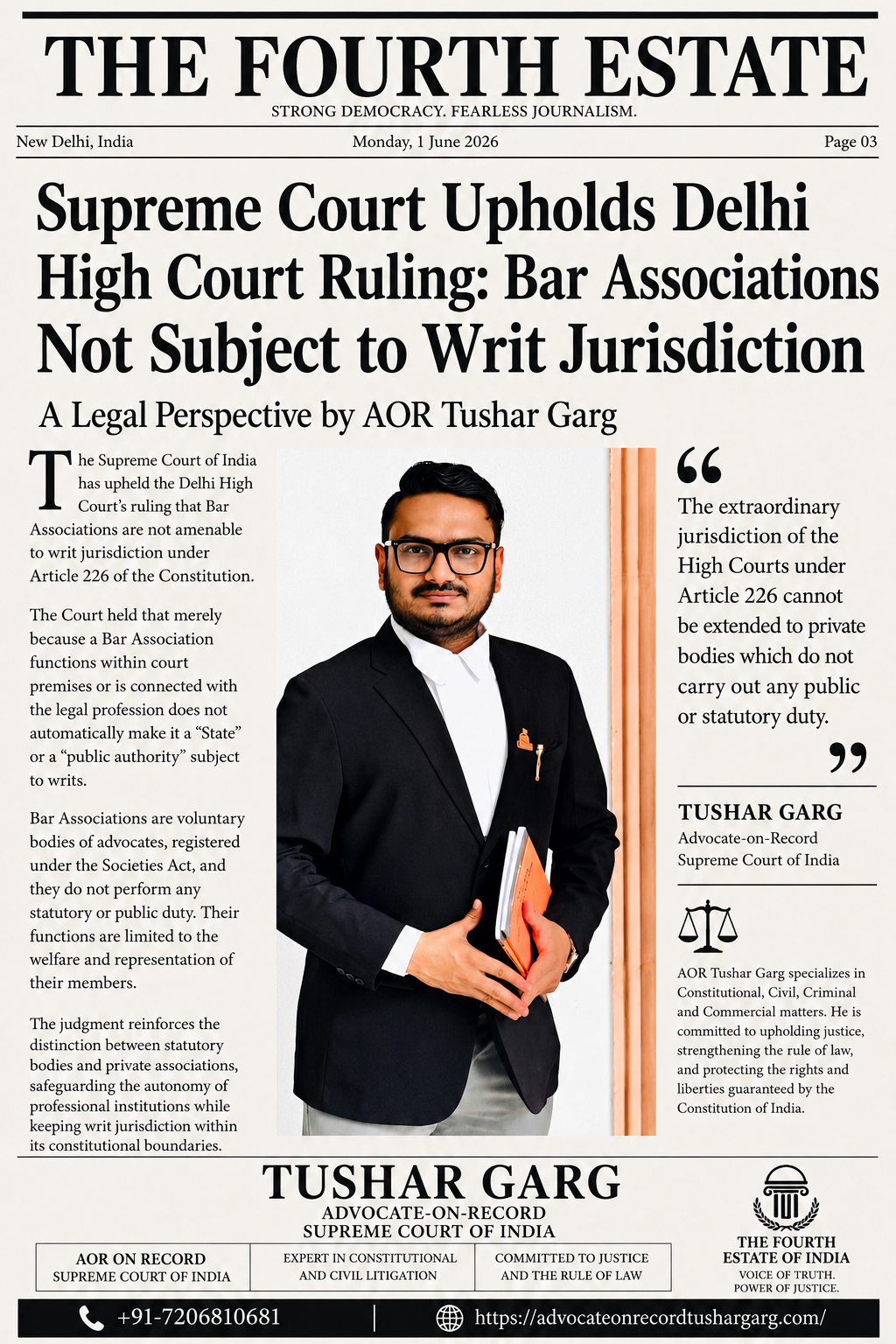
The Supreme Court of India has recently reaffirmed an important legal principle concerning the scope of writ jurisdiction under Article 226 of the Constitution. In a significant judgment, the apex court upheld the Delhi High Court’s ruling that a Bar Association is not amenable to writ jurisdiction merely because it is connected with the legal profession or functions within court premises. The decision has far-reaching implications for legal institutions, professional bodies, and the administration of justice.
This ruling clarifies the constitutional position of Bar Associations and strengthens the distinction between public authorities and private associations operating within the judicial ecosystem.
Understanding Writ Jurisdiction Under Article 226
Article 226 of the Constitution of India empowers High Courts to issue writs for the enforcement of fundamental rights and for any other purpose. Traditionally, writ jurisdiction is exercised against the State, statutory authorities, government bodies, and organizations performing public duties.
However, a recurring legal question has been whether professional bodies such as Bar Associations can be subjected to writ proceedings. The Supreme Court’s latest judgment provides much-needed clarity on this issue.
Background of the Case
The dispute arose when certain actions of a Bar Association were challenged through a writ petition before the Delhi High Court. The petitioners argued that since Bar Associations play an important role in the administration of justice and operate within court premises, their decisions should be open to judicial review under writ jurisdiction.
The Delhi High Court rejected this argument, holding that a Bar Association is essentially a voluntary association of advocates and does not perform statutory functions that would make it amenable to writ jurisdiction.
The matter subsequently reached the Supreme Court, which examined the constitutional and legal framework governing Bar Associations.
Supreme Court’s Key Findings
The Supreme Court agreed with the Delhi High Court and observed that Bar Associations are generally registered societies formed by advocates for the welfare and representation of their members. They are not created by statute and do not derive their powers directly from any legislative enactment.
The Court emphasized that merely because a Bar Association functions within court premises or has an important role in the legal community does not automatically transform it into a public authority.
The judgment highlights that writ jurisdiction can only be invoked against bodies performing public or statutory duties. Since Bar Associations primarily function as representative organizations for advocates, they cannot ordinarily be treated as State entities or public authorities under Article 226.
Distinction Between Statutory Bodies and Voluntary Associations
One of the most significant aspects of the ruling is the distinction drawn between statutory bodies and voluntary associations.
Statutory bodies derive their existence, powers, and responsibilities from legislation. Examples include government departments, public authorities, regulatory commissions, and statutory tribunals. Their actions are subject to judicial review through writ proceedings.
In contrast, Bar Associations are generally voluntary organizations governed by their own constitutions, rules, and bye-laws. While they may influence the legal profession and coordinate with courts, their internal administration remains largely private in nature.
The Supreme Court clarified that such organizations cannot be equated with statutory authorities merely because they are associated with the justice delivery system.
Impact on Bar Associations Across India
This judgment is expected to have a substantial impact on Bar Associations across the country. It provides legal certainty regarding their status and limits the circumstances under which their internal decisions can be challenged through writ petitions.
Disputes relating to membership, elections, disciplinary actions, or internal governance may now need to be resolved through alternative legal remedies rather than invoking writ jurisdiction.
The decision also reinforces the autonomy of Bar Associations in managing their affairs while ensuring that they remain accountable under applicable civil laws and regulatory frameworks.
Significance for the Legal Profession
For advocates and legal practitioners, the judgment serves as an important precedent concerning the constitutional status of professional bodies.
The ruling recognizes that Bar Associations play a valuable role in promoting professional welfare, legal education, and institutional development. At the same time, it preserves the constitutional boundaries governing judicial review.
The Supreme Court’s approach ensures that writ jurisdiction remains focused on public authorities and entities performing public functions, thereby preventing its unnecessary expansion into private organizational matters.
AOR Tushar Garg’s Perspective
According to Advocate-on-Record Tushar Garg, the judgment reflects a balanced interpretation of constitutional principles. The Supreme Court has carefully distinguished between public law remedies and private law disputes.
The decision underscores that the mere presence of public importance in an organization’s activities does not automatically subject it to writ jurisdiction. Courts must examine the source of power, statutory character, and nature of functions performed by the concerned body.
This ruling will serve as an important precedent for future cases involving professional associations, societies, clubs, and other non-statutory organizations.
Conclusion
The Supreme Court’s affirmation of the Delhi High Court ruling marks a significant development in constitutional jurisprudence. By holding that Bar Associations are not ordinarily amenable to writ jurisdiction, the Court has reinforced the distinction between public authorities and private associations.
The judgment safeguards the autonomy of Bar Associations while maintaining the integrity of Article 226. It provides greater clarity for advocates, legal institutions, and courts regarding the scope of judicial review.
As Indian constitutional law continues to evolve, this decision will remain an important reference point in determining when and how writ jurisdiction can be invoked against non-statutory bodies. The ruling ultimately strengthens the constitutional framework by ensuring that extraordinary judicial remedies are exercised within their intended limits.