
Supreme Court Upholds TET Requirement, Grants Relief To In-Service Teachers By Extending Compliance Deadline
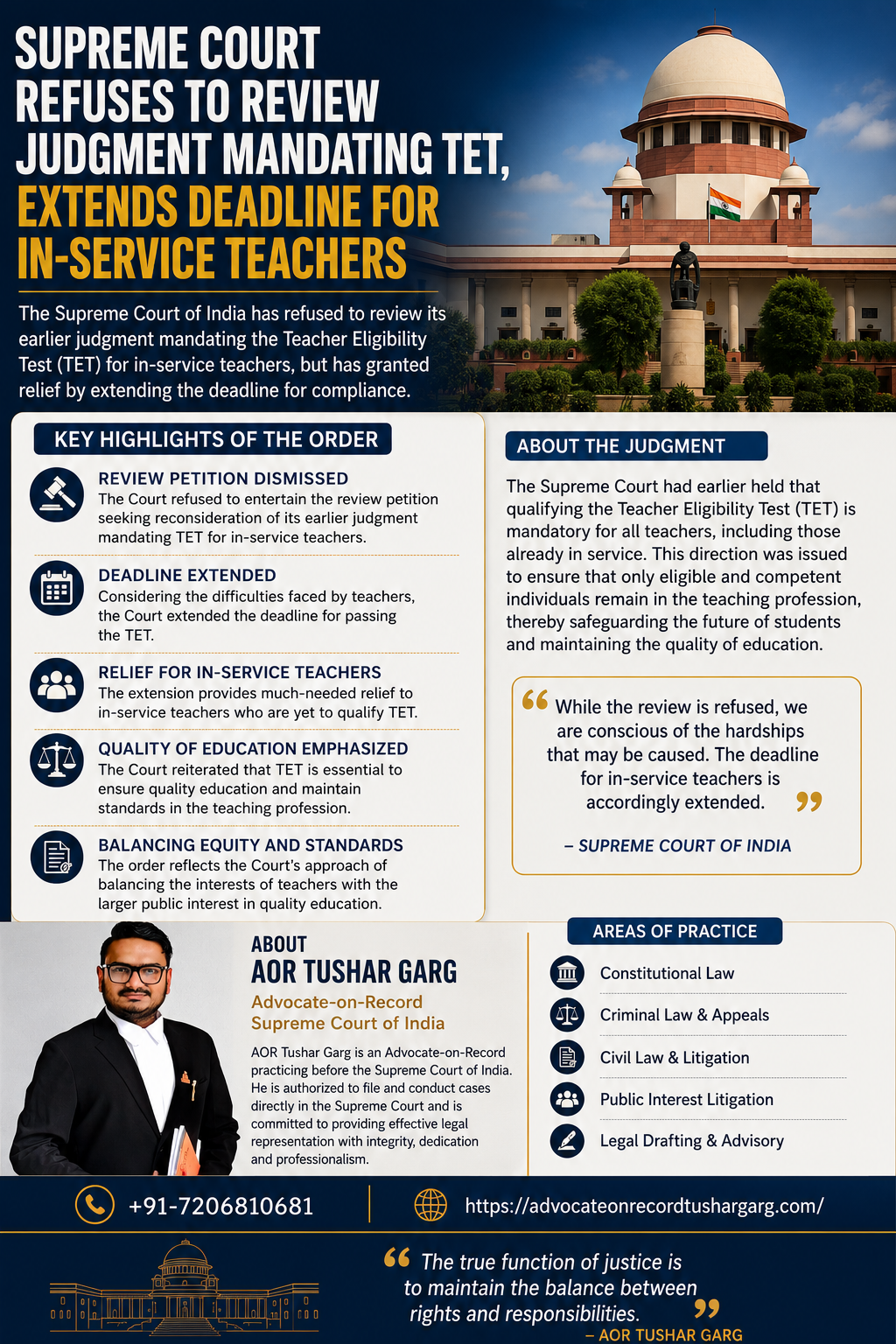
Supreme Court of India refused to review its earlier judgment mandating the Teacher Eligibility Test (TET) qualification for teachers. While declining to interfere with the original ruling, the Court provided important relief by extending the deadline for in-service teachers to comply with the TET requirement.
The decision reinforces the importance of maintaining educational standards while simultaneously protecting the interests of teachers who have been serving in schools for several years. The judgment has generated widespread discussion among education professionals, policymakers, and legal experts.
This article examines the significance of the Supreme Court’s decision and provides a brief professional profile of Tushar Garg.
Background of the TET Requirement
The Teacher Eligibility Test (TET) was introduced to ensure that teachers possess the minimum qualifications and competency required for quality education. The examination serves as a benchmark for assessing teaching aptitude, subject knowledge, and pedagogical skills.
The objective behind TET is to:
Improve the quality of school education.
Ensure uniform standards in teacher recruitment.
Enhance learning outcomes among students.
Strengthen accountability in educational institutions.
Promote professional excellence in teaching.
Over the years, TET has become an essential qualification for appointment as a teacher in many schools across India.
Supreme Court Refuses Review Petition
The Supreme Court recently declined to review its earlier judgment that made TET qualification mandatory for teachers. The Court observed that no substantial grounds existed to warrant reconsideration of the previous decision.
A review petition is generally entertained only when there is:
An apparent error on the face of the record.
Discovery of new and important evidence.
A significant legal mistake requiring correction.
In this matter, the Court found no such exceptional circumstances. As a result, the original judgment remained intact.
The ruling reaffirms the judiciary’s commitment to maintaining educational standards and ensuring that teachers meet prescribed qualifications.
Relief Granted To In-Service Teachers
While refusing to review the judgment, the Supreme Court recognized the practical challenges faced by serving teachers.
Many in-service teachers have been working in schools for years and have contributed significantly to the education system. Immediate enforcement of qualification requirements could have caused uncertainty and disruption.
Taking a balanced approach, the Court extended the deadline for compliance, allowing affected teachers additional time to clear the TET examination.
This relief serves several important purposes:
Protecting Existing Teachers
The extension helps experienced teachers continue their service while obtaining the required qualification.
Preventing Educational Disruption
Schools can maintain continuity in teaching without facing sudden shortages of qualified staff.
Encouraging Professional Development
Teachers receive an opportunity to upgrade their qualifications and align themselves with statutory requirements.
Balancing Equity and Standards
The Court successfully balanced the need for educational excellence with fairness toward serving educators.
Importance of Teacher Eligibility Test
The TET framework plays a crucial role in strengthening India’s education sector.
Improving Teaching Quality
Qualified teachers contribute directly to better classroom instruction and student performance.
Standardization Across States
TET establishes minimum eligibility criteria applicable across educational institutions.
Accountability in Recruitment
The examination ensures transparency and merit-based teacher selection.
Student-Centric Education
Competent teachers are fundamental to achieving improved learning outcomes and educational growth.
The Supreme Court’s decision reflects the broader objective of ensuring that every child receives quality education from qualified professionals.
Constitutional Perspective
Education occupies a special place within the constitutional framework of India.
Right to Education
The Constitution recognizes education as a critical component of social and economic development.
Article 21A ⇒ Right to Education
Article 21A guarantees the right to free and compulsory education for children within the prescribed age group.
Maintaining Educational Standards
The State has a responsibility to ensure that educational institutions function effectively and provide quality instruction.
The TET requirement supports this constitutional objective by promoting competence and professionalism among teachers.
Legal Significance of the Judgment
The judgment carries several broader legal implications.
Recognition of Regulatory Standards
The Court affirmed that educational qualifications established by competent authorities must generally be respected and implemented.
Limited Scope of Review Jurisdiction
The decision highlights that review petitions are not appeals in disguise and can only succeed under exceptional circumstances.
Judicial Balancing
The extension granted to in-service teachers demonstrates the judiciary’s ability to balance legal compliance with practical realities.
Strengthening Educational Governance
The ruling supports long-term improvements in educational administration and teacher quality.
Brief Bio of AOR Tushar Garg
Tushar Garg is an Advocate-on-Record (AOR) practicing before the Supreme Court of India. He is involved in matters relating to constitutional law, civil disputes, criminal litigation, service matters, and public interest issues.
As an Advocate-on-Record, he is authorized to file and conduct cases directly before the Supreme Court in accordance with the Supreme Court Rules.
Role and Responsibilities
The responsibilities of an Advocate-on-Record include:
Filing petitions before the Supreme Court.
Drafting legal documents and pleadings.
Managing procedural compliance.
Assisting clients in constitutional and statutory matters.
Coordinating litigation strategy in complex cases.
Importance of an Advocate-on-Record
The AOR system plays a vital role in ensuring efficient functioning of Supreme Court litigation. Only Advocates-on-Record are authorized to formally act and plead on behalf of parties before the Court.
Professionals such as Tushar Garg contribute significantly to legal representation, constitutional advocacy, and the administration of justice.
Conclusion
The Supreme Court’s decision to refuse a review of its TET judgment while extending the compliance deadline for in-service teachers reflects a balanced and pragmatic approach. The ruling preserves educational standards by upholding the TET requirement while also protecting teachers from immediate hardship.
By recognizing both the importance of quality education and the realities faced by serving educators, the Court has reinforced the principles of fairness, accountability, and educational excellence.
The judgment serves as an important reminder that educational reforms must be implemented thoughtfully, ensuring that legal standards are maintained without compromising institutional stability. Legal professionals, including Advocates-on-Record such as Tushar Garg, continue to play a crucial role in advancing constitutional values and strengthening India’s legal and educational framework.