

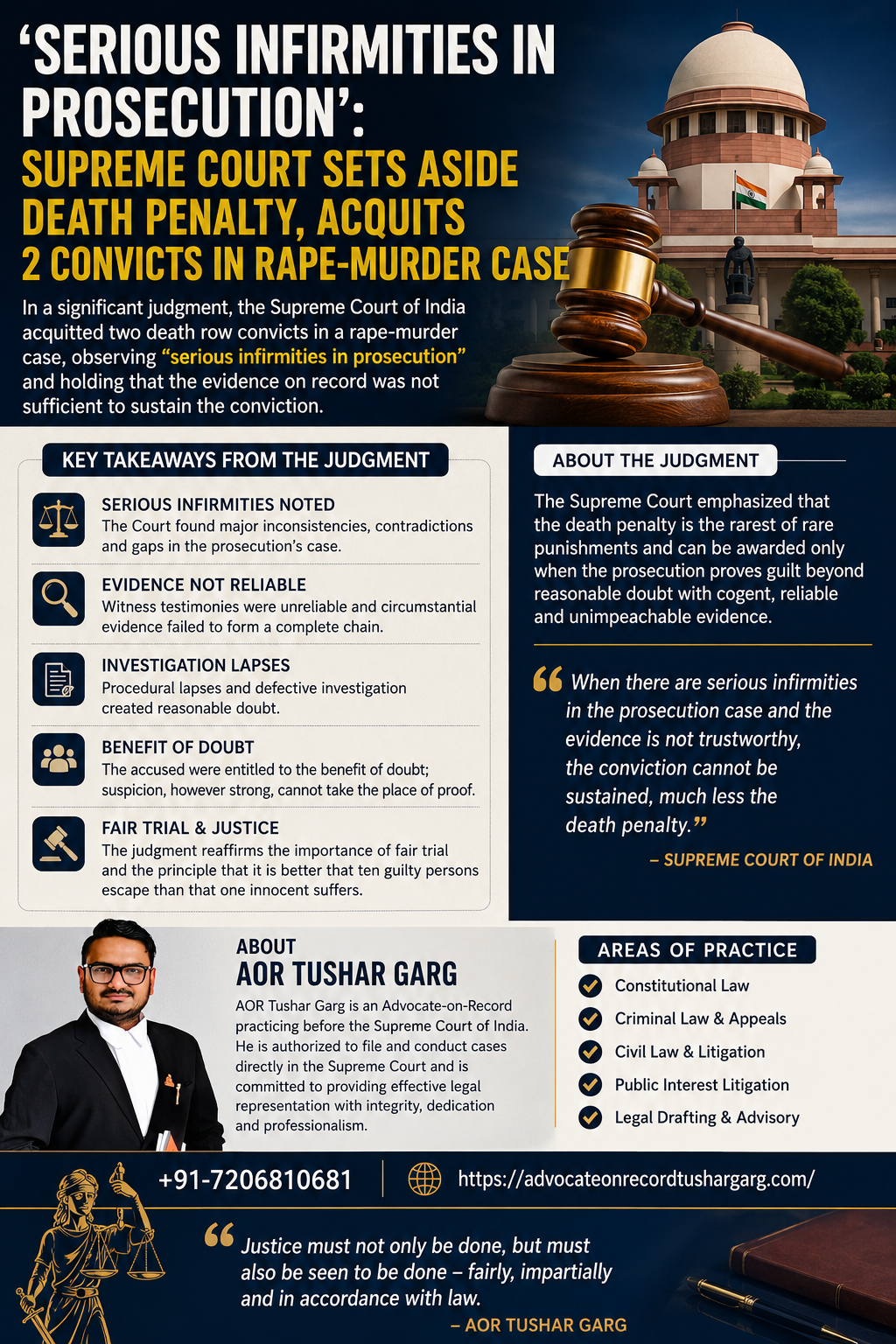
Serious Infirmities In Prosecution’: Supreme Court Sets Aside Death Penalty, Acquits 2 Convicts In Rape-Murder Case
Supreme Court of India recently acquitted two death row convicts in a rape-murder case after observing “serious infirmities in prosecution.” The decision once again highlighted the importance of reliable evidence, procedural fairness, and the constitutional principle that guilt must be proven beyond reasonable doubt before imposing the harshest punishment under law.
The judgment has attracted attention from legal experts, constitutional scholars, and criminal law practitioners across the country. It also reflects the judiciary’s continuing commitment to protecting the rights guaranteed under the Constitution of India.
Supreme Court’s Observation on “Serious Infirmities In Prosecution”
The Supreme Court emphasized that criminal convictions, particularly in cases involving capital punishment, must be based on strong, credible, and legally admissible evidence. The bench observed that the prosecution failed to establish guilt conclusively and that there were major inconsistencies and weaknesses in the investigation and evidence presented before the court.
The Court noted that where doubts arise regarding the prosecution story, the benefit must go to the accused. In criminal jurisprudence, suspicion alone cannot replace proof.
The observations of the Court focused on:
Contradictions in witness testimonies
Weak circumstantial evidence
Procedural lapses during investigation
Failure to establish an unbroken chain of evidence
Concerns regarding fairness of prosecution
The judgment reaffirmed that the death penalty cannot be sustained where evidence is uncertain or unreliable.
Importance of Fair Trial in Criminal Justice
The Indian criminal justice system is based on the principle that every accused person is presumed innocent until proven guilty. Courts are expected to examine evidence carefully before recording convictions, especially in cases involving severe punishment such as life imprisonment or death penalty.
Constitutional Protection
Article 21 of the Constitution guarantees protection of life and personal liberty.
Article 21 ⇒ Protection of Life and Personal Liberty
This constitutional safeguard ensures that no person can be deprived of liberty except according to procedure established by law.
The Supreme Court has consistently held that a fair investigation and fair trial are essential components of Article 21. Any serious defect in prosecution or investigation may violate constitutional rights.
Death Penalty and Judicial Scrutiny
The death penalty is considered the harshest punishment under Indian law. Therefore, courts apply the highest level of judicial scrutiny before confirming such sentences.
The Supreme Court has repeatedly observed that:
Evidence must be free from doubt
Investigation should be impartial and transparent
Conviction must satisfy the “beyond reasonable doubt” standard
Circumstantial evidence should form a complete chain
Where these standards are not met, courts may acquit the accused even in serious offences.
The recent acquittal demonstrates that the judiciary prioritizes justice over public emotion or pressure. It also reflects the principle that protecting innocent persons from wrongful conviction is equally important in a democratic legal system.
Legal Significance of the Judgment
This judgment carries important implications for criminal law and prosecution agencies in India.
1. Importance of Proper Investigation
The ruling highlights the need for professional and scientific investigation methods. Any negligence, inconsistency, or procedural lapse may weaken the prosecution’s case.
2. Protection Against Wrongful Conviction
The Supreme Court’s decision reinforces the principle that innocent persons should not be punished because of flawed investigations or unreliable evidence.
3. Strengthening Rule of Law
The judgment strengthens public confidence in the judiciary by showing that courts remain independent and guided solely by constitutional principles and evidence.
4. Human Rights Perspective
The decision also reflects the importance of human rights and due process in criminal justice administration.
Role of Advocates in Supreme Court Litigation
Cases involving constitutional rights, criminal appeals, and death penalty matters require experienced legal representation before the Supreme Court.
An Advocate-on-Record (AOR) plays a crucial role in conducting litigation before the apex court. Only registered AORs are authorized to file and manage cases directly before the Supreme Court under its rules.
Their responsibilities include:
Filing petitions and appeals
Ensuring procedural compliance
Drafting legal documents
Coordinating hearings and case records
Assisting senior advocates and litigants
Brief Bio of AOR Tushar Garg
Tushar Garg is an Advocate-on-Record practicing before the Supreme Court of India. He is involved in handling matters related to constitutional law, criminal litigation, civil disputes, and public interest issues.
As an AOR, he is authorized to file and conduct cases directly before the Supreme Court, which requires specialized qualification under the Supreme Court Rules.
Professional Role and Functions
The role of an Advocate-on-Record is highly important in Supreme Court practice because procedural accuracy and compliance are essential for effective litigation.
The key functions performed by an AOR include:
Filing Special Leave Petitions (SLPs)
Managing constitutional and criminal appeals
Drafting petitions, affidavits, and applications
Representing litigants before the Supreme Court
Advising clients on legal remedies and judicial procedures
Importance of AOR Practice
Advocates-on-Record serve as the official link between litigants and the Supreme Court registry. Their expertise helps ensure that cases are properly presented and legally maintainable.
Professionals like Tushar Garg contribute significantly to constitutional litigation and judicial administration in India.
Supreme Court and Constitutional Morality
The Supreme Court’s recent acquittal order reflects the broader constitutional philosophy that justice must be based on fairness, evidence, and due process rather than assumptions.
The Court has repeatedly emphasized that:
Liberty is a constitutional value
Criminal trials must remain fair and unbiased
Prosecution agencies must act responsibly
Courts must protect individual rights
Such judgments strengthen democratic institutions and uphold the rule of law in India.
Conclusion
The Supreme Court’s acquittal of two death row convicts in the rape-murder case after finding “serious infirmities in prosecution” is an important reminder of the fundamental principles of criminal justice. The judgment underscores that convictions, especially those involving capital punishment, cannot rest on weak or doubtful evidence.
The decision also reinforces constitutional protections under Article 21 and highlights the judiciary’s role in safeguarding fairness and due process.
At the same time, legal professionals such as Tushar Garg continue to play an important role in Supreme Court litigation by assisting in the administration of justice and constitutional governance in India.