Supreme Court Petition Seeks Nationwide Verification Of Advocates’ Law Degrees After BCI Chief Raises Alarm Over Fake Lawyers
By AOR Tushar Garg, Supreme Court of India
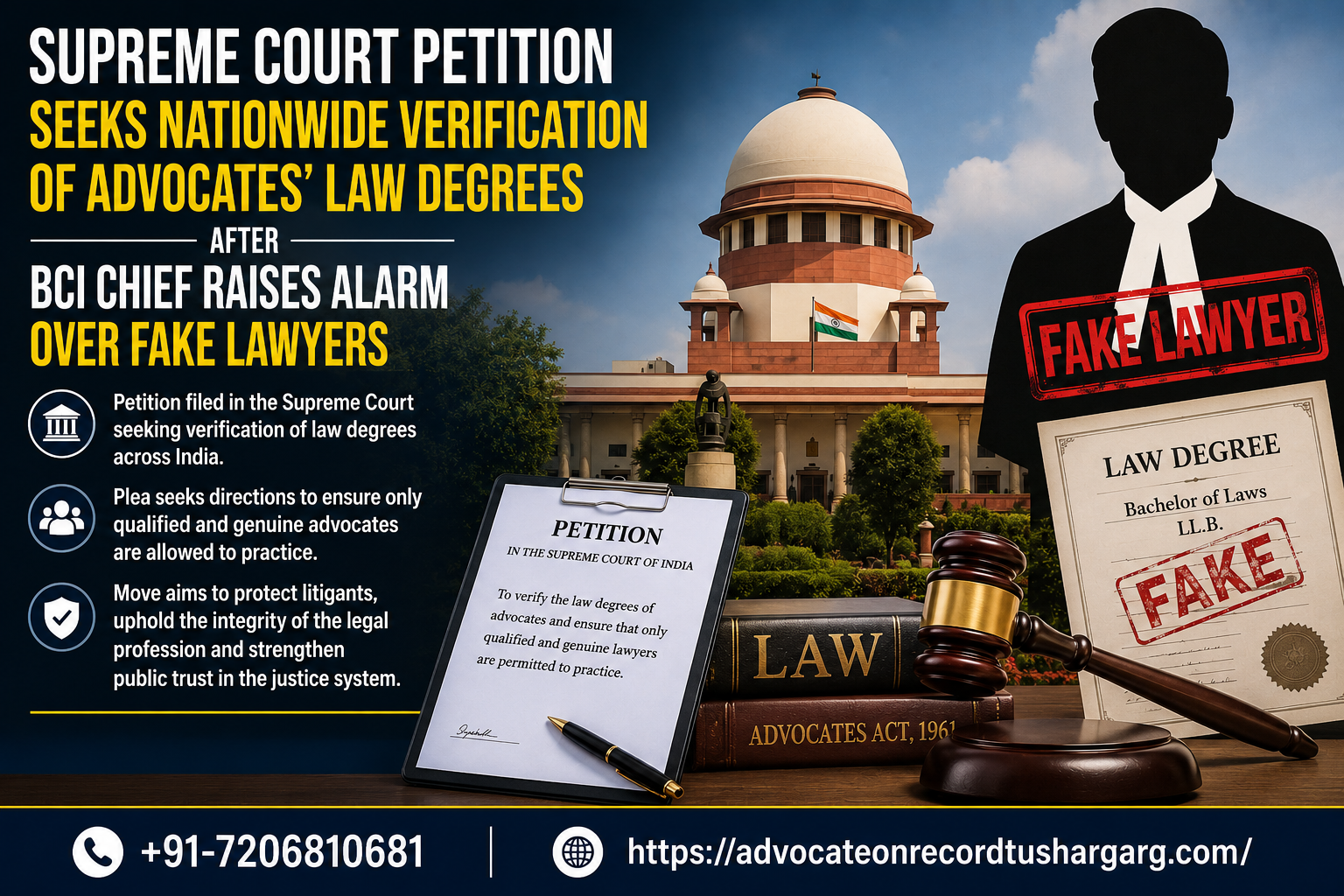
The legal profession is one of the most respected pillars of democracy. Advocates are not merely representatives of clients; they are officers of the court entrusted with protecting justice, constitutional values, and the rule of law. However, recent developments concerning the issue of fake advocates and questionable law degrees have raised serious concerns across the country. The matter gained further attention after the Chairperson of the Bar Council of India (BCI) reportedly made strong remarks regarding the increasing presence of fake advocates in the legal system. Following these remarks, a plea has now been filed before the Supreme Court seeking verification of law degrees and stricter scrutiny of enrollment processes.
The issue is not just administrative in nature; it directly impacts public trust in the judicial system. Every litigant who enters a courtroom expects that the person representing them is legally qualified, ethically trained, and duly authorized to practice law. If individuals with fake degrees or fraudulent credentials are allowed to appear before courts, it undermines the credibility of the justice delivery system itself.
The plea before the Supreme Court reportedly seeks a nationwide verification mechanism for law degrees possessed by practicing advocates. It also calls for proper authentication of enrollment records maintained by State Bar Councils. Such a move, if implemented effectively, could become a landmark step towards restoring transparency and accountability within the legal profession.
Over the years, concerns regarding fake law degrees have surfaced repeatedly in different states. Cases have emerged where individuals allegedly obtained enrollment certificates using forged educational documents or manipulated records. In some situations, unrecognized institutions were also found issuing questionable degrees. These incidents not only damage the reputation of genuine advocates but also create confusion and mistrust among the public.
The Bar Council of India, being the apex statutory body regulating legal education and professional standards, plays a critical role in maintaining the sanctity of the profession. The BCI has already introduced several reforms in legal education, including stricter inspection norms for law colleges and digital enrollment initiatives. However, the growing concern surrounding fake advocates indicates that more robust mechanisms may now be necessary.
The remarks made by the BCI Chairperson appear to reflect a larger institutional concern that the legal profession cannot afford to ignore. The Supreme Court’s intervention, if it comes, may help establish uniform standards for verification across all states and union territories. A centralized digital database of advocates and verified law degrees could become one possible solution to address the issue comprehensively.
Technology can play a transformative role in this process. Today, digital verification systems are widely used in banking, education, and government recruitment. Similar mechanisms can be adopted within the legal ecosystem. Universities, law colleges, State Bar Councils, and the Bar Council of India can work together to create an integrated verification portal that allows instant authentication of academic qualifications and enrollment details.
Another important aspect is the impact of fake advocates on litigants. Many individuals approach lawyers during extremely sensitive phases of life involving criminal cases, family disputes, property matters, employment issues, or constitutional rights. If a litigant unknowingly engages an unqualified person posing as an advocate, the consequences can be severe. It may lead to financial loss, delay in justice, or even irreversible legal damage.
The judiciary has consistently emphasized the importance of ethics and professional integrity in the legal profession. Advocates are expected to maintain high standards of honesty and competence. Therefore, ensuring that only qualified individuals are permitted to practice law is not merely a procedural requirement but a constitutional necessity linked to access to justice.
At the same time, the issue should also be approached carefully to avoid unnecessary harassment of genuine advocates. Any verification process introduced must be transparent, efficient, and fair. Thousands of practicing advocates across India have earned their qualifications through legitimate institutions and years of hard work. The system must ensure that honest professionals are not subjected to avoidable procedural difficulties.
The matter also highlights the need for reforms in legal education. Stronger regulation of law colleges, periodic audits, and stricter accreditation standards can help prevent the emergence of fraudulent institutions. Legal education is the foundation of the profession, and maintaining its quality is essential for the future of the justice system.
Young law graduates entering the profession today also deserve a transparent and credible environment. When fake advocates infiltrate the profession, it creates unfair competition and diminishes the value of genuine academic achievements. A clean and accountable legal framework ultimately benefits aspiring lawyers, litigants, and the judiciary alike.
The plea filed before the Supreme Court may become a turning point in addressing these longstanding concerns. If meaningful directions are issued, India could witness one of the most significant reforms in advocate verification and legal professional standards in recent years. Such reforms would strengthen public confidence and reinforce the dignity of the legal profession.
In a democratic society governed by the rule of law, the integrity of the legal profession cannot be compromised. Courts, regulatory bodies, and legal institutions must work collectively to ensure that justice is administered by qualified and ethical professionals. The current developments surrounding verification of law degrees and fake advocates should therefore be viewed not merely as a controversy, but as an opportunity to strengthen the foundations of the Indian legal system.
— AOR Tushar Garg
Advocate-on-Record, Supreme Court of India