

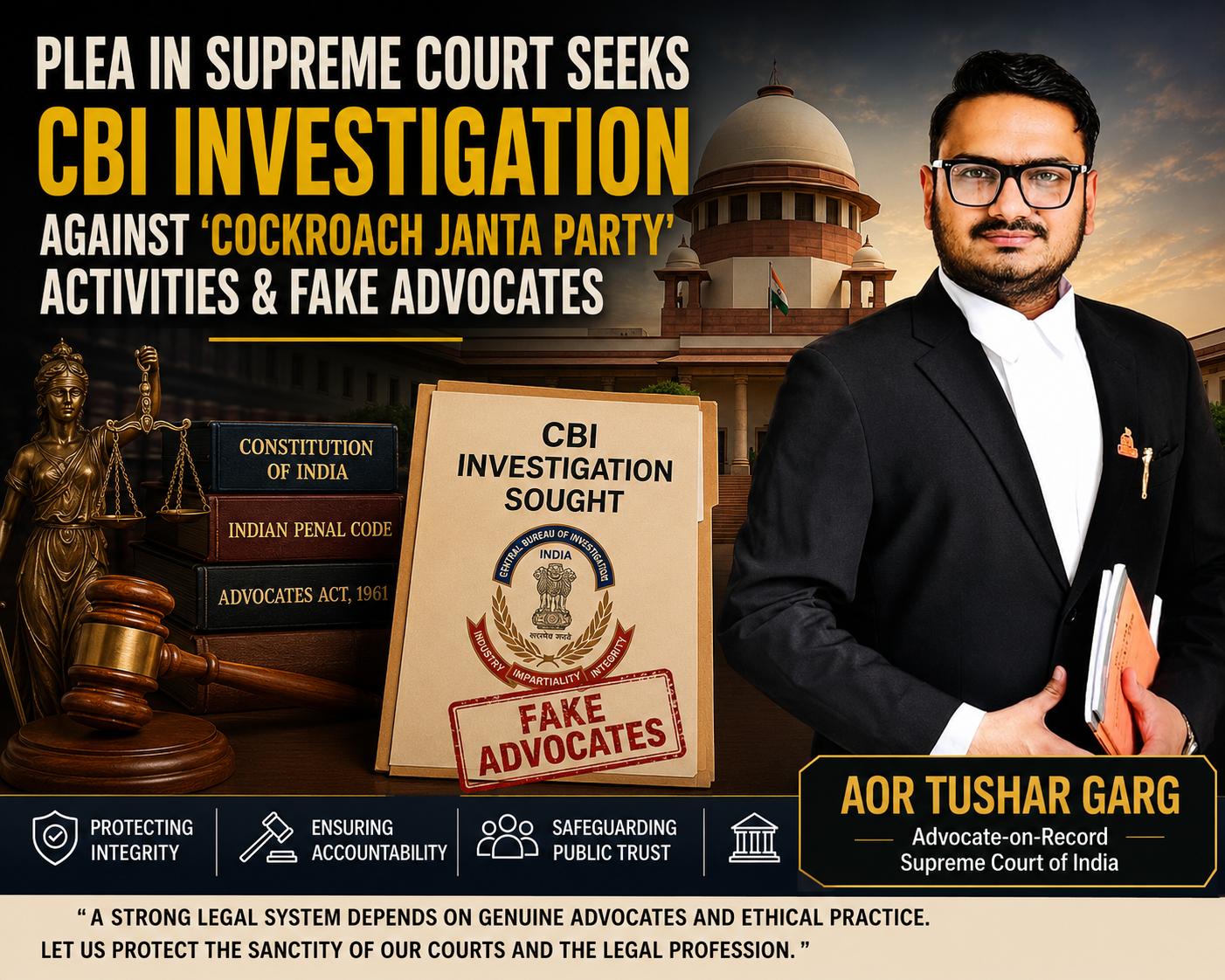
Plea In Supreme Court Seeks CBI Investigation Against ‘Cockroach Janta Party’ Activities & Fake Advocates
Protecting the Integrity of the Legal Profession and Judicial System
By AOR Tushar Garg, Supreme Court of India
The legal profession occupies a position of immense trust and responsibility in a democratic society governed by the rule of law. Advocates are considered officers of the court and play a critical role in ensuring justice, constitutional governance, and protection of citizens’ rights. However, in recent years, concerns regarding fake advocates, fraudulent legal activities, unauthorized representation before courts, and misuse of legal institutions have emerged as serious challenges for the Indian justice delivery system.
A recent plea before the Supreme Court of India seeking a CBI investigation into alleged activities connected with the so-called “Cockroach Janta Party” and fake advocates has once again highlighted the urgent need for stricter regulation, verification mechanisms, and institutional accountability within the legal ecosystem.
The matter has generated significant public discussion because it touches upon a sensitive and critical issue — the credibility and integrity of the legal profession itself.
The Growing Concern of Fake Advocates in India
The issue of fake advocates is not entirely new. Over the years, multiple reports from various states have revealed instances where individuals allegedly practiced law without possessing valid law degrees, enrollment certificates, or authorization from State Bar Councils.
Such unauthorized persons often:
Misrepresent themselves as advocates
Mislead litigants and vulnerable citizens
Exploit legal ignorance for financial gain
File unauthorized petitions or legal documents
Damage public trust in the justice system
The consequences of such fraudulent practices can be extremely serious. Innocent litigants may lose their cases, suffer financial losses, or become victims of legal scams. More importantly, it undermines the sanctity of courts and the dignity of the legal profession.
Why Verification of Advocates Is Important
Under the provisions of the Bar Council of India and State Bar Councils, only duly enrolled advocates possessing recognized law degrees are permitted to practice law before courts and tribunals.
The verification process exists to ensure:
Professional competence
Ethical accountability
Educational qualifications
Adherence to professional conduct rules
Protection of litigants’ interests
When fake advocates enter the system, they bypass these safeguards and create risks for the administration of justice.
Significance of the Plea Before the Supreme Court
The plea reportedly seeking a CBI investigation reflects the seriousness of the allegations involved. Whenever allegations involve organized fraudulent activities, misuse of legal identity, or large-scale deception affecting public institutions, demands for an independent investigation agency often arise.
The involvement of the Central Bureau of Investigation is generally sought in matters where:
Multi-state operations are alleged
Organized fraud networks are suspected
Public confidence requires restoration
Independent investigation is considered necessary
The Supreme Court’s consideration of such matters demonstrates the judiciary’s commitment to maintaining transparency and institutional credibility.
Protecting the Dignity of the Legal Profession
The legal profession is built on ethics, discipline, and public trust. Advocates are expected to uphold constitutional morality, assist courts fairly, and act in the interest of justice.
Unfortunately, the actions of a few unauthorized or unethical individuals can negatively impact the image of the entire legal fraternity. Genuine advocates who spend years acquiring legal education, clearing enrollment procedures, and practicing ethically may face reputational harm due to such incidents.
Therefore, strict action against fake advocates is not merely a regulatory issue — it is essential for preserving the dignity of the profession itself.
Need for Stronger Digital Verification Systems
India’s legal system is rapidly digitizing through e-filing, virtual hearings, and digital court infrastructure. This transformation presents an opportunity to strengthen advocate verification systems nationwide.
Some important reforms that can help include:
1. Unified Digital Advocate Database
A centralized national database linked with Bar Council records can help litigants verify advocate credentials instantly.
2. QR-Based Identity Verification
Digital identity cards with QR codes can reduce impersonation and unauthorized representation.
3. Mandatory Verification Before Filing
Online court filing systems may integrate advocate authentication mechanisms.
4. Public Awareness Campaigns
Citizens should be educated on how to verify advocates before engaging legal services.
5. Strict Penal Action
Strong legal consequences against fake practitioners can act as a deterrent.
Role of Courts and Regulatory Bodies
The judiciary and Bar Councils have an important responsibility in ensuring professional integrity within the legal system. Timely disciplinary proceedings, verification drives, and institutional reforms can help strengthen public confidence.
The Supreme Court of India as well as various High Courts have repeatedly emphasized professional ethics and accountability in the legal profession. Several judgments have highlighted that the practice of law is not a commercial business but a noble profession connected with public service and constitutional justice.
Public Trust Is the Foundation of Justice
Every judicial institution depends upon public confidence. Citizens approach courts with the expectation that justice will be delivered through a fair, transparent, and professionally regulated system.
If unauthorized individuals misuse legal identity or exploit court procedures, it affects not only individual litigants but also institutional trust. Therefore, addressing allegations involving fake advocates becomes necessary for safeguarding the credibility of the justice system.
Importance of Ethical Legal Practice
Young lawyers and law students must understand that legal practice is rooted in integrity, honesty, and constitutional responsibility. Professional success in law cannot be built through shortcuts, false representation, or unethical conduct.
Ethical advocacy requires:
Respect for the court
Honesty with clients
Professional discipline
Continuous legal learning
Commitment to justice
The future of the legal profession depends upon maintaining these values.
Conclusion
The plea seeking a CBI investigation into alleged activities related to the so-called “Cockroach Janta Party” and fake advocates has once again drawn national attention toward the urgent issue of professional authenticity and accountability in the legal system.
Strong institutional mechanisms, digital verification reforms, public awareness, and strict enforcement of professional standards are essential to protect the sanctity of the legal profession. At a time when India’s judiciary is embracing modernization and digital transformation, ensuring that only genuine and qualified advocates practice law must remain a top priority.
The legal profession is one of the pillars of democracy, and preserving its integrity is essential for maintaining public faith in justice, constitutional governance, and the rule of law.
AOR Tushar Garg
Advocate-on-Record, Supreme Court of India