

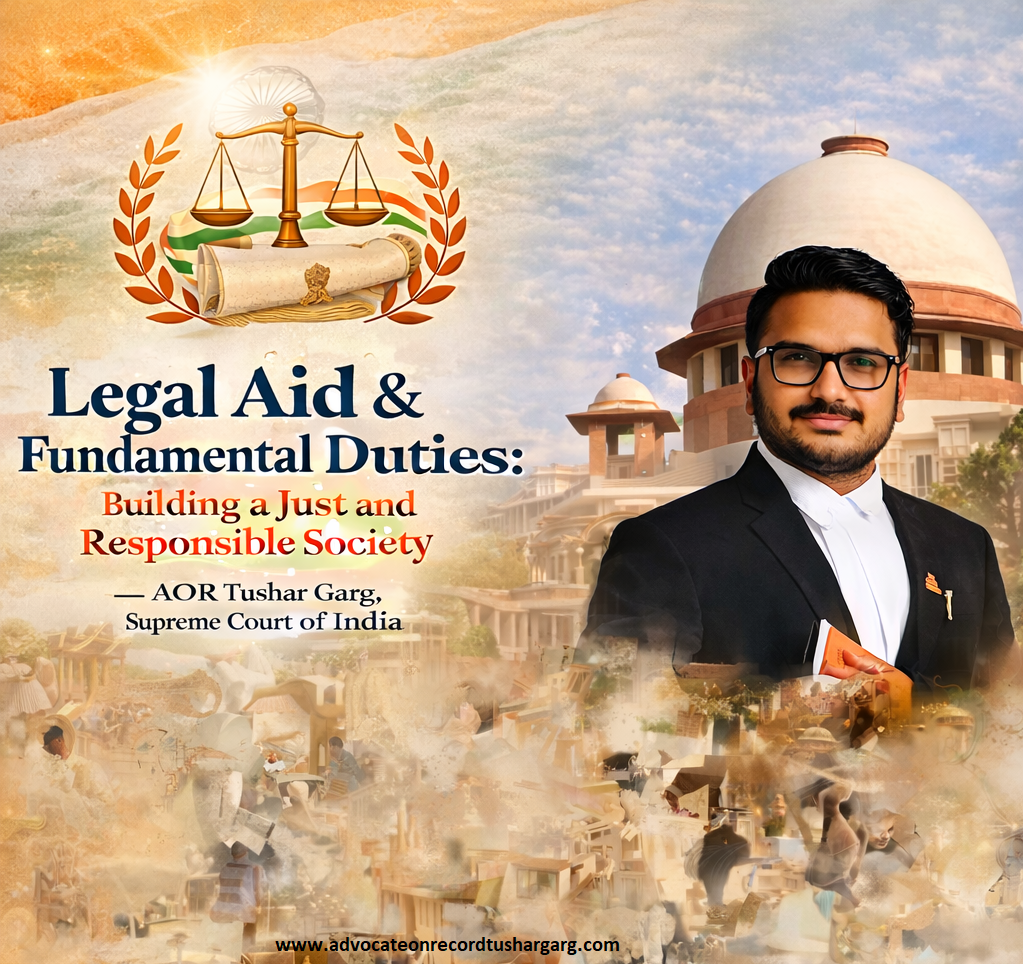
Legal Aid & Fundamental Duties: Building a Just and Responsible Society
By AOR Tushar Garg, Supreme Court of India
In a democratic nation like India, the true strength of the legal system lies not only in the existence of laws but in their accessibility and the awareness of citizens. Two vital pillars that uphold this framework are Legal Aid and Fundamental Duties. While legal aid ensures that justice is accessible to all, fundamental duties remind citizens of their responsibility towards the nation. Together, they create a balanced ecosystem of rights and responsibilities that is essential for a fair and progressive society.
Understanding Legal Aid in India
Legal aid refers to the provision of free legal services to individuals who cannot afford to hire a lawyer or bear the costs of legal proceedings. The concept finds its constitutional backing in Article 39A of the Indian Constitution, which directs the State to ensure that justice is not denied to any citizen due to economic or other disabilities.
The National Legal Services Authority (NALSA) plays a crucial role in implementing legal aid programs across the country. It works through State Legal Services Authorities, District Legal Services Authorities, and Legal Aid Clinics to ensure that the benefits reach the grassroots level.
Legal aid services include:
Free legal consultation and advice
Representation in courts and tribunals
Assistance in filing legal documents
Legal awareness and literacy programs
The objective is simple yet powerful—to make justice accessible to everyone, irrespective of their financial status.
Importance of Legal Aid
Legal aid is not just a welfare measure; it is a fundamental necessity for ensuring equality and justice. Its importance can be understood through several dimensions:
1. Ensuring Equality Before Law
The Indian Constitution guarantees equality before the law. However, without legal aid, this equality would remain theoretical. Legal aid bridges the gap between the privileged and the underprivileged, ensuring that justice is not limited to those who can afford it.
2. Protection of Fundamental Rights
Many citizens are unaware when their rights are violated. Legal aid empowers them with knowledge and support, enabling them to seek justice effectively.
3. Support for Vulnerable Sections
Women, children, laborers, marginalized communities, and persons with disabilities often face barriers in accessing justice. Legal aid ensures that these groups receive the support they need to protect their rights.
4. Strengthening Democracy
A democracy thrives when every citizen has a voice. Legal aid ensures that even the weakest sections of society can approach the courts and be heard, thereby strengthening democratic values.
5. Prevention of Exploitation
Lack of legal awareness often leads to exploitation. Whether it is an underpaid worker or a tenant facing unlawful eviction, legal aid provides the necessary tools to challenge injustice.
Who is Eligible for Legal Aid?
Legal aid is available to a wide range of individuals, including:
Women and children
Members of Scheduled Castes and Scheduled Tribes
Victims of human trafficking
Persons with disabilities
Individuals with low income
These services are accessible through Legal Aid Clinics, District Legal Services Authorities, and Lok Adalats, which offer speedy and cost-effective dispute resolution.
Fundamental Duties: The Other Side of the Coin
While rights empower citizens, duties guide them. Fundamental Duties are enshrined in Article 51A of the Constitution and were introduced through the 42nd Amendment of the Indian Constitution.
These duties serve as moral obligations for every citizen and include:
Respecting the Constitution, the National Flag, and the National Anthem
Promoting harmony and the spirit of brotherhood
Protecting the environment
Safeguarding public property
Developing scientific temper and humanism
Striving towards excellence in all spheres
Although Fundamental Duties are not directly enforceable by courts, they play a significant role in shaping responsible citizenship.
The Interconnection Between Legal Aid and Fundamental Duties
Legal aid and fundamental duties are deeply interconnected. While legal aid focuses on ensuring access to justice, fundamental duties emphasize responsible behavior that minimizes disputes and promotes social harmony.
Legal awareness programs, which are a key component of legal aid initiatives, educate citizens about both their rights and their duties. When people understand their responsibilities, they are less likely to engage in unlawful activities, thereby reducing the burden on the judicial system.
For instance, if citizens fulfill their duty to promote harmony and avoid conflict, disputes decrease significantly. Similarly, respecting public property and adhering to laws contribute to a more orderly society, reducing the need for legal intervention.
Thus, legal aid empowers citizens, while fundamental duties guide their conduct—both working together to create a balanced and just society.
Role of Citizens in Promoting Justice
The responsibility of building a just society does not lie solely with the government or the judiciary. Every citizen has a role to play. Simple actions can make a significant difference:
Spreading awareness about free legal aid services
Assisting those who are unaware of their legal rights
Respecting laws and fulfilling fundamental duties
Participating in community initiatives that promote justice
Even a small step, such as informing someone about the availability of legal aid, can transform lives.
The Way Forward
India has made significant progress in expanding legal aid services, but challenges remain. Lack of awareness, social stigma, and accessibility issues still prevent many people from availing these services. Strengthening legal literacy and promoting civic responsibility are key to overcoming these barriers.
Technology can also play a vital role in this regard. Online legal aid platforms, helplines, and digital awareness campaigns can help reach a wider audience, especially in remote areas.
At the same time, inculcating the values of fundamental duties from an early age—through education and community engagement—can foster a culture of responsibility and respect for the law.
Conclusion
Legal aid and fundamental duties together form the backbone of a just and equitable society. While legal aid ensures that justice is accessible to all, fundamental duties ensure that citizens act responsibly and contribute positively to the nation.
A society becomes truly just not merely by the existence of laws, but by the awareness, participation, and responsibility of its citizens.
As members of this democratic nation, it is our collective duty to:
Ensure that no one is denied justice due to lack of resources
Promote awareness about legal rights and duties
Act responsibly and uphold the values of the Constitution
Only then can we move towards a society where justice is not a privilege, but a guaranteed right for all.
— AOR Tushar Garg
Advocate-on-Record, Supreme Court of India