

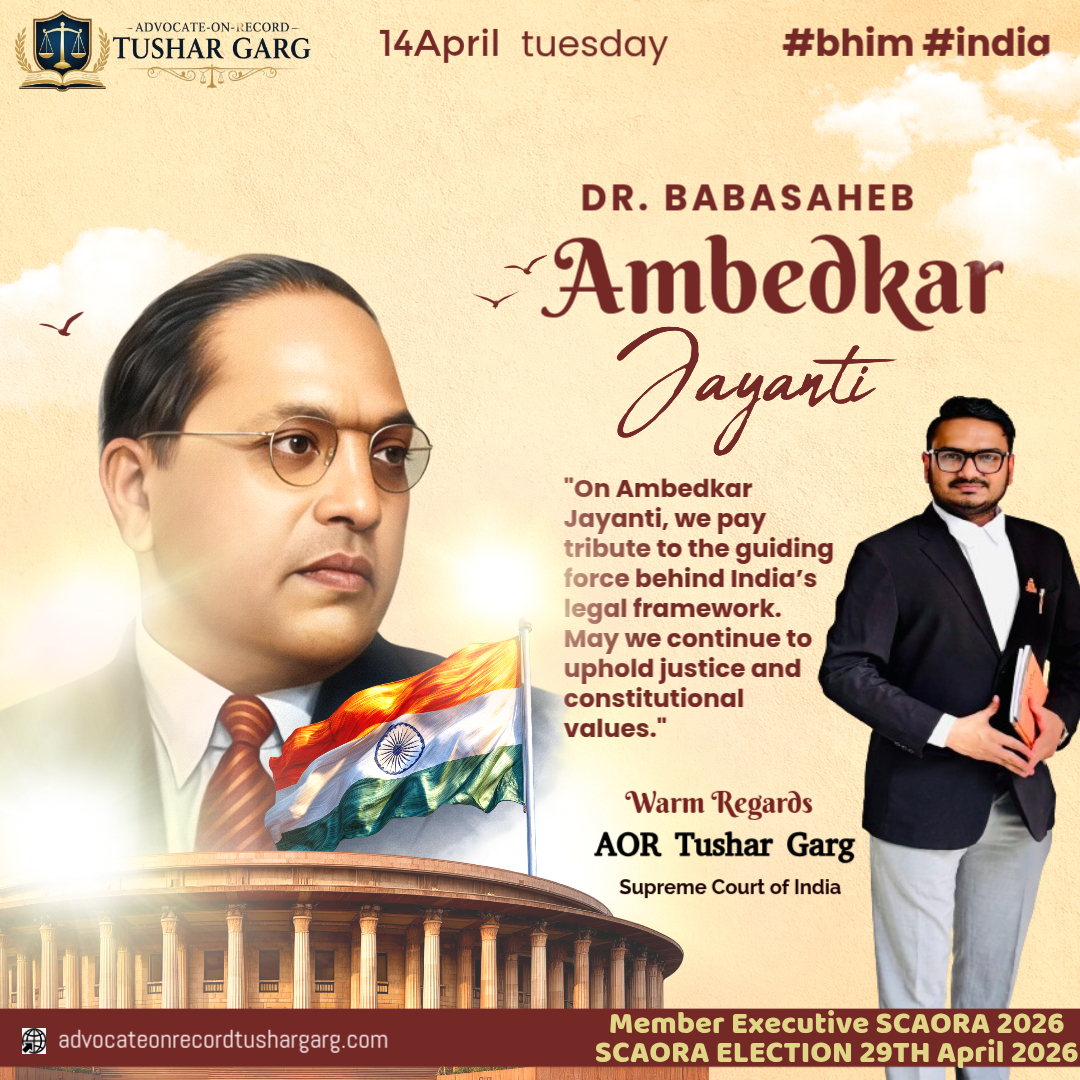
Dr. B.R. Ambedkar Jayanti: A Legal Legacy that Continues to Shape Indian Justice
Every year, 14th April is celebrated across India as Dr. Bhimrao Ramji Ambedkar Jayanti, a day that goes beyond remembrance—it is a reaffirmation of constitutional values, justice, and equality. For the legal fraternity, this occasion holds profound significance, as Dr. B.R. Ambedkar is not just a historical figure but the principal architect of the Constitution of India, the very foundation upon which our legal system stands today.
The Architect of Modern Indian Law
Dr. Ambedkar’s contribution to Indian law is unparalleled. As the Chairman of the Drafting Committee of the Constitution, he envisioned a nation governed by rule of law, where every citizen—irrespective of caste, religion, gender, or background—would enjoy equal rights and dignity. His legal foresight ensured that India adopted a Constitution that is both progressive and resilient.
The Constitution embodies principles such as fundamental rights, separation of powers, judicial independence, and constitutional remedies, which remain the backbone of Indian democracy. Articles like Article 14 (Right to Equality), Article 19 (Freedom of Speech), and Article 21 (Right to Life and Personal Liberty) reflect Dr. Ambedkar’s unwavering commitment to justice and liberty.
A Vision Rooted in Social Justice
For Dr. Ambedkar, law was not merely a tool of governance but a powerful instrument of social transformation. He believed that legal frameworks must actively work to eliminate inequalities and uplift marginalized communities. His advocacy led to the inclusion of provisions for affirmative action (reservations), safeguarding the rights of Scheduled Castes and Scheduled Tribes.
Even today, courts across India—including the Supreme Court—continue to interpret laws in light of these constitutional ideals. Landmark judgments often echo Ambedkar’s vision of a just and inclusive society, proving that his influence is not confined to history but lives on in everyday legal practice.
Relevance in Contemporary Legal Practice
In modern times, the role of legal professionals—especially those practicing before the Supreme Court—becomes crucial in upholding the constitutional framework envisioned by Dr. Ambedkar. Issues such as fundamental rights, constitutional interpretation, public interest litigation, and access to justice are deeply rooted in the principles he laid down.
Advocates, particularly Advocates-on-Record (AORs), carry a significant responsibility in ensuring that justice is not just delivered but is accessible to all. Filing Special Leave Petitions, handling constitutional matters, and representing clients in the highest court require a deep understanding of the Constitution—something that directly traces back to Ambedkar’s legacy.
Ambedkar’s Enduring Influence on the Judiciary
Dr. Ambedkar strongly believed in the independence of the judiciary as a safeguard against misuse of power. Today, the judiciary stands as the guardian of the Constitution, ensuring that legislative and executive actions remain within constitutional boundaries.
From protecting civil liberties to addressing complex socio-legal issues, the judiciary’s role continues to reflect Ambedkar’s vision. His emphasis on constitutional morality reminds us that laws must be interpreted not just in letter, but in spirit.
A Day of Reflection for the Legal Community
Ambedkar Jayanti is not just a ceremonial occasion; it is a moment for legal professionals to reflect on their role in society. It calls upon advocates, judges, and law students to uphold the ideals of fairness, equality, and justice in their daily practice.
In a rapidly evolving legal landscape, where new challenges emerge every day, the guiding principles laid down by Dr. Ambedkar serve as a constant source of inspiration. Whether it is defending fundamental rights, promoting legal awareness, or ensuring access to justice, the legal fraternity must strive to honor his vision.
Conclusion: Carrying Forward the Constitutional Vision
As we celebrate Dr. B.R. Ambedkar Jayanti, we are reminded that the Constitution is not just a document—it is a living testament to the ideals of justice, equality, and liberty. Dr. Ambedkar’s legacy challenges us to continuously work towards a society where these values are not just written, but practiced.
For those engaged in the legal profession, especially at the Supreme Court level, this day reinforces the duty to uphold constitutional principles with integrity and dedication. It is a call to ensure that justice reaches every corner of society, just as Dr. Ambedkar envisioned.
— AOR Tushar Garg
Advocate-on-Record, Supreme Court of India
📞 7206810681
🌐 AdvocateOnRecordTusharGarg.com