

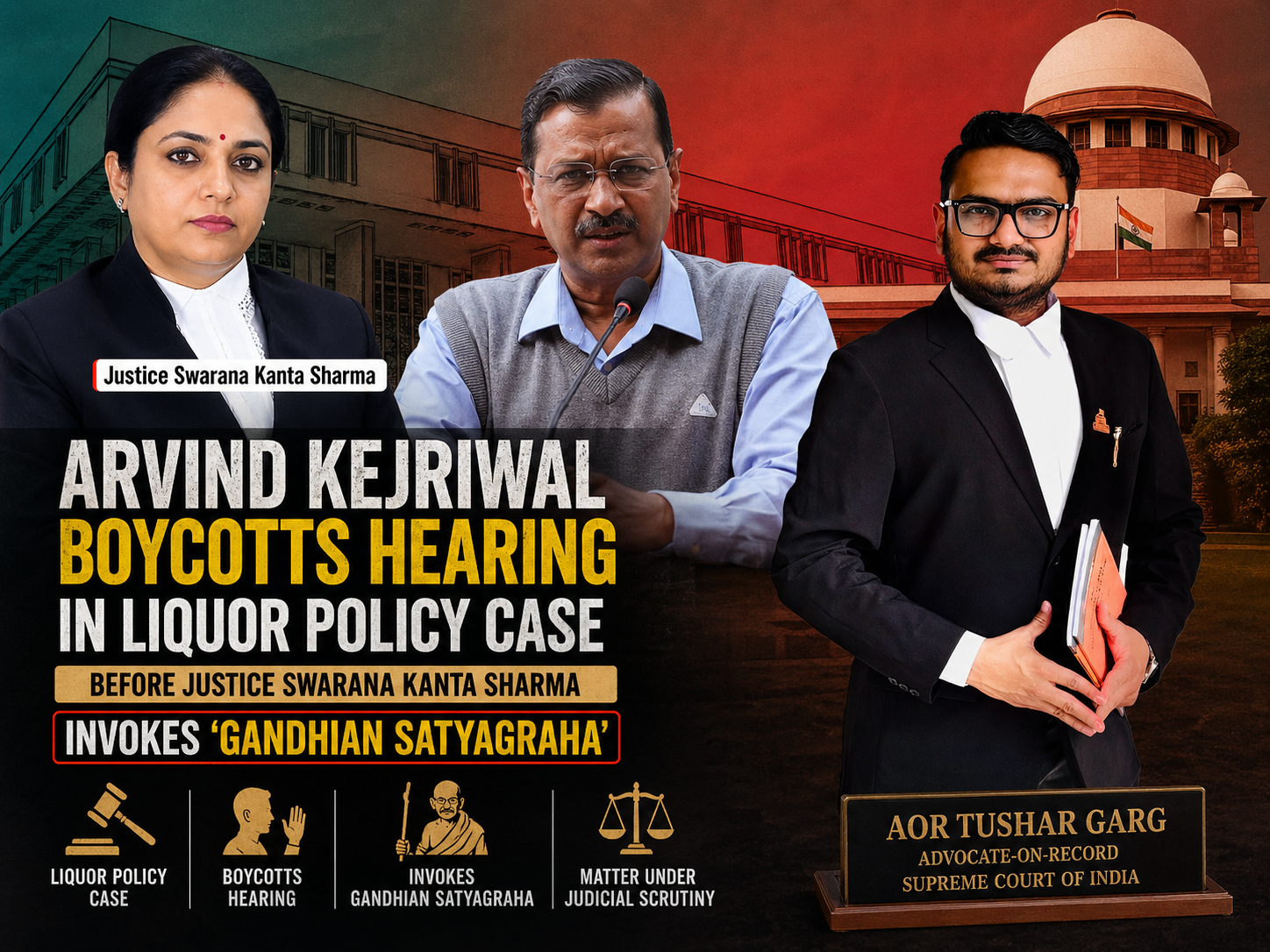
Legal Resistance or Political Symbolism? Arvind Kejriwal’s ‘Gandhian Satyagraha’ in the Liquor Policy Case Under Judicial Scrutiny
The recent developments surrounding Arvind Kejriwal in the Delhi liquor policy case have once again brought the intersection of law, politics, and public sentiment into sharp focus. His decision to boycott the hearing before Justice Swarana Kanta Sharma, while invoking the principles of “Gandhian Satyagraha,” has sparked widespread debate across legal and political circles.
This move is not merely procedural—it carries symbolic and constitutional significance. By refusing to participate in the hearing and framing his stand as a peaceful resistance rooted in Mahatma Gandhi’s philosophy, Kejriwal seeks to present his legal battle as one of moral conviction rather than just judicial contestation.
However, in a constitutional democracy governed by the rule of law, the courtroom remains the ultimate arena for justice. Boycotting judicial proceedings, even as a symbolic protest, raises critical questions about legal accountability, institutional respect, and the limits of political messaging.
As legal professionals, we understand that dissent has a place in democracy, but it must coexist with due process. The judiciary is not merely a venue for legal disputes—it is a pillar of constitutional balance. Any attempt to bypass or delegitimize judicial forums risks undermining public trust in institutions that safeguard democracy.
The invocation of “Gandhian Satyagraha” in this context is especially noteworthy. Satyagraha, as envisioned by Mahatma Gandhi, was rooted in truth, transparency, and acceptance of consequences. It was not about avoiding legal processes but about challenging injustice through moral courage while remaining accountable.
The liquor policy case itself has evolved into one of the most high-profile political and legal controversies in recent years. It involves allegations of irregularities, corruption, and abuse of authority in the framing and implementation of Delhi’s excise policy. Given the gravity of these allegations, the matter deserves rigorous judicial examination rather than symbolic resistance.
For the public, this case serves as a reminder that leadership is tested not only in moments of political triumph but also in times of legal scrutiny. The response of those in power to judicial processes shapes public perception of democracy and governance.
From a legal standpoint, the courts must remain insulated from political narratives. Their legitimacy rests on impartiality, constitutional fidelity, and procedural fairness. Every litigant—regardless of office, influence, or public support—must engage with the justice system on equal terms.
As someone deeply committed to the legal fraternity and constitutional values, I believe such moments demand thoughtful reflection rather than reactionary judgment. The principles of justice, accountability, and institutional respect must prevail over political spectacle.
In the broader context, this episode underscores the delicate balance between political expression and legal responsibility. Democracy thrives when institutions function independently and citizens, including elected leaders, submit themselves to the same legal standards.
The law does not operate through symbolism alone—it requires participation, evidence, and adjudication. To uphold democracy, all stakeholders must reinforce faith in the judicial process, not withdraw from it.
AOR Tushar Garg
Supreme Court of India