

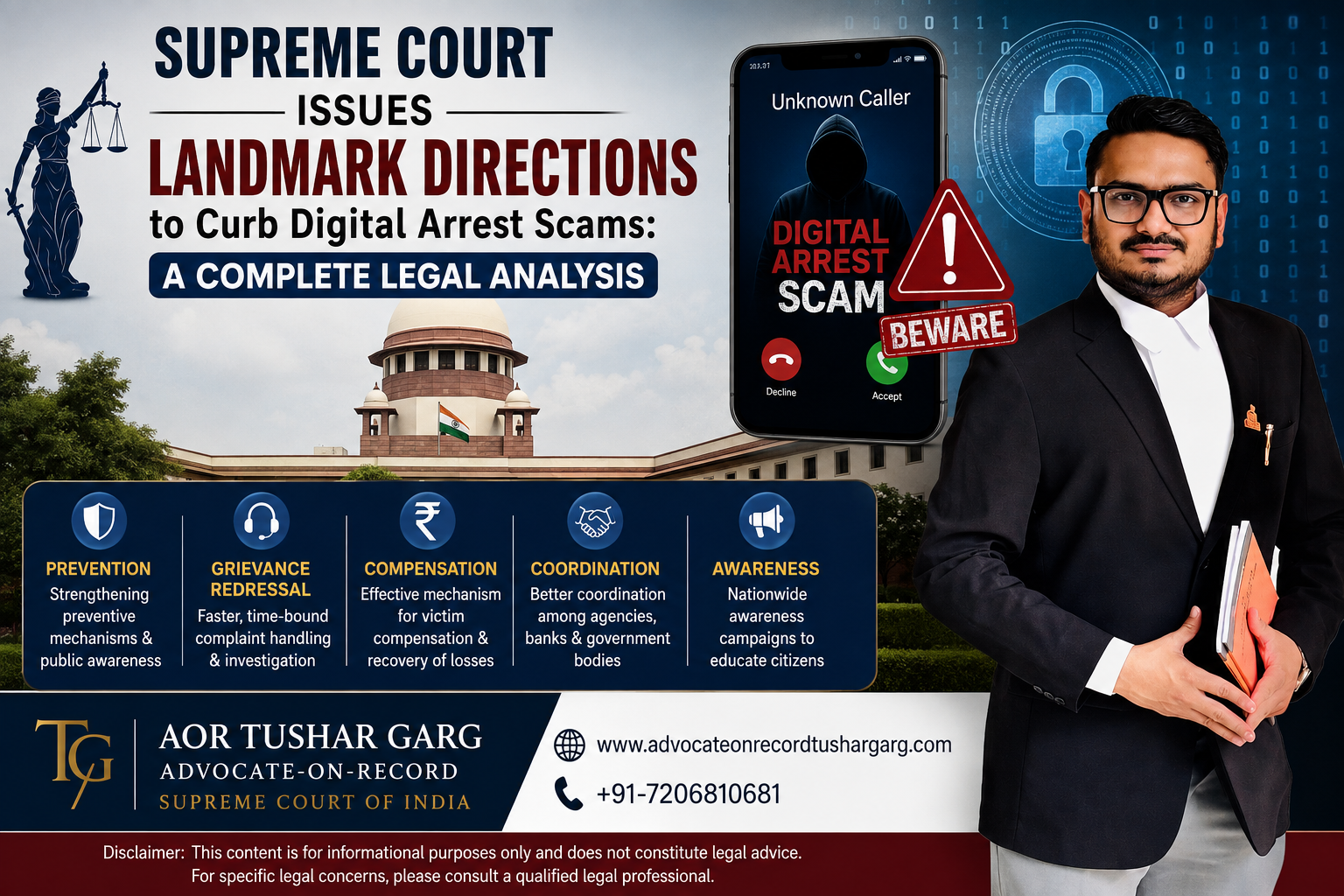
Supreme Court Issues Landmark Directions to Curb Digital Arrest Scams: A Complete Legal Analysis
India has witnessed an alarming rise in Digital Arrest Scams, where fraudsters impersonate police officers, CBI officials, ED officers, RBI representatives, or judges to intimidate innocent citizens into transferring money. These cybercriminals falsely claim that the victim is involved in money laundering, drug trafficking, tax evasion, or other criminal investigations and threaten immediate arrest unless money is paid.
Recognizing the growing threat posed by such sophisticated cyber frauds, the Supreme Court of India has recently issued significant directions aimed at strengthening the country’s response to digital arrest scams. The Court emphasized the need for coordinated preventive measures, speedy grievance redressal, victim compensation, and greater public awareness.
This landmark development reinforces the constitutional responsibility of governments and law enforcement agencies to protect citizens from cyber-enabled financial crimes.
What is a Digital Arrest Scam?
A Digital Arrest Scam is a form of cyber fraud in which criminals impersonate government authorities and create fear by claiming that the victim has committed a criminal offence.
The fraudsters typically:
Pretend to be officers from the Police, CBI, ED, Customs, RBI, Income Tax Department, or Telecom Department.
Claim that the victim’s Aadhaar, PAN, SIM card, or bank account has been linked to criminal activities.
Force victims to remain on continuous video calls.
Threaten immediate arrest or asset seizure.
Demand that money be transferred to so-called “safe” government accounts for verification.
In reality, no genuine government agency follows such procedures.
Why the Supreme Court Intervened
The Supreme Court observed that digital arrest scams have become a nationwide menace affecting people across all age groups.
Victims often suffer:
Massive financial losses
Mental trauma
Emotional distress
Loss of savings
Delay in recovery due to fragmented grievance mechanisms
The Court stressed that cyber fraud is no longer an individual problem but a serious threat to public confidence in digital governance and financial systems.
Supreme Court’s Key Directions
1. Strengthening Prevention Mechanisms
The Court directed authorities to adopt proactive measures for preventing cyber frauds rather than merely reacting after crimes occur.
Suggested measures include:
Real-time monitoring of suspicious transactions
Better coordination among banks
Faster freezing of fraudulent accounts
Improved cyber intelligence
AI-based fraud detection systems
Public awareness campaigns
2. Faster Grievance Redressal
Victims often face delays while reporting cyber crimes.
The Supreme Court emphasized the need for:
Single-window complaint mechanisms
Time-bound investigation
Immediate registration of complaints
Better coordination between banks and cyber police
Technology-enabled complaint tracking
This ensures quicker action and improves the chances of recovering stolen money.
3. Victim Compensation
One of the most significant observations relates to victim compensation.
The Court highlighted the importance of creating effective mechanisms to compensate genuine victims wherever legally permissible, particularly where institutional failures or delayed action contribute to financial loss.
Authorities have been encouraged to develop transparent policies regarding compensation and recovery.
4. Coordination Between Agencies
The Court stressed that cyber fraud cannot be addressed by a single agency.
Effective coordination is required among:
State Police
Cyber Crime Cells
Banks
RBI
Telecom Companies
Financial Intelligence Units
Central Government Agencies
A coordinated national strategy is essential to combat organized cybercrime.
5. Public Awareness
Many victims fall prey because they are unaware that government agencies never conduct arrests through video calls or demand payments into private accounts.
The Supreme Court emphasized nationwide awareness campaigns through:
Television
Newspapers
Social media
Educational institutions
Banks
Telecom operators
Public awareness remains the first line of defence.
Legal Rights of Victims
If you become a victim of a digital arrest scam:
Immediately report the incident on the National Cyber Crime Reporting Portal.
Call the Cyber Crime Helpline (1930) without delay.
Inform your bank immediately to freeze suspicious transactions.
Preserve call recordings, screenshots, WhatsApp chats, emails, and transaction details.
File an FIR where required.
Seek legal advice if substantial financial loss has occurred.
Prompt reporting significantly increases the chances of recovery.
Constitutional Perspective
The Supreme Court’s approach reflects broader constitutional values, including:
Protection of life and personal liberty under Article 21.
Protection against arbitrary actions.
Right to access justice.
Duty of the State to ensure public safety in the digital ecosystem.
The judgment underscores that technological advancement must be accompanied by effective legal safeguards.
Practical Safety Tips
Citizens should remember:
No police officer conducts arrests through WhatsApp or video calls.
No court orders payment into personal bank accounts.
Never share OTPs, banking credentials, or PINs.
Never transfer money under pressure.
Verify the identity of any caller claiming to be a government official.
Disconnect suspicious calls immediately.
Report incidents without delay.
Significance of the Supreme Court’s Directions
The directions represent an important step towards strengthening India’s cyber security framework.
They aim to:
Improve institutional accountability.
Enhance inter-agency cooperation.
Protect digital consumers.
Encourage faster recovery of stolen funds.
Build public confidence in online financial transactions.
As cybercrime continues to evolve, judicial oversight will play a crucial role in ensuring that legal institutions remain responsive to emerging technological challenges.
Conclusion
Digital arrest scams exploit fear, misinformation, and technology to deceive innocent citizens. The Supreme Court’s latest directions send a clear message that cyber fraud requires a coordinated, victim-centric, and technology-driven response.
While stronger institutional mechanisms are essential, public awareness remains the most effective defence. Every citizen should remain vigilant, verify official communications, and report suspicious activities immediately.
About AOR Tushar Garg
AOR Tushar Garg is an Advocate-on-Record, Supreme Court of India, providing legal representation in constitutional matters, civil disputes, criminal appeals, special leave petitions (SLPs), writ petitions, arbitration, and other complex litigation before the Supreme Court of India. Through legal insights and analysis, he aims to simplify important judicial developments for the public and the legal community.
Website: https://advocateonrecordtushargarg.com
Contact: +91-7206810681
Disclaimer
This article is intended solely for informational and educational purposes. It does not constitute legal advice, legal opinion, or create an attorney-client relationship. Readers should consult a qualified legal professional before making any legal decisions. The views expressed are based on publicly available judicial developments and are subject to future legal interpretations and changes in law.