

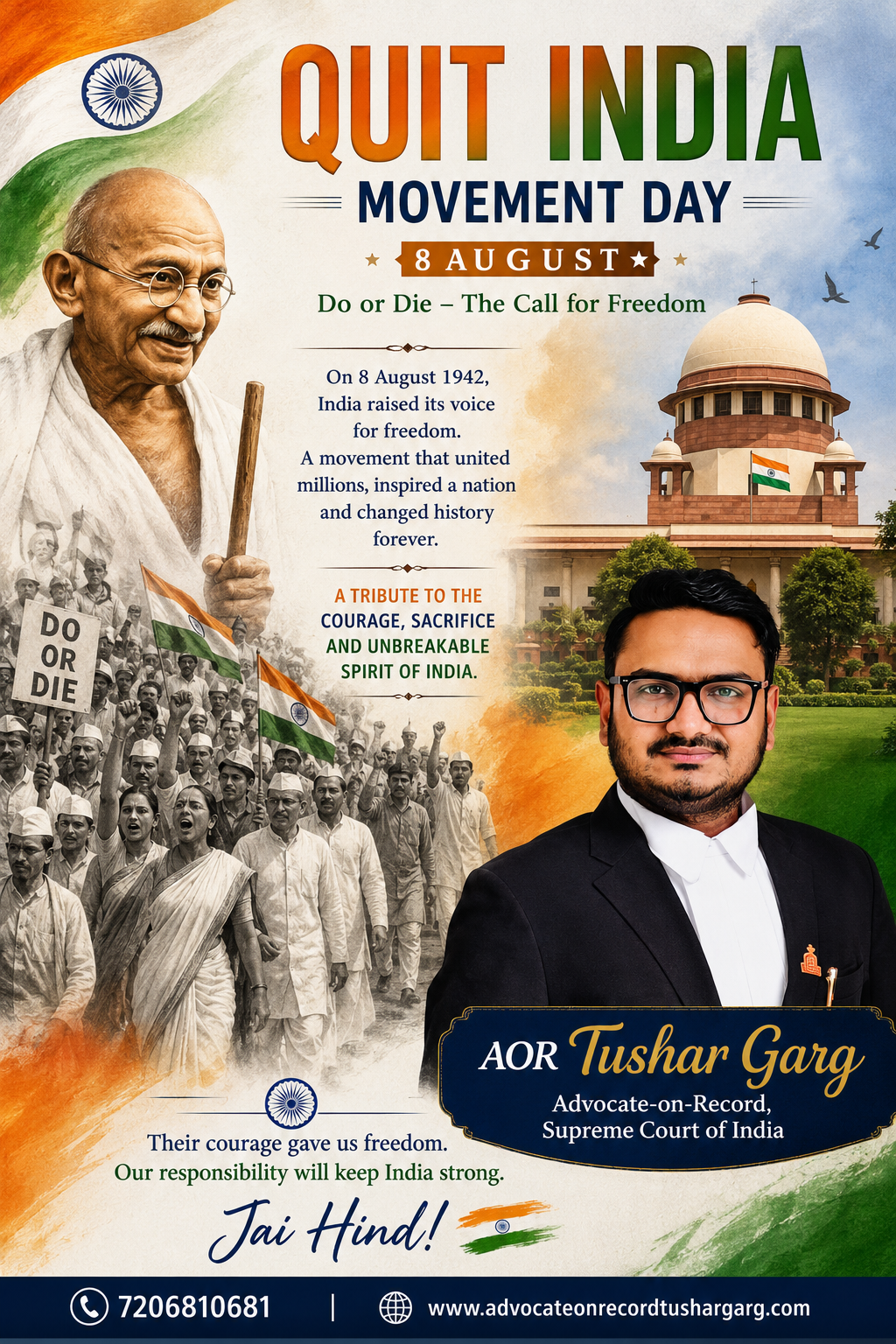
Quit India Movement Day 2026: Remembering the Call for Freedom and the Spirit of “Do or Die”
Quit India Movement Day, observed every year on 8 August, is a powerful reminder of one of the most decisive chapters in India’s freedom struggle. On 8 August 1942, the Indian National Congress launched the historic Quit India Movement, calling upon the British to leave India and demanding an immediate end to colonial rule. Mahatma Gandhi gave the nation the unforgettable message of “Do or Die,” inspiring millions of Indians to participate in the struggle for independence.
The movement represented the determination of ordinary citizens, students, workers, women, farmers, and national leaders who were prepared to make immense sacrifices for the country’s freedom. Even though the movement faced severe repression, arrests, censorship, and violence, its spirit could not be suppressed.
The Historical Background
By 1942, India had already witnessed decades of resistance against British rule. The Non-Cooperation Movement, Civil Disobedience Movement, Salt Satyagraha, and numerous revolutionary activities had strengthened the demand for independence.
The Second World War created further political tension. Britain involved India in the war without obtaining the consent of Indian leaders. The failure of the Cripps Mission to provide a satisfactory proposal for Indian self-government further increased frustration among national leaders.
Against this background, the Congress Working Committee decided that the time had come for a final mass movement demanding an end to British rule.
On 8 August 1942, at the historic session of the All India Congress Committee in Bombay, the Quit India resolution was adopted. Mahatma Gandhi called upon Indians to remain united and fearless in their struggle for freedom.
His message, “Do or Die,” became the central slogan of the movement.
The Meaning of “Do or Die”
Gandhi’s call was not simply a slogan of confrontation. It represented determination, courage, sacrifice, and unwavering commitment to India’s freedom.
The message encouraged people to continue the struggle peacefully and with discipline, even when faced with imprisonment and repression. Gandhi wanted Indians to demonstrate that the desire for independence could not be permanently suppressed.
Thousands of people responded to the call. Leaders were arrested soon after the movement began, but instead of ending the movement, the arrests encouraged people across the country to continue the struggle.
The Role of Ordinary Indians
One of the most remarkable features of the Quit India Movement was the participation of ordinary citizens.
Students organized demonstrations and underground activities. Workers participated in strikes. Women played an important role in mobilizing communities and supporting the movement. Farmers and villagers also became active participants in many parts of the country.
With major leaders imprisoned, underground networks emerged to keep communication and resistance alive. Newspapers and clandestine radio broadcasts helped spread information despite strict censorship.
The movement therefore became more than a political campaign. It became a nationwide expression of the Indian people’s determination to achieve freedom.
Women and Youth in the Movement
Women and young people played an especially significant role during the Quit India Movement.
Young activists participated in protests, distributed messages, organized meetings, and helped maintain underground communication networks. Women also demonstrated extraordinary courage.
Figures such as Aruna Asaf Ali became symbols of resistance. Her role in continuing the movement after the arrest of major leaders demonstrated the courage and determination of Indian women during the freedom struggle.
The participation of young people also showed that the demand for independence had become deeply rooted among the next generation.
The Price of Freedom
The Quit India Movement came at a tremendous cost. Thousands of people were arrested, while many others faced imprisonment, police action, censorship, and other forms of repression.
The British administration attempted to suppress demonstrations and underground activities through strict measures. Yet the movement continued in different forms across several parts of India.
Although the Quit India Movement did not immediately achieve independence, it significantly weakened the political foundations of British rule. It demonstrated that continuing colonial rule without Indian cooperation would become increasingly difficult.
India eventually achieved independence on 15 August 1947.
Why Quit India Movement Day Still Matters
More than eight decades later, Quit India Movement Day continues to carry an important message for every Indian.
The movement reminds us that freedom was not achieved overnight. It was the result of decades of sacrifice, courage, unity, and determination.
Today, India is a democratic republic where citizens enjoy fundamental rights and participate in the country’s political and social life. Remembering the freedom struggle reminds us that these democratic values come with responsibilities.
We must respect the Constitution, protect democratic institutions, maintain social harmony, and contribute positively to society.
Freedom should not be understood merely as freedom from foreign rule. It also means freedom from discrimination, corruption, ignorance, poverty, intolerance, and injustice.
A Message for the Young Generation
For India’s youth, Quit India Movement Day provides an opportunity to learn from the courage of the freedom fighters.
The generation that participated in the freedom struggle faced circumstances very different from those we experience today. Yet their determination teaches us that meaningful change requires courage, discipline, patience, and collective responsibility.
Young Indians can honour that legacy by becoming responsible citizens, respecting the law, pursuing education, helping society, protecting the environment, and promoting unity.
The strongest tribute to our freedom fighters is not merely remembering their names—it is building a stronger, more just, and more responsible India.
Remembering the Legacy
On Quit India Movement Day 2026, we remember Mahatma Gandhi and all the known and unknown freedom fighters who contributed to India’s independence.
Their sacrifices remind us that national progress depends on unity and a strong commitment to democratic values.
For AOR Tushar Garg, Advocate-on-Record, Supreme Court of India, the occasion also carries a special significance in reminding citizens of the importance of justice, constitutional values, rule of law, and respect for democratic institutions. The freedom struggle ultimately paved the way for a nation governed by its own Constitution and institutions dedicated to justice and equality.
As we remember the historic events of 1942, let us renew our commitment to the values that make India strong.
The Quit India Movement was a call for freedom. Today, its legacy calls upon us to protect that freedom through responsibility, unity, constitutional respect, and service to the nation.
On Quit India Movement Day 2026, let us remember the courage of our freedom fighters and proudly carry forward their dream of a free, united, democratic, and progressive India.
Jai Hind! 🇮🇳
AOR Tushar Garg
Advocate-on-Record, Supreme Court of India