
World Tribal Day 2026: Constitutional Rights, Tribal Heritage and the Legal Protection of Scheduled Tribes in India
World Tribal Day, observed on 9 August, is an important occasion to recognise the rich cultural heritage, traditions, identity and contributions of Indigenous and tribal communities. In India, the occasion also provides an opportunity to reflect on the constitutional safeguards and statutory protections available to Scheduled Tribes (STs).
India’s constitutional framework does not merely recognise social diversity; it also creates specific mechanisms for protecting vulnerable communities and promoting equality and social justice. For Scheduled Tribes, these safeguards extend across fundamental rights, affirmative action, political representation, administration of Scheduled Areas and specialised legal protection.
Constitutional Recognition of Scheduled Tribes
The Constitution of India contains several provisions specifically relevant to Scheduled Tribes.
Article 342 provides the constitutional mechanism for specifying the communities that are treated as Scheduled Tribes in relation to a particular State or Union Territory. This is an important distinction because ST recognition is constitutionally linked to the relevant State or Union Territory.
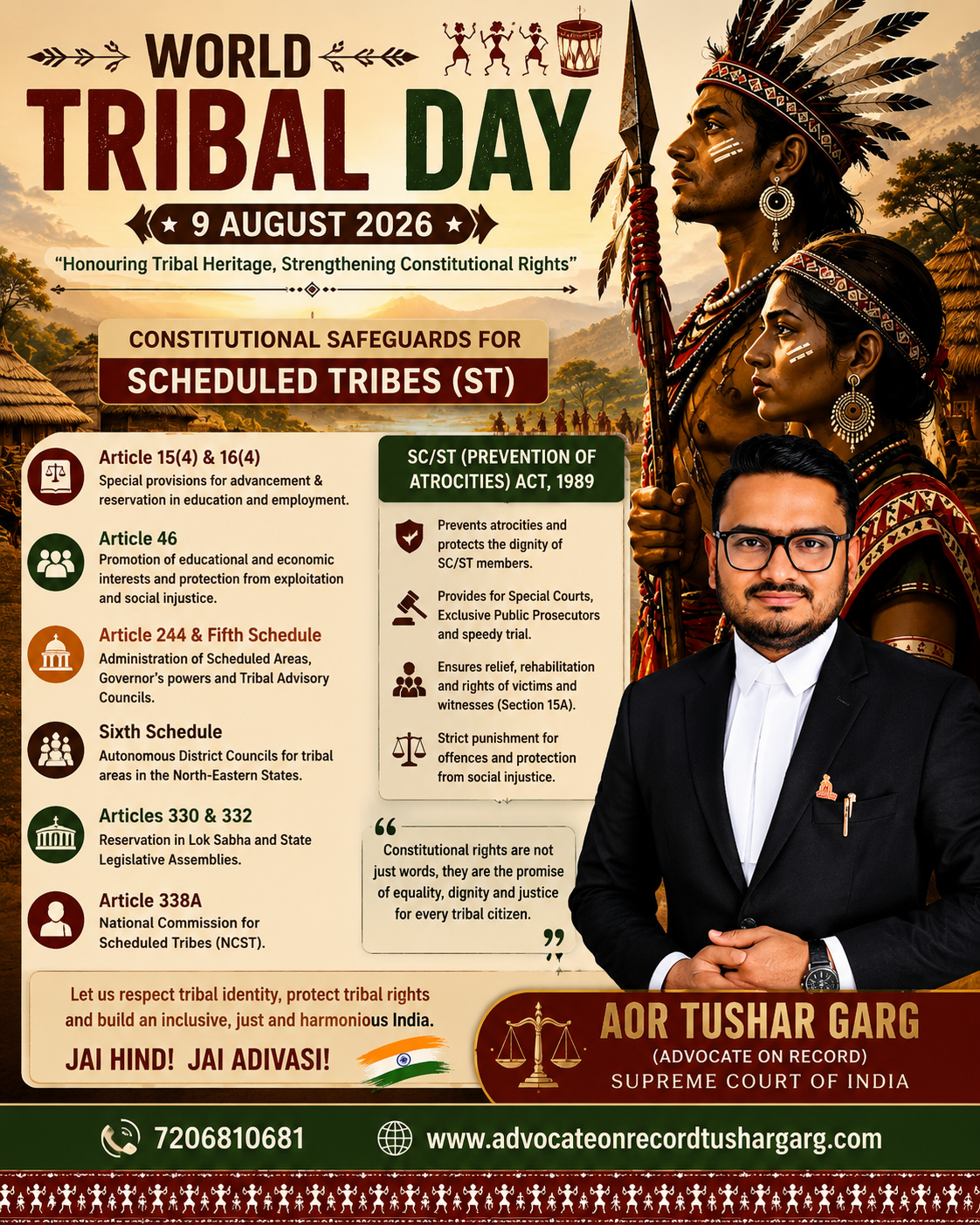
The Constitution also provides for affirmative measures to address historical and social disadvantages. Article 15(4) enables the State to make special provisions for the advancement of socially and educationally backward classes and for Scheduled Castes and Scheduled Tribes. Article 16(4) enables reservation in public employment for backward classes that, in the State’s opinion, are not adequately represented in public services.
These provisions reflect an important constitutional principle: formal equality may sometimes require substantive measures to ensure meaningful equality.
Article 46 and the Directive Principle of Social Justice
Article 46 directs the State to promote the educational and economic interests of weaker sections of the people, particularly Scheduled Castes and Scheduled Tribes, and to protect them from social injustice and exploitation.
Although Directive Principles are not enforceable in the same manner as Fundamental Rights, they provide an important constitutional direction for public policy.
For ST communities, Article 46 is particularly significant because development cannot be separated from protection against exploitation, discrimination and dispossession.
Article 244 and the Fifth Schedule
One of the most important constitutional protections concerning Scheduled Tribes is found in Article 244 read with the Fifth Schedule.
The Fifth Schedule deals with the administration and control of Scheduled Areas and Scheduled Tribes in areas covered by Article 244(1). It provides a special administrative framework intended to protect tribal interests.
The Fifth Schedule gives the Governor certain powers relating to Scheduled Areas. For example, the Governor may make regulations concerning matters such as the transfer of tribal land and the allotment of land to members of Scheduled Tribes. The constitutional framework also provides for Tribes Advisory Councils in relevant States.
The Ministry of Tribal Affairs explains that the Fifth Schedule is concerned with Scheduled Areas outside the North-Eastern States covered by the Sixth Schedule.
This framework demonstrates that tribal protection is not limited to welfare schemes; it also involves special constitutional arrangements for governance and protection of community interests.
The Sixth Schedule and Tribal Autonomy
The Constitution also contains special provisions under the Sixth Schedule for certain tribal areas in Assam, Meghalaya, Tripura and Mizoram.
The Sixth Schedule provides for autonomous institutions in specified tribal areas, giving local communities an important role in managing certain aspects of administration, social customs, land and local governance.
Thus, the Constitution recognises that India’s tribal communities are diverse and that a uniform administrative model may not always adequately protect their interests.
Political Representation
The Constitution also provides mechanisms for political representation of Scheduled Castes and Scheduled Tribes.
Seats are reserved for SCs and STs in the Lok Sabha under Article 330 and in State Legislative Assemblies under Article 332, subject to the constitutional framework.
Political representation is essential because constitutional democracy is strengthened when historically disadvantaged communities have meaningful participation in legislative institutions.
National Commission for Scheduled Tribes
Another important constitutional safeguard is the National Commission for Scheduled Tribes (NCST) under Article 338A.
The Commission has an important role in monitoring constitutional and legal safeguards for Scheduled Tribes, investigating complaints and participating in the protection of ST interests.
This institutional mechanism provides an additional constitutional avenue for addressing concerns relating to discrimination, rights and implementation of safeguards.
SC/ST Prevention of Atrocities Act, 1989
Constitutional protection is supplemented by specific legislation.
The Scheduled Castes and the Scheduled Tribes (Prevention of Atrocities) Act, 1989 is one of India’s most significant statutory protections against atrocities committed against members of SC and ST communities.
The Act was enacted in 1989 and came into force on 30 January 1990. Its stated purpose includes preventing atrocities, providing for Special Courts and Exclusive Special Courts, and providing relief and rehabilitation to victims.
The legislation contains provisions dealing with offences of atrocities, punishment, Special Courts, appeals, Special Public Prosecutors and the rights of victims and witnesses. Section 15A, in particular, recognises rights of victims and witnesses.
The Act therefore represents an important link between constitutional equality and practical access to criminal justice.
Why Legal Awareness Matters
Having laws on paper is only one part of social justice. Effective implementation, legal awareness, accessible institutions and timely judicial remedies are equally important.
Members of Scheduled Tribes should be aware of their constitutional and statutory protections, while public authorities must ensure that these safeguards are implemented fairly and effectively.
Legal professionals also have an important role in ensuring that constitutional rights are interpreted and enforced in accordance with the principles of justice, dignity and equality.
A Commitment to Tribal Heritage and Constitutional Values
World Tribal Day is not simply a celebration of culture. It is also an opportunity to recognise the constitutional promise of equality, dignity, participation and protection from exploitation.
India’s tribal communities have contributed enormously to the country’s cultural diversity, environmental heritage, social traditions and freedom struggle. Their languages, customs, knowledge systems, art, music and relationship with nature form an important part of India’s identity.
The constitutional framework seeks to balance development with protection of rights. The challenge before modern India is to ensure that economic progress reaches tribal communities without undermining their dignity, culture, legitimate rights and participation in decision-making.
Conclusion
World Tribal Day 2026 should therefore be viewed as both a celebration and a reminder of constitutional responsibility.
From Articles 15(4), 16(4), 46, 244, 330, 332, 338A and 342 to the Fifth and Sixth Schedules and the SC/ST (Prevention of Atrocities) Act, 1989, India’s legal framework contains several important safeguards for Scheduled Tribes.
The true meaning of social justice lies not merely in recognising rights but in making those rights accessible to every citizen.
As AOR Tushar Garg, Advocate-on-Record, Supreme Court of India, we can reaffirm the commitment to constitutional values, rule of law, equal dignity and access to justice for all communities.
Let us celebrate tribal heritage, respect tribal identity and strengthen the constitutional promise of justice and equality.
Jai Hind! 🇮🇳
Jai Adivasi!
This article is for general legal awareness and does not constitute legal advice.