

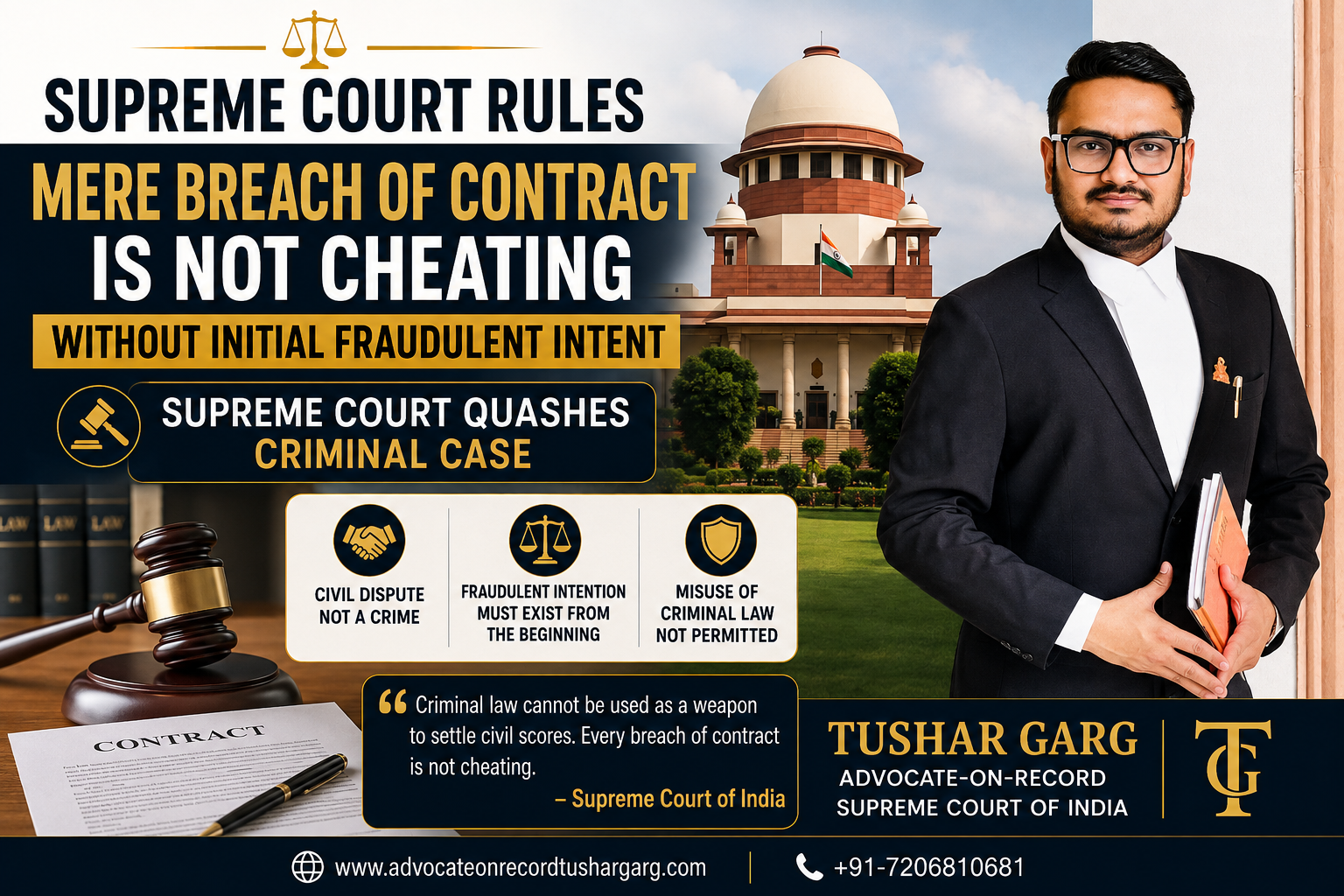
Supreme Court Rules Mere Breach of Contract Is Not Cheating Without Initial Fraudulent Intent
The Supreme Court of India has once again reinforced an important principle of criminal jurisprudence by holding that a mere breach of contract cannot be treated as the offence of cheating unless there was dishonest or fraudulent intention from the very inception of the transaction. The Court quashed criminal proceedings initiated against the accused, observing that contractual disputes should not be converted into criminal prosecutions merely to exert pressure on the opposite party.
This judgment serves as a significant reminder that the distinction between civil liability and criminal liability must be carefully maintained. Businesses, entrepreneurs, contractors, and individuals involved in commercial transactions should understand that every contractual failure does not automatically amount to a criminal offence.
Understanding the Case
The dispute arose from a contractual arrangement between two parties where one party alleged that the other had failed to fulfill contractual obligations. Instead of pursuing civil remedies for breach of contract, the complainant initiated criminal proceedings alleging the offence of cheating.
The accused approached the Supreme Court seeking quashing of the criminal case, arguing that the allegations merely disclosed a contractual dispute without any evidence suggesting fraudulent intention at the time the agreement was entered into.
After examining the facts, the Supreme Court agreed with the accused and quashed the criminal proceedings.
Supreme Court’s Key Observation
The Supreme Court reiterated a well-established legal principle:
To constitute the offence of cheating, dishonest intention must exist from the very beginning of the transaction.
If the accused had genuine intentions at the time of entering into the contract but later failed to perform the contractual obligations due to subsequent circumstances, the dispute remains civil in nature.
The Court emphasized that criminal law cannot be used as a tool for recovering money or enforcing contractual obligations.
Difference Between Civil Breach and Criminal Cheating
The judgment clearly distinguishes between two legal concepts.
Civil Breach of Contract
A civil breach occurs when:
One party fails to perform contractual obligations.
Payment is delayed.
Goods or services are not delivered as agreed.
There is non-performance without fraudulent intention.
The appropriate remedy is filing a civil suit for damages, recovery of money, or specific performance.
Criminal Cheating
Cheating under criminal law requires:
Dishonest intention from the beginning.
False representation made knowingly.
Inducing another person to deliver property or money.
Wrongful loss to the victim and wrongful gain to the accused.
Without these essential ingredients, criminal prosecution cannot continue.
Why This Judgment Matters
The Supreme Court noted that criminal complaints are increasingly being filed in commercial disputes to pressure the opposite party into settlement.
Such misuse of criminal proceedings not only burdens investigating agencies but also clogs the judicial system.
The Court observed that parties cannot convert purely contractual disputes into criminal cases merely because one party failed to fulfill contractual promises.
Protection Against Misuse of Criminal Law
This judgment provides significant protection to:
Business owners
Company directors
Contractors
Service providers
Vendors
Developers
Entrepreneurs
Many commercial disputes involve delays, financial losses, or non-performance. These issues may amount to breach of contract but do not automatically constitute criminal offences.
The Supreme Court has reaffirmed that criminal law should only be invoked where there is clear evidence of deception or fraudulent intention from the outset.
Legal Principles Reaffirmed
The Court reaffirmed several settled principles:
Every breach of contract is not cheating.
Fraudulent intention must exist at the inception of the agreement.
Criminal proceedings should not replace civil remedies.
Courts must prevent abuse of criminal process.
Commercial disputes should ordinarily be resolved through civil proceedings.
These principles strengthen the rule of law by ensuring that criminal justice is reserved for genuine criminal conduct.
Impact on Commercial Litigation
The judgment is expected to have a far-reaching impact on commercial litigation across India.
Businesses frequently face criminal complaints arising out of failed contracts, loan disputes, partnership disagreements, and supply agreements.
This ruling reinforces judicial scrutiny before allowing criminal prosecutions in contractual matters.
Investigating agencies and lower courts are expected to carefully examine whether the allegations disclose dishonest intention from the very beginning before permitting criminal proceedings to continue.
Role of the Supreme Court Under Section 482 CrPC / Section 528 BNSS
The Supreme Court has consistently exercised its inherent powers to prevent abuse of judicial process by quashing criminal proceedings where the allegations do not disclose the commission of a cognizable offence.
Where the dispute is predominantly civil and lacks criminal intent, higher courts may intervene to secure the ends of justice.
This judgment further strengthens that approach.
Legal Takeaway for Businesses
Businesses entering into contracts should:
Draft comprehensive written agreements.
Clearly define obligations and payment terms.
Preserve all communications and documentary evidence.
Use arbitration or civil remedies for contractual disputes.
Avoid invoking criminal proceedings unless genuine fraud is involved.
Similarly, individuals facing false criminal complaints arising from contractual disputes should seek appropriate legal remedies before the High Court or Supreme Court.
How AOR Tushar Garg Can Assist
Disputes involving allegations of cheating, breach of contract, commercial fraud, or misuse of criminal proceedings require experienced legal representation before constitutional courts.
Advocate-on-Record Tushar Garg regularly represents clients before the Supreme Court of India in matters involving:
Special Leave Petitions (SLPs)
Criminal Appeals
Quashing of FIRs and Criminal Proceedings
Commercial and Contractual Disputes
Constitutional Litigation
Civil Appeals
Writ Petitions
With extensive experience in Supreme Court practice, AOR Tushar Garg assists clients in protecting their legal rights against unwarranted criminal prosecutions arising from civil disputes.
Conclusion
The Supreme Court’s ruling reinforces a crucial legal distinction between breach of contract and criminal cheating. Unless there is clear evidence that the accused possessed fraudulent or dishonest intention at the very inception of the transaction, criminal prosecution for cheating cannot be sustained.
This landmark decision safeguards individuals and businesses from the misuse of criminal law in contractual disputes and reiterates that civil remedies remain the appropriate course for resolving breaches of contract. The judgment strengthens commercial certainty, prevents abuse of the criminal justice system, and upholds the fundamental principle that criminal liability cannot arise from every contractual default.
Disclaimer: This post is intended solely for informational and educational purposes and should not be construed as legal advice or a legal opinion. It provides a general overview of a recent Supreme Court judgment and may not apply to every factual situation. Readers are advised to seek independent legal advice before acting on any information contained herein. The outcome of every legal matter depends on its specific facts and applicable law. As per the rules of the Bar Council of India, this content does not solicit or advertise legal services