

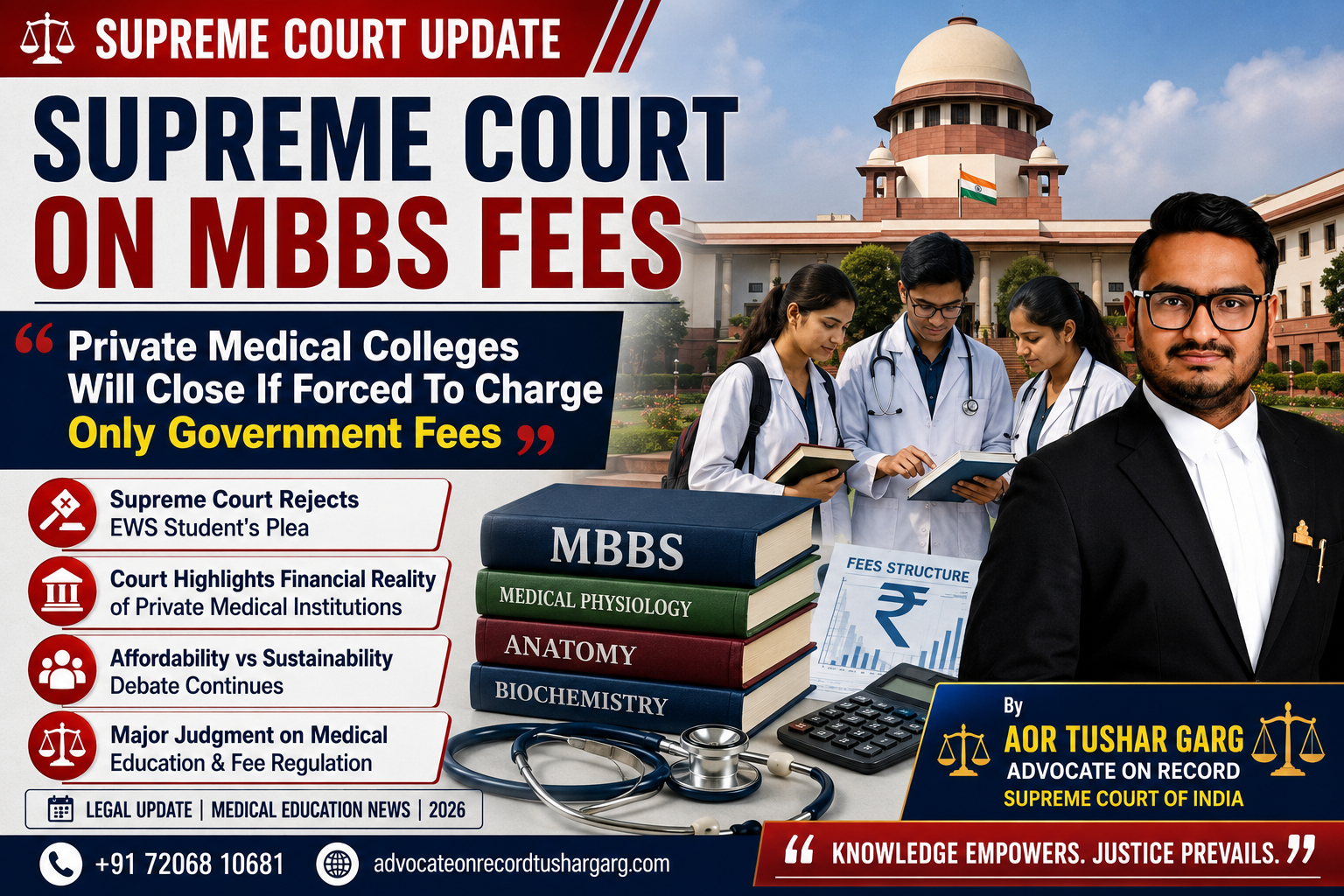
Supreme Court Rejects EWS Student’s Plea on MBBS Fees: “Private Medical Colleges Will Close If Forced To Charge Only Government Fees”
Understanding the Landmark Judgment on Medical Education and Fee Regulation
Medical education in India has long been a subject of debate, particularly regarding the high fees charged by private medical colleges. In a significant development, the Supreme Court of India recently rejected a plea filed by an Economically Weaker Section (EWS) student seeking admission in a private medical college at government college fee rates. The Court observed that forcing private medical institutions to charge only government-level fees could threaten their very existence.
The ruling has sparked discussions across the education sector, among students, parents, policymakers, and legal experts regarding affordability, educational quality, and the balance between private investment and public interest.
Background of the Case
The petitioner, an EWS category student, approached the Supreme Court seeking relief concerning the fee structure applicable to admissions in private medical colleges. The argument centered on ensuring affordable medical education for economically weaker students and extending the benefits of reservation policies in a meaningful manner.
The student contended that if EWS reservations are provided in private institutions, the fee structure should also be comparable to that of government medical colleges so that economically disadvantaged students can genuinely avail themselves of educational opportunities.
The matter raised an important constitutional and policy question: Can private medical colleges be compelled to provide education at government-regulated fee levels for all EWS candidates?
Supreme Court’s Observations
While hearing the matter, the Supreme Court emphasized the practical realities involved in operating private medical institutions. The Bench observed that private colleges invest enormous resources in acquiring land, developing infrastructure, purchasing medical equipment, maintaining hospitals, and paying faculty salaries.
The Court remarked that if private medical colleges were compelled to charge only government college fees, many institutions would struggle financially and could eventually shut down.
According to the Court, there is a substantial difference between government-funded institutions and privately managed educational establishments. Government colleges receive significant financial support from public funds, whereas private institutions largely depend on fee revenue to sustain operations.
The Court therefore declined to interfere with the existing fee structure and dismissed the plea.
Why Medical Education Costs More in Private Colleges
Private medical colleges generally incur significant operational expenses, including:
Infrastructure Development
Medical colleges require large campuses, teaching facilities, laboratories, libraries, hostels, and attached hospitals. Establishing and maintaining these facilities involves substantial investment.
Faculty and Staff Expenses
Qualified professors, doctors, researchers, nurses, and administrative staff form the backbone of medical institutions. Competitive salaries are essential to attract and retain skilled professionals.
Advanced Medical Equipment
Modern medical education depends on sophisticated diagnostic machines, simulation laboratories, surgical equipment, and research facilities, all of which require continuous investment.
Regulatory Compliance
Medical colleges must comply with standards prescribed by the National Medical Commission (NMC) and other regulatory authorities. Maintaining these standards often involves considerable financial expenditure.
Because of these factors, private colleges argue that charging government-level fees may not be economically viable.
The EWS Reservation Debate
The Economically Weaker Section (EWS) reservation policy was introduced to provide educational and employment opportunities to individuals from financially disadvantaged backgrounds who do not fall under existing reservation categories.
While reservation ensures seat availability, the question of affordability remains a challenge. Many students argue that reserving seats alone may not be sufficient if tuition fees remain beyond their financial capacity.
Supporters of the petition believe that meaningful access to education requires both reservation and financial support. Otherwise, students from weaker economic backgrounds may continue facing barriers despite securing admission.
Balancing Accessibility and Sustainability
The Supreme Court’s observations highlight the need to strike a balance between two important objectives:
Ensuring Affordable Education
Medical education should be accessible to deserving students irrespective of their economic status. Scholarships, education loans, fee waivers, and government support schemes can help achieve this objective.
Protecting Institutional Viability
Private educational institutions must remain financially sustainable to maintain educational standards and continue providing quality medical education.
The Court’s decision reflects an attempt to balance these competing interests while recognizing the economic realities of private educational institutions.
Implications for Medical Aspirants
The judgment is likely to have significant implications for students seeking admission to private medical colleges.
Continued Fee Structures
Private medical colleges are expected to continue charging fees approved by the respective fee regulatory authorities.
Increased Focus on Scholarships
Students from economically weaker backgrounds may need to rely more heavily on scholarships, financial aid programs, and government-sponsored educational support schemes.
Policy Discussions May Continue
The issue of affordability in medical education is unlikely to disappear. Policymakers may continue exploring mechanisms to make medical education more accessible without undermining the financial sustainability of private institutions.
Legal Significance of the Judgment
The ruling reinforces an important legal principle that private institutions cannot always be equated with government institutions for financial and operational purposes.
The Court recognized the autonomy of private educational establishments while also acknowledging the broader public interest in promoting access to education.
This judgment may serve as a reference point in future cases involving fee regulation, educational autonomy, and reservation-related policies in professional institutions.
Conclusion
The Supreme Court’s decision rejecting the EWS student’s plea underscores the complex challenges surrounding medical education in India. While affordability remains a genuine concern for thousands of aspiring doctors, the Court highlighted that compelling private medical colleges to charge only government-level fees could jeopardize their financial sustainability.
The judgment reflects the ongoing challenge of balancing educational accessibility with institutional viability. Moving forward, policymakers may need to focus on expanding scholarships, financial assistance programs, and public medical education infrastructure to ensure that deserving students are not denied opportunities due to economic constraints.
As India seeks to strengthen its healthcare system and produce more qualified medical professionals, finding practical solutions to the affordability question will remain a crucial policy priority.
By AOR Tushar Garg
Advocate on Record, Supreme Court of India