Holika Dahan: A Legal and Ethical Reflection on Justice, Renewal, and Social Harmony
— Inspired by the message of Tushar Garg, Advocate on Record at the Supreme Court of India
Holika Dahan, observed on the eve of Holi, is one of India’s most symbolically rich cultural traditions. While widely known for its mythological roots and spiritual meaning, the festival also offers profound insights when viewed through the lens of law, justice, and social responsibility. The ceremonial bonfire is not merely a religious act; it represents the burning of injustice, immorality, and social discord — values that resonate deeply with the foundational principles of a lawful and equitable society.
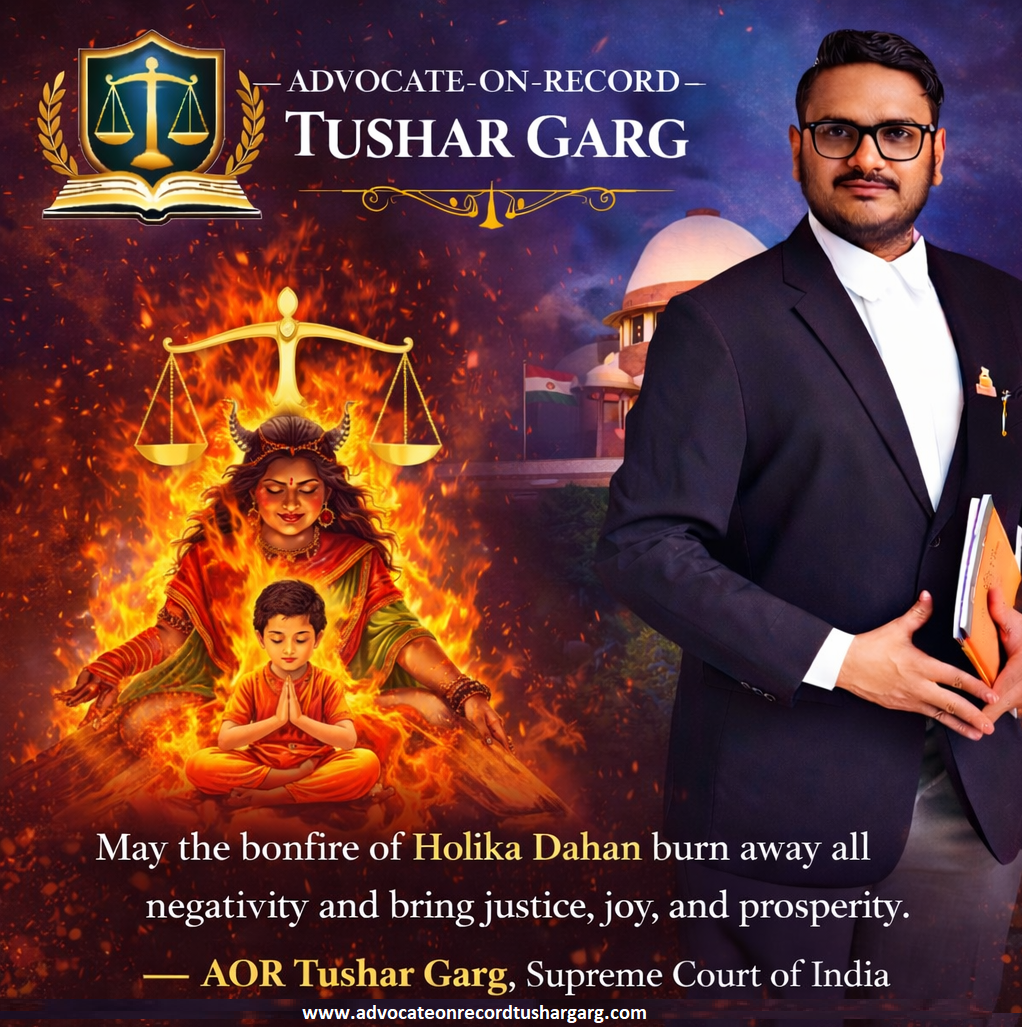
The message that Holika Dahan should “burn away all negativity and bring justice, joy, and prosperity” captures a powerful convergence of spirituality and constitutional values. It reminds us that festivals are not only cultural celebrations but also ethical reminders of the duties individuals owe to society and to the rule of law.
Mythology and the Principle of Justice
The origins of Holika Dahan lie in the ancient legend of Prahlad and King Hiranyakashipu. Hiranyakashipu, driven by arrogance and a desire for absolute authority, demanded unquestioned obedience from his subjects. His son Prahlad, however, stood firmly for truth and devotion, refusing to abandon his principles. In an attempt to eliminate him, the king conspired with his sister Holika, who possessed a boon that made her immune to fire. She sat with Prahlad in a blazing pyre, intending his destruction. Yet, justice prevailed — Prahlad survived, and Holika perished.
From a legal and ethical perspective, this narrative symbolizes a fundamental truth: abuse of power ultimately leads to downfall, while adherence to righteousness ensures protection. The story mirrors a core constitutional idea — that authority must be exercised within moral and lawful limits. The triumph of Prahlad represents the victory of justice over tyranny, echoing the rule of law that governs modern democratic institutions.
Symbolism of the Bonfire: Purification and Accountability
The Holika bonfire is a powerful metaphor for purification. Communities gather to burn symbolic representations of negativity, signifying the rejection of harmful thoughts, unjust actions, and social evils. In a legal framework, this symbolism aligns with the idea of accountability. Just as the fire consumes what is impure, the justice system seeks to eliminate wrongdoing and restore moral balance.
Law does not function merely as a set of rules; it is a mechanism for maintaining order, fairness, and human dignity. Holika Dahan encourages introspection — a process similar to ethical self-regulation that underlies responsible citizenship. Individuals are reminded to examine their conduct, discard prejudice, and act with integrity. This inner discipline strengthens the social fabric upon which legal systems depend.
Justice as a Collective Responsibility
Holika Dahan also emphasizes the idea that justice is not confined to courtrooms. While institutions uphold law, society sustains justice through everyday conduct. Respect for others’ rights, fairness in personal dealings, and commitment to truth are essential components of a just community.
The festival therefore acts as a moral reminder that legal harmony begins with individual responsibility. When citizens act ethically, social conflicts reduce, and institutions function more effectively. Justice becomes not merely a legal outcome but a shared cultural value.
Social Harmony and Constitutional Values
India’s constitutional framework is founded on principles such as equality, dignity, and fraternity. Holika Dahan reinforces these ideals by promoting unity and collective renewal. The communal gathering around the sacred fire transcends divisions of class, background, and belief, fostering social cohesion.
From a jurisprudential viewpoint, harmony within society is essential for the effective functioning of law. Legal systems operate best in environments where mutual respect prevails. Festivals like Holika Dahan nurture this environment by encouraging reconciliation, forgiveness, and shared hope.
Renewal, Joy, and Prosperity
Holika Dahan marks the transition from winter to spring, symbolizing renewal and new beginnings. In legal philosophy, renewal can be understood as reform — the continuous effort to improve institutions, correct injustices, and adapt to evolving social needs. Just as the festival signifies the end of darkness and the arrival of light, the pursuit of justice seeks to replace inequality with fairness and despair with hope.
Joy and prosperity, in this context, are not merely emotional or material outcomes. They represent the broader well-being that emerges when justice and ethical conduct guide society. A lawful society fosters trust; trust promotes cooperation; and cooperation leads to collective prosperity.
Contemporary Relevance
In modern times, the message of Holika Dahan carries renewed significance. Societies today confront challenges such as misinformation, intolerance, and ethical erosion. The festival’s symbolism encourages individuals to resist these forces and reaffirm commitment to truth and justice.
Viewing Holika Dahan through a legal perspective highlights the interconnectedness of moral values and institutional integrity. Laws are effective only when supported by a culture that respects fairness and accountability. The festival thus becomes a cultural expression of constitutional morality.
Conclusion
Holika Dahan is far more than a traditional ritual; it is a timeless reminder of the principles that sustain a just and harmonious society. By symbolically burning negativity, individuals reaffirm their dedication to truth, fairness, and ethical responsibility. The festival’s message aligns closely with the ideals of justice, dignity, and social order that form the foundation of modern legal systems.
When interpreted through the perspective of law and social ethics, Holika Dahan inspires both personal transformation and collective progress. It calls upon individuals to uphold righteousness, promote harmony, and contribute to a society where justice, joy, and prosperity prevail.
In this way, the sacred flames of Holika Dahan continue to illuminate not only spiritual paths but also the enduring pursuit of justice in human society.
AOR Tushar Garg, Advocate on Record at the Supreme Court of India, offers a profound perspective on Holika Dahan that goes beyond tradition to reflect core values of justice and societal well-being. He believes that the festival’s symbolic bonfire represents burning away negativity, prejudice, and injustice from both personal life and society at large. Holika Dahan, in his view, calls for introspection, ethical action, and renewal of one’s commitment to fairness and harmony. It is not only a celebration but a reminder to uphold truth, foster joy, and work toward collective prosperity.