

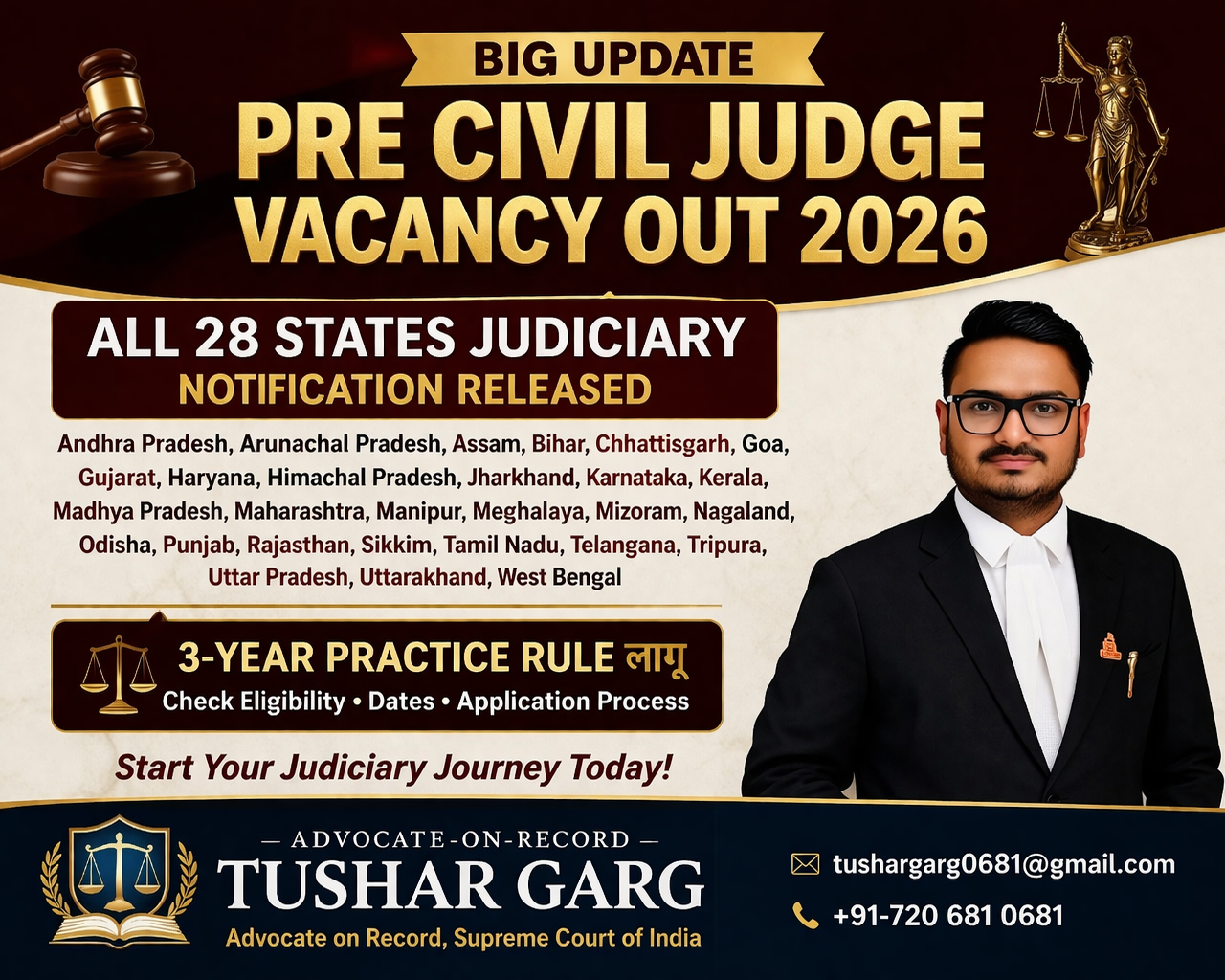
Pre Civil Judge Vacancy Out 2026 – All 28 States Judiciary Notification Released (Andhra Pradesh, Arunachal Pradesh, Assam, Bihar, Chhattisgarh, Goa, Gujarat, Haryana, Himachal Pradesh, Jharkhand, Karnataka, Kerala, Madhya Pradesh, Maharashtra, Manipur, Meghalaya, Mizoram, Nagaland, Odisha, Punjab, Rajasthan, Sikkim, Tamil Nadu, Telangana, Tripura, Uttar Pradesh, Uttarakhand, West Bengal)
By AOR Tushar Garg
Becoming a Civil Judge in India is one of the most prestigious career paths for law graduates. However, a major change has impacted judiciary aspirants — the mandatory 3-year legal practice rule. This rule determines whether a candidate is eligible to appear for the Civil Judge (Junior Division) Judicial Services Examination.
In this detailed blog, we will explain:
• Supreme Court judgment on 3-year practice
• Eligibility criteria for judiciary exams
• State-wise rules across all 28 states
• Impact on fresh law graduates
Supreme Court Judgment on 3-Year Practice Rule
In a landmark decision (2025), the Supreme Court of India made it mandatory for candidates to have minimum 3 years of legal practice before appearing in judicial service exams.
Key Highlights:
• Applies to Civil Judge (Junior Division) posts
• Practice counted from date of enrolment as advocate
• Fresh law graduates are not eligible immediately after LLB
• Objective: Improve quality and courtroom experience of judges
What is the 3-Year Practice Rule?
The rule requires:
• Minimum 3 years continuous legal practice
• Practice must be as a registered advocate under Bar Council
• Proof required:
o Certificate from senior advocate (10+ years experience)
o Endorsement by judicial officer
Practice includes:
• Court appearances
• Drafting, pleadings
• Trial court or High Court litigation
Eligibility Criteria for Civil Judge Exam
Basic Requirements:
• LLB Degree (recognized university)
• Age: 21–35 years (varies by state)
• Enrollment with State Bar Council
• 3 years legal practice (mandatory as per SC rule)
Why 3-Year Practice Rule Was Introduced
The Supreme Court emphasized:
• Judges must have practical courtroom exposure
• Fresh graduates lack real litigation experience
• Better decision-making comes from hands-on practice
State-Wise Judiciary Exam Eligibility (All 28 States)
Important: Even after SC ruling, implementation may vary slightly based on High Court notifications.
States Where 3-Year Practice is Already Mandatory / Likely Applicable
North India
• Delhi
• Haryana
• Punjab
• Himachal Pradesh
• Uttarakhand
• Uttar Pradesh
• Rajasthan
• Jammu & Kashmir
Example: Delhi & Haryana already require 3-year practice
West India
• Maharashtra
• Gujarat
• Goa
Central India
• Madhya Pradesh
• Chhattisgarh
East India
• Bihar
• Jharkhand
• West Bengal
• Odisha
South India
• Andhra Pradesh
• Telangana
• Tamil Nadu
• Karnataka
• Kerala
North-East India
• Assam
• Arunachal Pradesh
• Manipur
• Meghalaya
• Mizoram
• Nagaland
• Tripura
• Sikkim
Important Note on State Variations
Even though the Supreme Court has mandated the rule:
• Some states may temporarily allow freshers (transition phase)
• Some states strictly require practice certificate
• Always check official notification of High Court / PSC
Impact on Judiciary Aspirants
Positive Impact:
Better trained judges
Practical knowledge of court procedures
Improved justice delivery system
Negative Impact:
Delay for fresh graduates
Increased competition after 3 years
Financial struggle during initial practice
Latest Update (2026)
• Supreme Court is reviewing uniform implementation
• Discussions ongoing with High Courts
• Likely same rule across India soon
Tips for Aspirants During 3-Year Practice
• Join a senior advocate (litigation exposure)
• Focus on drafting + court appearances
• Maintain case records for proof
• Prepare simultaneously for judiciary exams
Conclusion
The 3-year practice rule for judicial exams marks a significant shift in India’s judicial recruitment system. While it creates challenges for fresh graduates, it ultimately ensures that future judges are more experienced, competent, and courtroom-ready.
For aspiring Civil Judges, the key is to balance practice with preparation and stay updated with state notifications.
About AOR Tushar Garg
AOR Tushar Garg is a distinguished legal professional practicing in the Supreme Court of India, guiding law aspirants and clients with expert legal insights and judicial exam strategies.
Website: advocateonrecordtushargarg.com