
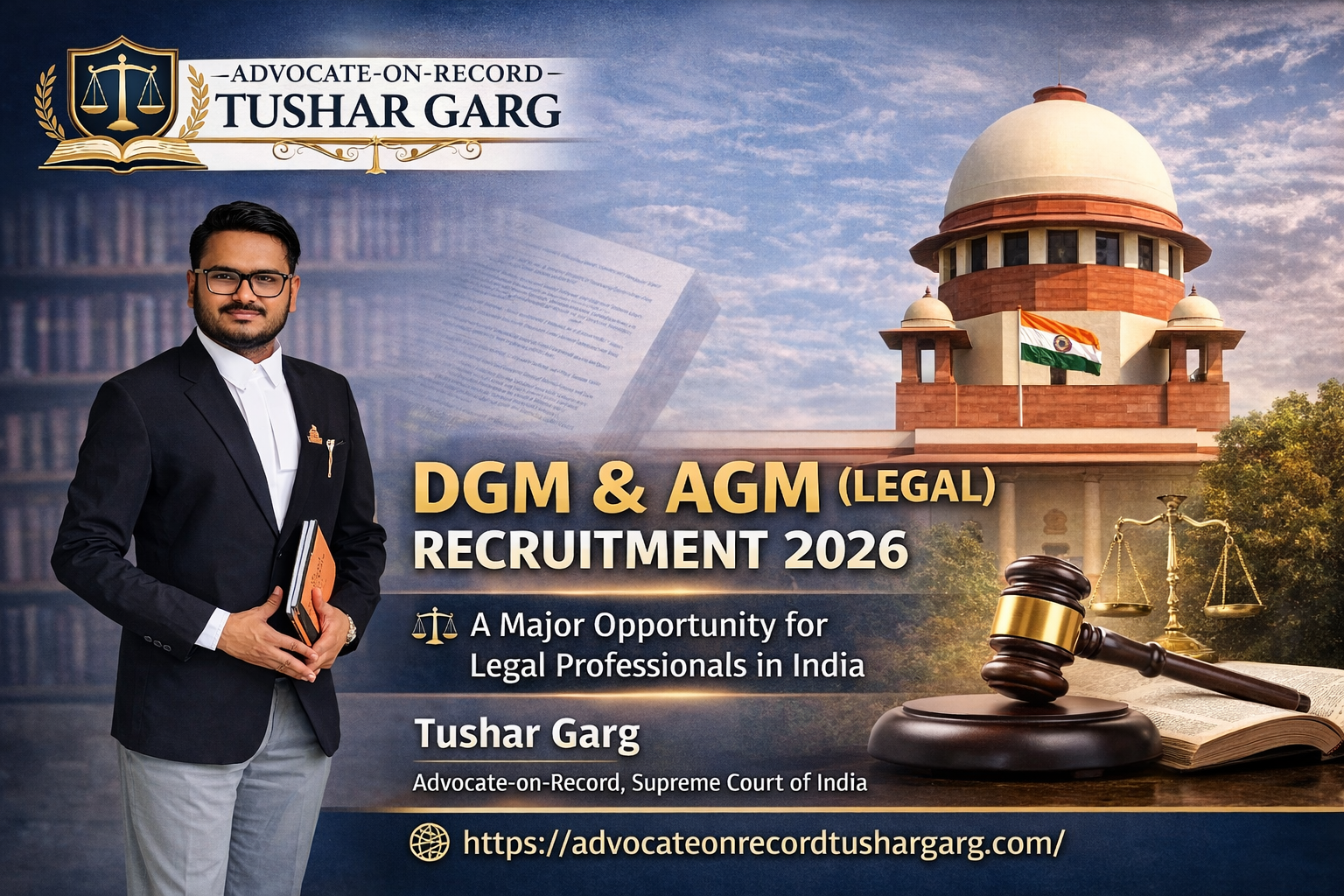
New Opportunity for Legal Professionals – DGM & AGM (Legal) Recruitment Advertisement Explained
The legal profession in India continues to expand with increasing opportunities in government organizations, public sector undertakings, and corporate sectors. Recently, an important recruitment advertisement titled “Final Advertisement for DGM and AGM (Legal)” dated 13 March 2026 has attracted significant attention among legal professionals and aspiring candidates. Such advertisements open doors for experienced advocates and legal experts who wish to contribute their expertise in high-level managerial legal roles.
In this blog, we will explore the significance of the DGM (Deputy General Manager) and AGM (Assistant General Manager) Legal positions, the typical eligibility criteria, responsibilities, and why such opportunities are important for legal professionals in India. Insights related to legal practice before the Supreme Court of India and the perspective of Tushar Garg also help in understanding the broader legal landscape.
Understanding the Roles: DGM (Legal) and AGM (Legal)
The posts of Deputy General Manager (Legal) and Assistant General Manager (Legal) are senior legal positions generally offered by government organizations, public sector undertakings (PSUs), and large corporations. These roles require experienced legal professionals capable of handling complex litigation, corporate legal compliance, and strategic legal advisory.
The AGM (Legal) position typically involves mid-senior responsibilities such as handling legal documentation, assisting in policy drafting, monitoring litigation matters, and ensuring compliance with statutory regulations. On the other hand, the DGM (Legal) role is more senior and often involves leadership responsibilities, including managing legal teams, supervising litigation strategies, and providing strategic legal guidance to top management.
Recruitment advertisements for such posts are important because they bring transparency and provide an opportunity for qualified lawyers to enter leadership roles in the legal departments of organizations.
Key Responsibilities of Legal Managers
Professionals appointed as AGM or DGM (Legal) usually perform a wide range of responsibilities. These may include:
1. Litigation Management
Handling court cases, preparing legal strategies, coordinating with advocates, and representing the organization in different judicial forums.
2. Legal Advisory Services
Providing expert legal advice to the organization’s management regarding contracts, policies, and compliance matters.
3. Contract Drafting and Vetting
Drafting, reviewing, and negotiating contracts, agreements, and other legal documents to safeguard the organization’s interests.
4. Regulatory Compliance
Ensuring that the organization follows all applicable laws, rules, and regulatory frameworks.
5. Coordination with External Counsel
Senior legal officers often coordinate with advocates practicing in courts including High Courts and the Supreme Court of India.
These responsibilities demand strong analytical skills, legal expertise, and practical courtroom experience.
Eligibility and Experience Requirements
Most advertisements for AGM (Legal) and DGM (Legal) positions specify strict eligibility criteria to ensure that only experienced legal professionals apply. While specific requirements vary by organization, common eligibility conditions include:
Educational Qualification:
Candidates must possess a Bachelor’s Degree in Law (LLB) from a recognized university.
Professional Experience:
Usually, several years of legal practice or corporate legal experience is required.
AGM positions may require around 8–12 years of experience, while DGM roles may demand 12–15 years or more.
Court Experience:
Experience in litigation before courts such as High Courts or the Supreme Court of India is often considered an advantage.
Knowledge of Corporate and Administrative Law:
Candidates must be familiar with contract law, arbitration, regulatory laws, and government policies.
Legal professionals who have strong litigation backgrounds or who have worked closely with senior advocates often have a competitive edge in these recruitment processes.
Importance of Experienced Advocates in Legal Management
Senior legal positions require individuals who possess not only academic knowledge but also practical legal experience. Advocates who regularly appear before courts develop a deeper understanding of litigation procedures, legal drafting, and judicial interpretation.
For instance, experienced legal professionals like Tushar Garg have built reputations through years of practice in constitutional law, corporate litigation, and advisory services. As an Advocate-on-Record practicing before the Supreme Court of India, such professionals demonstrate the level of expertise required for handling high-stakes legal matters.
Their work highlights the importance of strong legal representation and professional ethics in the Indian judicial system.
Selection Process for Legal Posts
Recruitment for senior legal positions generally involves a structured selection process designed to assess both professional knowledge and practical legal skills. The selection process may include:
1. Application Screening
Initial scrutiny of applications based on eligibility, qualifications, and experience.
2. Written Test or Case Analysis
Some organizations conduct written examinations or legal case analysis tests to evaluate analytical skills.
3. Personal Interview
Shortlisted candidates are invited for interviews where their legal knowledge, litigation experience, and leadership skills are assessed.
4. Document Verification
Candidates must submit proof of educational qualifications, bar enrollment, and professional experience.
This comprehensive process ensures that only capable and qualified legal professionals are appointed to these important roles.
Why These Legal Opportunities Matter
The recruitment of AGM and DGM (Legal) professionals reflects the growing importance of legal governance within organizations. With increasing regulatory frameworks, corporate compliance requirements, and complex commercial disputes, organizations need experienced legal leaders who can guide them through legal challenges.
Such roles also provide lawyers with opportunities to transition from courtroom practice to strategic legal management. Professionals working in these roles gain exposure to corporate governance, policy development, and high-level decision-making.
Furthermore, legal experts associated with leading courts such as the Supreme Court of India often contribute valuable insights that help organizations navigate complex legal issues effectively.
Conclusion
The Final Advertisement for DGM and AGM (Legal) dated 13 March 2026 represents a significant opportunity for experienced legal professionals seeking leadership roles in the legal field. These positions require a combination of legal expertise, litigation experience, and strategic decision-making skills.
As the legal landscape in India continues to evolve, professionals with strong backgrounds in litigation and advisory services—such as Tushar Garg—demonstrate how dedication and expertise can shape successful legal careers.
Opportunities like these not only strengthen the legal departments of organizations but also contribute to a more robust and effective legal system in India.