

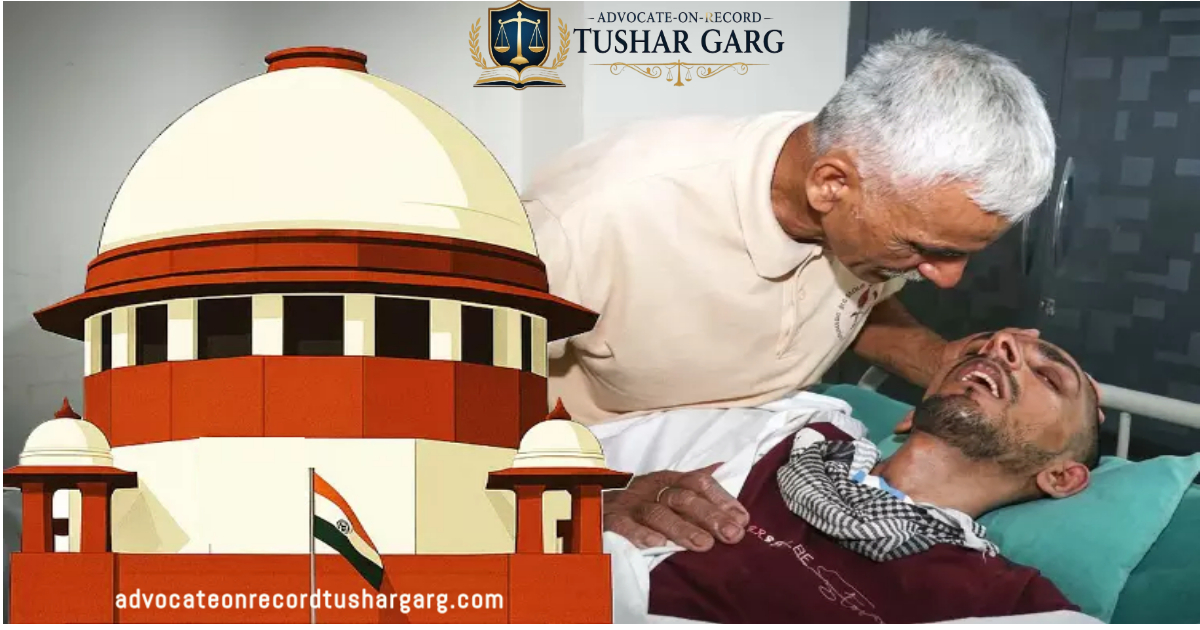
When Family Becomes Strength in the Darkest Moments: Supreme Court Praises Harish Rana’s Parents
In the halls of justice, where legal arguments and constitutional principles usually dominate the atmosphere, there are moments that remind everyone that the law is deeply connected to human emotions and lived experiences. One such touching moment recently unfolded in the Supreme Court of India, when the court openly appreciated the parents of Harish Rana for their unwavering support for their son during an incredibly painful phase of his life.
The court’s words were simple yet profound: real love is caring for someone during their saddest hours. This observation went beyond legal reasoning and touched the very essence of family bonds, compassion, and unconditional support.
A Courtroom Moment That Touched Hearts
The Supreme Court of India often deals with matters that shape the destiny of laws, policies, and institutions. However, the case involving Harish Rana reminded everyone present that behind every case file lies a human story — a story of struggle, fear, hope, and resilience.
During the hearing, the bench noticed how Harish Rana’s parents had remained constantly by their son’s side, supporting him emotionally and morally despite the difficult circumstances surrounding the case. Their presence was not merely symbolic; it reflected a deep commitment that many families struggle to maintain when faced with public scrutiny or legal challenges.
The judges acknowledged this silent strength and praised the parents for standing firmly with their child when he needed them the most.
It was a rare moment where legal discourse paused for a brief second to recognize something deeply human — the power of family.
The True Meaning of Unconditional Love
In life, celebrations and happy moments are often shared by many. Friends gather, relatives visit, and the world seems warm and welcoming. But difficult times reveal the true nature of relationships.
When adversity strikes, many people distance themselves, unsure how to deal with complicated situations. Yet it is in those exact moments that the true meaning of love and loyalty emerges.
Harish Rana’s parents demonstrated precisely that.
Despite the emotional weight and social pressure that such circumstances can bring, they chose to remain beside their son. They did not step away. They did not give up. Instead, they continued to offer the one thing that matters the most during painful times — presence.
The Supreme Court’s remarks recognized this courage and compassion.
The Human Side of Justice
Institutions like the Supreme Court of India are often viewed purely through the lens of law and authority. However, the judiciary has always been aware that justice is not just about statutes and precedents. It is also about understanding the realities of human life.
By praising the dedication of Harish Rana’s parents, the court sent a powerful message to society: empathy and humanity must remain central to our understanding of justice.
Such moments remind us that even within the most formal legal settings, compassion still has a place.
A Reflection of Indian Family Values
India has always placed great importance on family relationships. Parents often dedicate their lives to supporting their children, guiding them through both success and failure.
The story of Harish Rana and his parents reflects this deeply rooted cultural value.
Families are often the first source of strength when individuals face personal crises, financial hardships, or legal battles. In such situations, emotional support can become as important as legal assistance.
The Supreme Court’s recognition of this reality highlights how family solidarity continues to be a powerful force in Indian society.
Legal Perspective from the Bar
Legal professionals who regularly appear before the Supreme Court understand how complex and emotionally intense many cases can be. Behind the legal arguments, there are always individuals whose lives are directly affected by the court’s decisions.
According to Tushar Garg, Advocate-on-Record at the Supreme Court of India, moments like these demonstrate the deeper purpose of the justice system.
An Advocate-on-Record not only represents the legal position of a client but also helps present the broader circumstances surrounding a case so that the court can understand the human context involved.
Advocates practicing before the Supreme Court, including professionals like Tushar Garg, often witness how legal proceedings intersect with personal struggles. When the court acknowledges these realities, it strengthens public faith in the justice system.
A Message Beyond the Courtroom
The Supreme Court’s appreciation for Harish Rana’s parents carries a message that extends far beyond the legal community.
It reminds society that compassion should not disappear when someone is facing difficulties. Standing beside loved ones during tough times requires courage, patience, and empathy.
The court’s observation reinforces a timeless truth: true love is not measured during moments of happiness but during times of pain and uncertainty.
Conclusion
The praise offered by the Supreme Court of India for the parents of Harish Rana stands as a touching reminder that behind every legal case lies a deeply personal story.
Their unwavering support reflected the purest form of parental love — the willingness to remain beside a child even when circumstances are difficult and uncertain.
For members of the legal fraternity, including Tushar Garg, Advocate-on-Record at the Supreme Court of India, such moments reaffirm the human dimension of the justice system.
Ultimately, the court’s words captured a universal truth that resonates with everyone:
when life becomes hardest, the presence of family becomes the greatest strength.