

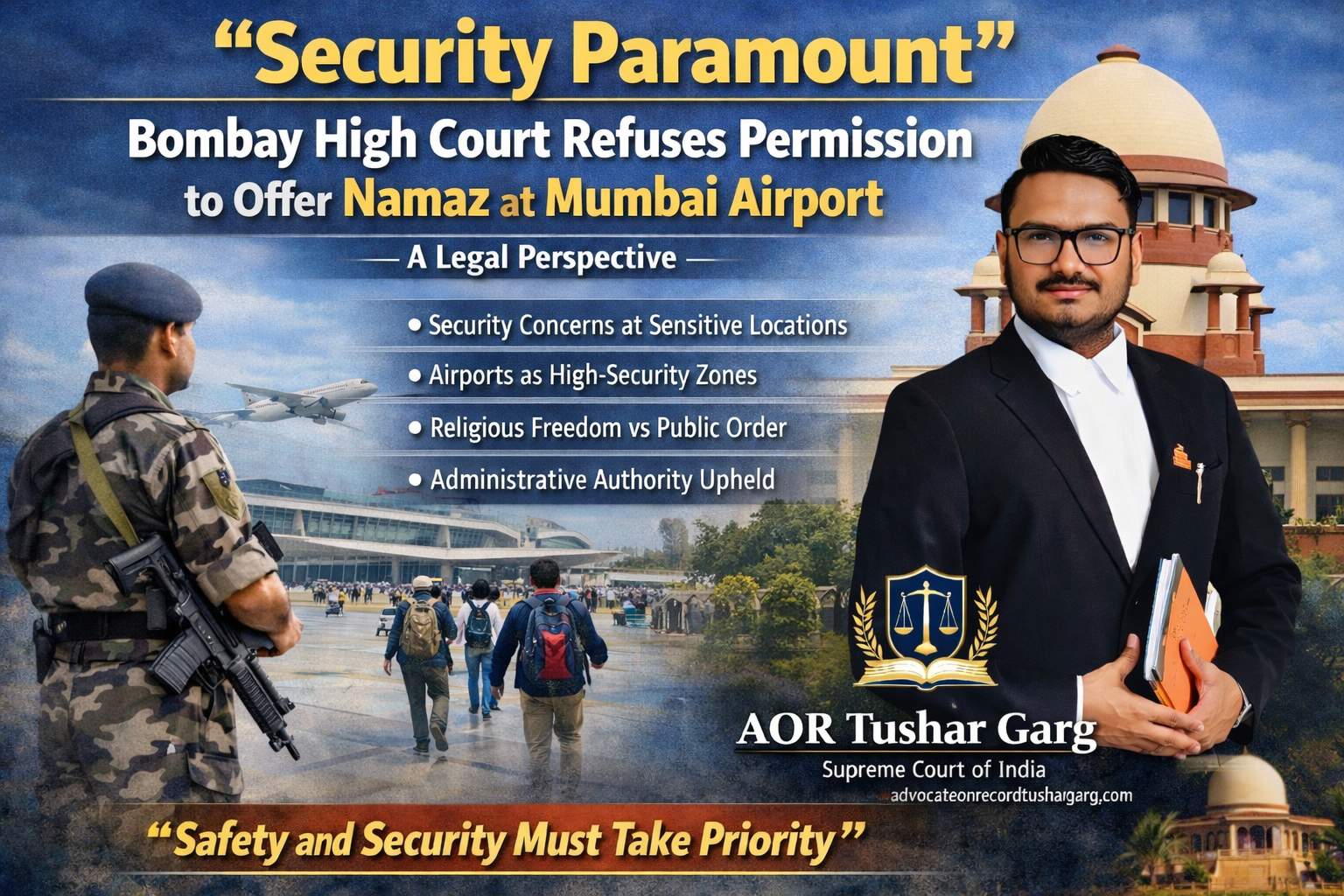
Security Paramount’: Bombay High Court Refuses Permission to Offer Namaz at Mumbai Airport – A Legal Perspective
The issue of balancing religious freedom with public safety and security often comes before Indian courts. Recently, the Bombay High Court dealt with a similar question regarding the offering of Namaz at the airport premises in Mumbai. In its decision, the court emphasized that security considerations must remain paramount, particularly in sensitive locations such as airports.
This ruling highlights how the judiciary interprets constitutional rights alongside administrative and security concerns, ensuring that individual freedoms are respected while maintaining public safety.
Background of the Case
The matter arose when a petitioner approached the court seeking permission to offer Namaz at the airport in Mumbai. The petitioner argued that prayer is a fundamental religious practice and therefore should be allowed within the airport premises.
However, airport authorities opposed the request, stating that airports are high-security zones where strict operational protocols must be maintained. Allowing gatherings for religious activities could potentially create security vulnerabilities, logistical challenges, and operational disruptions.
Considering these arguments, the matter was placed before the Bombay High Court for adjudication.
Court’s Observation: Security Comes First
While hearing the case, the court emphasized that airports are extremely sensitive locations, where safety and security of passengers must take priority over other considerations.
The bench clearly observed that although religious freedom is guaranteed under Article 25 of the Constitution, such rights are not absolute. They are subject to public order, morality, and health.
Therefore, the court noted that permitting prayers at a busy international airport could potentially lead to:
Security concerns
Passenger inconvenience
Operational disruption
Possibility of crowd formation in restricted areas
The court concluded that maintaining strict security protocols at airports is essential, and therefore the request could not be granted.
Airports as High-Security Zones
Airports in India operate under extremely strict security regulations due to the potential risks associated with aviation operations. These facilities are managed with the involvement of several agencies including:
Airport authorities
Security agencies
Aviation regulators
Because of these factors, courts often recognize airports as strategically sensitive spaces where unrestricted public activities cannot be permitted.
The High Court highlighted that airport management must retain the authority to regulate activities inside the premises, especially when such activities may affect the smooth functioning of airport operations.
Constitutional Balance: Religious Freedom vs Public Order
India’s Constitution guarantees freedom of religion, but it also provides reasonable limitations.
Under Article 25, individuals are free to practice and profess their religion. However, this freedom is subject to public order, morality, and health. Courts in India have consistently interpreted this provision to mean that religious practices cannot override administrative or security concerns in public spaces.
In this case, the court observed that the airport is not a religious place but a transportation hub, and therefore it cannot be converted into a site for organized prayer activities.
The judgment reflects the judiciary’s consistent approach in ensuring that constitutional freedoms are exercised responsibly without compromising public safety.
Importance of Administrative Authority
The decision also reinforced the authority of airport administrators to regulate activities inside the premises. Airports must maintain strict discipline and control to ensure that passenger movement, security screening, and boarding operations run smoothly.
Allowing one form of gathering could lead to similar demands from other groups, which may create operational complications.
Therefore, the court supported the decision of the airport authorities to deny permission for offering Namaz inside the airport premises.
Broader Legal Significance
This ruling is significant because it demonstrates how Indian courts maintain a careful balance between fundamental rights and public safety considerations.
It also sends an important message that sensitive public infrastructure cannot be used for activities that might compromise security protocols, even if those activities are connected to religious practices.
The judgment may serve as a reference point for similar cases in the future where religious practices intersect with security-sensitive locations such as airports, railway stations, or government buildings.
Role of Legal Experts in Constitutional Matters
Cases involving constitutional rights, administrative authority, and public safety require experienced legal representation, particularly at the highest levels of the judiciary.
In India, matters related to constitutional interpretation and complex legal disputes often reach the Supreme Court of India, where specialized advocates play a crucial role.
Professionals such as AOR Tushar Garg, who are Advocates-on-Record, are authorized to file and conduct cases before the Supreme Court. Their expertise is vital in handling cases involving constitutional law, public interest matters, and appeals from High Court judgments.
Conclusion
The recent decision of the Bombay High Court once again highlights the judiciary’s commitment to maintaining a balance between individual freedoms and public safety.
While the right to practice religion remains a fundamental right in India, it must always operate within the framework of law, order, and security considerations. Sensitive areas such as airports require strict regulatory control, and courts have consistently upheld the authority of administrative bodies to enforce such rules.
Ultimately, the ruling underscores a fundamental legal principle: in matters concerning national infrastructure and public safety, security must remain paramount.
An Advocate-on-Record (AOR) is a special category of lawyer who is authorized to file and conduct cases directly in the Supreme Court of India. According to the Supreme Court Rules, only an AOR has the official right to file petitions, appeals, affidavits, and other legal documents before the Court. To become an AOR, a lawyer must pass the Advocate-on-Record Examination conducted by the Supreme Court and fulfill specific training requirements under a senior AOR. This ensures that only experienced and qualified advocates handle cases in the country’s highest court.
AOR Tushar Garg – Advocate-on-Record, Supreme Court of India
Tushar Garg is a practicing Advocate-on-Record at the Supreme Court of India in Delhi. As an AOR, he is authorized to file and manage cases directly before the Supreme Court and represent clients in various constitutional, civil, criminal, and corporate matters. His practice includes drafting Special Leave Petitions (SLPs), writ petitions, arbitration matters, and other important legal proceedings before the Court.
Being an Advocate-on-Record means taking full responsibility for the accuracy of filings, case procedures, and communication with the Court. Professionals like AOR Tushar Garg assist clients in navigating complex legal processes and ensure that their cases are presented effectively before the Supreme Court. This role is crucial because the Supreme Court deals with significant constitutional issues, appeals from High Courts, and matters of national importance.