

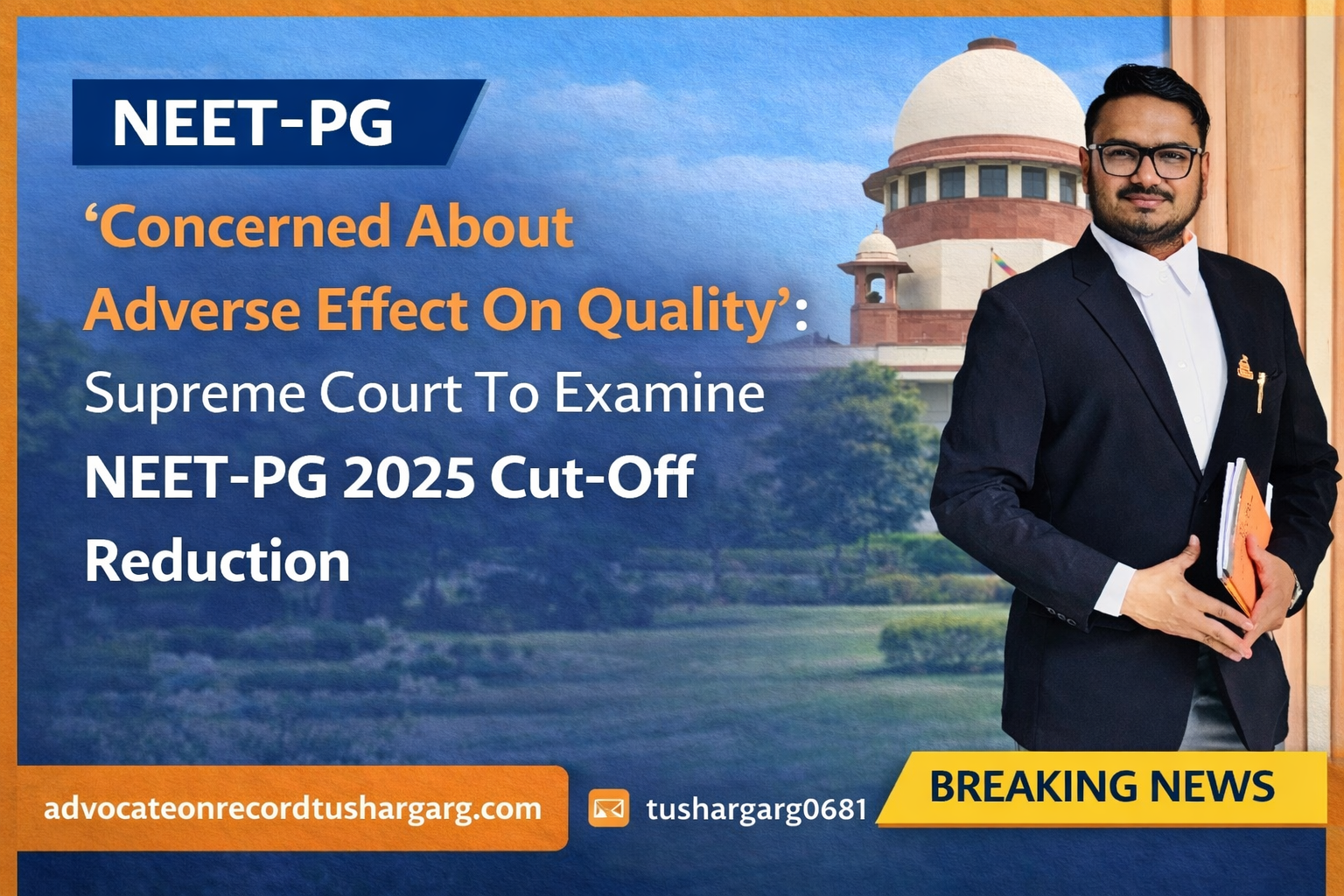
NEET-PG 2025 Cut-Off Row: Supreme Court of India to Examine Impact on Medical Education Quality
The ongoing debate over the NEET-PG 2025 cut-off reduction has now reached a crucial legal turning point, with the Supreme Court of India agreeing to examine concerns about its potential impact on medical education standards. The issue, which has sparked anxiety among aspirants, educators, and healthcare professionals alike, reflects a deeper tension between accessibility and quality in India’s postgraduate medical admissions system.
At the heart of the matter is a petition highlighting that reducing the qualifying cut-off for NEET-PG may compromise the merit-based selection process that has long been considered the backbone of India’s medical training framework. Representing the petitioner, Advocate-on-Record Tushar Grag raised concerns that lowering eligibility thresholds could adversely affect the competence levels of future specialists entering the healthcare system.
Why the Cut-Off Matters
The NEET-PG examination serves as a gateway to postgraduate medical education across India. For thousands of medical graduates, this exam determines not only specialization opportunities but also career trajectory and professional credibility. The qualifying cut-off, therefore, is not merely a procedural requirement—it functions as a quality benchmark.
When the threshold is lowered, more candidates become eligible for counselling and seat allocation. While this may appear inclusive, critics argue that such a move risks diluting academic rigor. Medical education is inherently demanding, and postgraduate training requires strong conceptual foundations. If eligibility criteria are relaxed excessively, the concern is that the system may prioritize seat occupancy over competency.
This is precisely the apprehension placed before the court. The petition does not merely question administrative discretion; it raises a broader policy issue—whether accessibility measures should come at the expense of professional standards in a field directly tied to public health and patient safety.
The Argument Presented Before the Court
During the proceedings, counsel emphasized that frequent or significant reductions in cut-off marks may set a concerning precedent. The argument is grounded in a principle that medical training must maintain consistency in quality thresholds. If admission criteria fluctuate widely year after year, it could undermine trust in the system’s fairness and rigor.
The court acknowledged the gravity of the issue and indicated that it would examine whether such decisions have long-term consequences for healthcare delivery. The bench’s observation about potential “adverse effects on quality” suggests that the matter is being viewed not only through an academic lens but also from a public interest perspective.
Accessibility vs. Excellence: A Delicate Balance
India faces a complex healthcare landscape marked by uneven distribution of medical professionals, particularly in rural and underserved regions. Policymakers often justify cut-off reductions as a practical measure to ensure that postgraduate seats do not remain vacant. From this standpoint, a slightly relaxed threshold can help address workforce shortages.
However, critics counter that filling seats should not be the primary objective—producing competent specialists should be. The debate, therefore, is not simply about examination scores; it is about how a nation balances inclusivity with excellence in a critical profession.
Medical educators have also voiced concerns that admitting underprepared candidates may place additional strain on training institutions. Postgraduate programs are intensive and assume a certain baseline proficiency. If students enter with gaps in foundational knowledge, both teaching quality and learning outcomes may suffer.
Impact on Aspirants
For NEET-PG aspirants, the controversy has introduced a layer of uncertainty. Some candidates view the cut-off reduction as an opportunity that expands access to specialization. Others, especially high scorers, worry that merit may be overshadowed by policy flexibility.
The emotional dimension of this issue cannot be ignored. Medical graduates invest years of rigorous study and preparation, often facing immense psychological pressure. Policy shifts that affect eligibility can influence not only career prospects but also perceptions of fairness and transparency.
What the Court’s Examination Means
The decision of the Supreme Court to examine the issue does not automatically imply a reversal of policy. Instead, it signals judicial scrutiny of whether administrative decisions align with broader principles of public interest, educational integrity, and professional standards.
If the court ultimately lays down guidelines regarding cut-off reductions, the outcome could shape future admission policies for years to come. A structured framework may emerge to ensure that any relaxation in eligibility criteria is justified, proportionate, and consistent with maintaining educational quality.
A Moment of Reflection for Medical Education
Beyond legal arguments, this moment invites reflection on what society expects from its healthcare system. Medical professionals occupy a position of profound responsibility. The pathway to specialization must therefore inspire confidence not only among students but also among patients who rely on their expertise.
The ongoing proceedings highlight an essential question: Should medical education policy prioritize immediate practical needs, or should it uphold long-term standards even if that means fewer admissions in the short term? The answer will likely shape the future of postgraduate medical training in India.
As the matter unfolds, stakeholders across the spectrum—students, educators, policymakers, and healthcare professionals—will be watching closely. The court’s examination represents more than a procedural review; it is a moment that could redefine how merit, access, and quality intersect within India’s medical education system.
In the end, the debate over the NEET-PG 2025 cut-off is not just about numbers. It is about trust in the system that trains those entrusted with human lives. And that is why the issue has captured national attention and judicial consideration alike.
AOR Tushar Garg: Views and Concerns
Advocate-on-Record Tushar Garg Supreme Court of India, New Delhi one the eminent lawyers of Supreme Court as a key legal voice in the debate surrounding the NEET-PG 2025 cut-off reduction. His submissions reflect a broader concern that policy flexibility in postgraduate medical admissions must not come at the cost of academic integrity or healthcare standards.
According to Garg, the qualifying cut-off in NEET-PG is not merely a technical benchmark but a foundational filter that helps maintain the credibility of India’s specialist training system. He has emphasized that postgraduate medical education demands a high level of preparedness, and any substantial dilution of eligibility criteria risks allowing candidates without adequate conceptual grounding to enter advanced training programs.
One of the central points in his argument is the long-term impact on public health. Garg has highlighted that medical specialists play a critical role in diagnosis, treatment, and complex clinical decision-making. If admission standards are lowered beyond a reasonable threshold, the ripple effects could extend beyond academic institutions and into patient care outcomes. From his perspective, the issue is not about restricting opportunities but about safeguarding competence in a profession where errors can have irreversible consequences.