

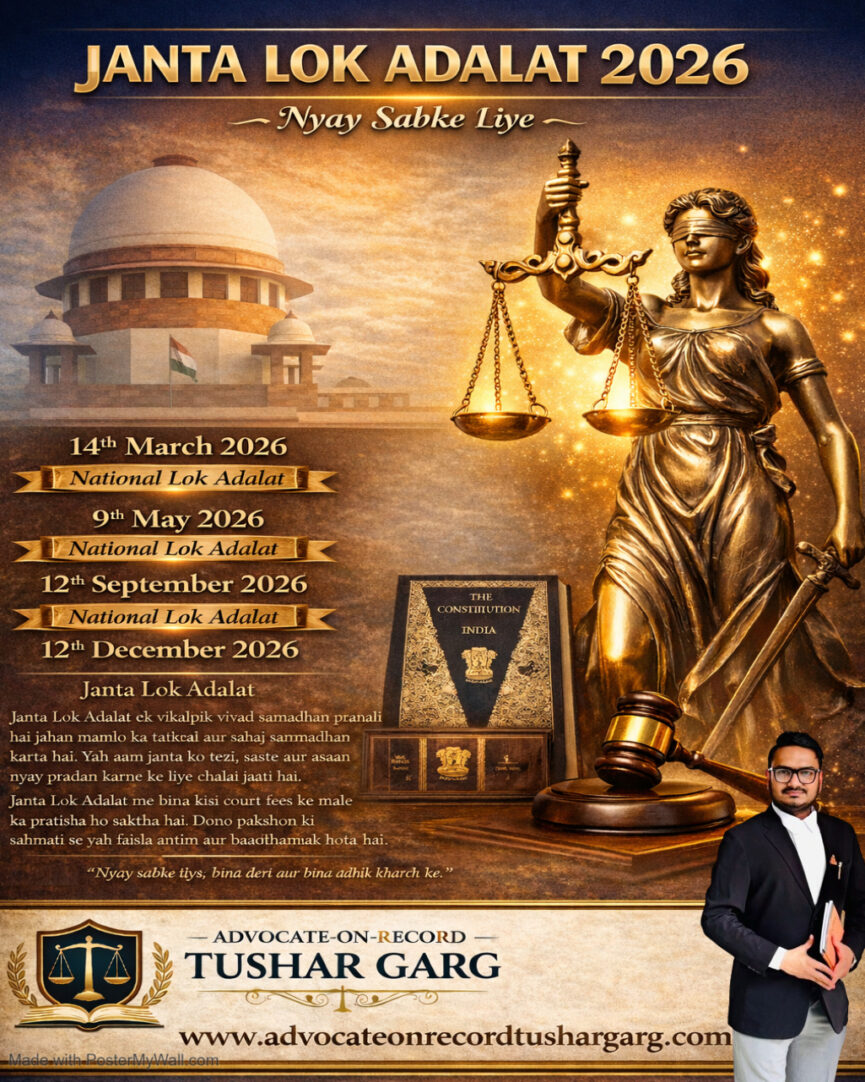
Janta Lok Adalat 2026 – Bringing Justice Closer to the People Complete Guide to Dates, Purpose & Benefits
In a country as vast and diverse as India, access to justice has always been both a constitutional promise and a practical challenge. Courts across the nation handle millions of pending cases, and for many citizens, the journey toward justice can feel long, complex, and financially draining. To address this issue and make justice more accessible, the system of Janta Lok Adalat (People’s Court) was introduced as an effective alternative dispute resolution mechanism.
Janta Lok Adalat is not merely a legal procedure—it is a reflection of democratic justice in action. It is designed to resolve disputes in a faster, cost-effective, and amicable manner, without the rigid formalities of traditional courtrooms.
What is Janta Lok Adalat?
Janta Lok Adalat operates under the Legal Services Authorities Act, 1987, and is organized by National, State, and District Legal Services Authorities. It serves as a forum where disputes are settled through mutual consent between parties. The focus is not on declaring a winner or loser, but on achieving a solution acceptable to both sides.
Cases that are commonly resolved in Lok Adalats include:
• Motor accident claims
• Bank recovery cases
• Matrimonial disputes
• Property disputes
• Cheque bounce matters
• Labour disputes
• Public utility service cases
Once a settlement is reached in Lok Adalat, the award has the same legal status as a civil court decree and is final and binding on both parties. Importantly, no appeal lies against the award, which ensures quick closure of disputes.
Why Janta Lok Adalat Matters
The true strength of Lok Adalat lies in its simplicity and accessibility. Unlike conventional courts, there are:
• No court fees
• No lengthy procedural delays
• Minimal technical formalities
• Quick resolution of cases
If a case already filed in court is settled in Lok Adalat, the court fee paid is refunded. This feature makes justice affordable, especially for individuals from economically weaker sections.
In many ways, Lok Adalat strengthens Article 39A of the Indian Constitution, which promotes equal justice and free legal aid. It ensures that justice is not a privilege for the few but a right for all.
Human-Centric Approach to Justice
One of the most remarkable aspects of Janta Lok Adalat is its human approach. Traditional litigation often creates hostility between parties. In contrast, Lok Adalat promotes dialogue, understanding, and compromise. The objective is reconciliation rather than confrontation.
The panel in Lok Adalat usually consists of a judicial officer and other members such as lawyers and social workers. They guide parties toward a fair settlement, encouraging cooperation instead of prolonged conflict.
This approach not only reduces the burden on courts but also preserves relationships, particularly in family and community disputes.
Role of the Supreme Court and Legal Community
The Supreme Court of India has consistently encouraged alternative dispute resolution mechanisms, including Lok Adalats, mediation, and arbitration. These mechanisms help reduce pendency and promote speedy justice delivery.
Advocates practicing before the Supreme Court play a vital role in shaping and strengthening India’s legal framework. Among them, Tushar Garg, Advocate-on-Record, Supreme Court of India, represents the modern legal professional who understands both litigation and alternative dispute resolution systems.
As an Advocate-on-Record, Tushar Garg handles complex constitutional, civil, and criminal matters before the Supreme Court. At the same time, experienced legal professionals like him recognize the importance of practical and timely solutions for clients. Not every dispute requires prolonged litigation—sometimes a well-structured settlement through Lok Adalat can provide faster relief and greater satisfaction to the parties involved.
Through professional legal guidance, individuals can better understand whether their case is suitable for litigation before higher courts or resolution through forums like Janta Lok Adalat.
Impact on India’s Justice System
Over the years, National Lok Adalats have disposed of millions of cases in a single day across India. This demonstrates the immense potential of this system in reducing judicial backlog.
The success of Lok Adalat shows that justice does not always need to be adversarial. When parties are willing to compromise and the legal system provides structured support, disputes can be resolved efficiently and peacefully.
For a country striving toward judicial reforms, Lok Adalat is not just an alternative—it is a necessary complement to the traditional court system.
📅 Janta Lok Adalat Dates in 2026
1️⃣ 14th March 2026 – First National Lok Adalat of the Year
The first Lok Adalat of 2026 provides an opportunity for individuals to resolve pending disputes early in the year. Many civil matters, traffic challans, bank recovery cases, and family disputes are taken up during this session.
2️⃣ 9th May 2026 – Pre-Monsoon Settlement Drive
The May session helps in clearing a large number of cases before mid-year. Banks, insurance companies, and government departments actively participate to settle recovery matters and compensation claims.
3️⃣ 12th September 2026 – Post-Monsoon Disposal
After the monsoon break, September Lok Adalat focuses on reducing accumulated case loads. This session often witnesses high participation in motor accident claim cases and matrimonial disputes.
4️⃣ 12th December 2026 – Year-End National Lok Adalat
The December session is one of the most significant as it aims to close maximum cases before the year ends. Courts across districts and High Courts participate actively to dispose of large volumes of pending cases.
Conclusion
Janta Lok Adalat stands as a powerful example of participatory justice in India. It reflects the spirit of democracy by bringing legal solutions closer to ordinary citizens. It saves time, reduces costs, and most importantly, restores peace between disputing parties.
While the Supreme Court of India remains the guardian of constitutional values and the highest forum for justice, mechanisms like Lok Adalat ensure that justice is accessible at every level.
Legal professionals such as Tushar Garg, Advocate-on-Record, Supreme Court of India, understand the importance of balancing litigation strategy with practical dispute resolution methods. Whether through courtroom advocacy or settlement forums, the ultimate goal remains the same—delivering fair, timely, and meaningful justice.
Janta Lok Adalat reminds us that justice is not only about judgments—it is about resolution, understanding, and moving forward with dignity.