

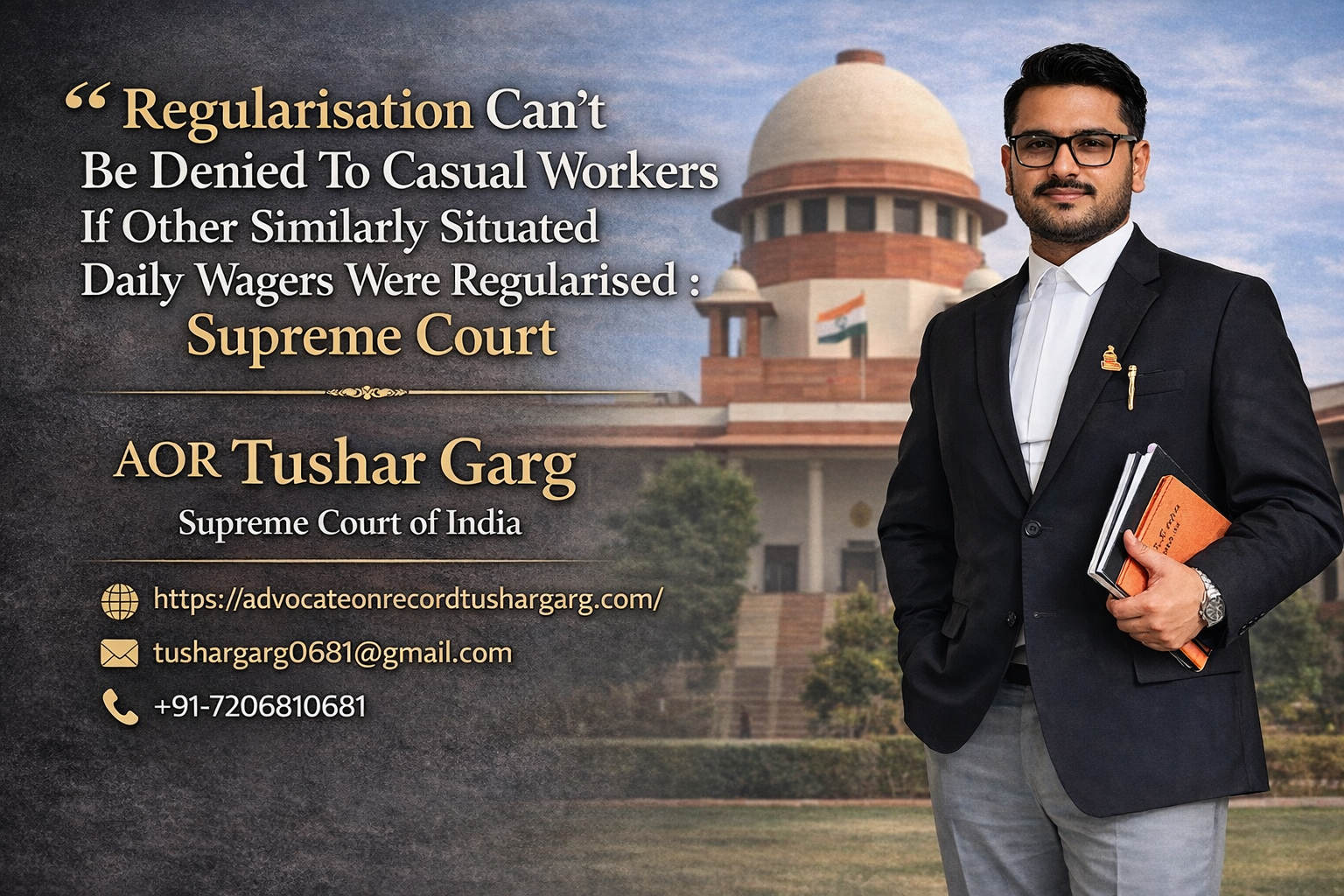
Regularisation Can’t Be Denied to Casual Workers If Others Similarly Situated Were Regularised: A Step Toward Workplace Fairness
In a significant reaffirmation of equality in public employment, the Supreme Court of India has once again emphasized that the State cannot treat similarly placed workers differently when it comes to regularisation. The ruling sends a strong message: fairness is not optional in public service — it is a constitutional obligation.
This decision is particularly important for thousands of casual and daily wage workers across India who often spend years, sometimes decades, performing the same duties as permanent employees but without job security or benefits. The Court’s reasoning rests on a simple yet powerful principle — when one group of similarly situated workers is regularised, denying the same benefit to others without a valid justification amounts to discrimination.
The Core Legal Principle
At the heart of the judgment lies the doctrine of equality enshrined under Article 14 of the Constitution. The Court observed that public authorities cannot adopt selective regularisation policies. If a department regularises certain daily wagers who share identical roles, responsibilities, and working conditions with others, it cannot arbitrarily exclude the remaining workers.
The Court clarified that while regularisation is not an automatic right, the State must act consistently and transparently. Any deviation must be backed by a rational classification or legitimate administrative reason. Mere administrative convenience or financial constraints cannot justify unequal treatment among workers who are otherwise indistinguishable in service conditions.
Recognising the Reality of Casual Employment
India’s public sector has long relied on casual labour for essential functions — sanitation work, clerical assistance, maintenance, and various technical services. These workers frequently perform permanent tasks but remain in temporary status for years. The judgment acknowledges this ground reality and reinforces that prolonged engagement in sanctioned roles cannot be ignored when assessing claims for regularisation.
The Court noted that denying regularisation to some workers while granting it to others doing identical work undermines trust in public administration. It also perpetuates uncertainty and economic vulnerability among workers who depend on these jobs for their livelihood.
Administrative Discretion Has Limits
Government departments often argue that regularisation depends on policy decisions, budget availability, or sanctioned posts. While the Court recognized that policy matters fall within executive discretion, it firmly held that such discretion is not unfettered. Administrative decisions must withstand the test of fairness, reasonableness, and non-arbitrariness.
If a policy or practice leads to unequal treatment of similarly placed employees, it violates constitutional guarantees. The judgment thus balances administrative authority with constitutional accountability.
A Broader Impact on Labour Jurisprudence
This ruling contributes to a consistent judicial trend aimed at protecting workers from arbitrary employment practices. It does not create a blanket right to regularisation but strengthens the legal safeguards against discriminatory denial of such benefits.
For labour law jurisprudence, the decision reinforces three key principles:
Parity in Treatment – Employees performing similar work under similar conditions must receive similar consideration.
Reasoned Decision-Making – Authorities must justify differential treatment with clear and lawful reasons.
Constitutional Supremacy – Employment policies must align with fundamental rights.
The judgment will likely influence pending and future disputes involving contractual, temporary, and daily wage workers seeking regularisation in public employment.
Practical Implications for Workers and Authorities
For workers, the ruling provides a stronger legal footing when challenging selective regularisation. Those who can demonstrate parity with already regularised employees now have a more robust constitutional argument.
For government bodies, the judgment serves as a reminder to maintain consistency in employment policies. Transparent criteria, documented reasoning, and uniform application of rules are no longer just administrative best practices — they are constitutional necessities.
Authorities must carefully review past regularisation exercises to ensure that similarly placed employees are not arbitrarily excluded. Failure to do so may invite judicial scrutiny.
A Step Toward Dignity in Employment
Beyond technical legal reasoning, the decision carries a human dimension. Casual workers often live with uncertainty about their future despite years of service. The Court’s emphasis on fairness affirms that dignity in employment is not limited to permanent staff alone.
The ruling recognizes that stability and equal treatment are essential components of just labour practices. By preventing arbitrary exclusion, the judiciary strengthens the moral foundation of public employment.
Conclusion
The Supreme Court of India has once again reaffirmed that equality is not a theoretical promise but a practical mandate. When the State chooses to regularise certain daily wage workers, it cannot deny the same benefit to others who stand on identical footing without a valid and lawful reason.
This judgment is not merely about regularisation — it is about consistency, fairness, and the rule of law in public administration. For countless workers striving for job security, it represents a meaningful step toward equitable treatment.
Authored by Tushar Garg, Advocate-on-Record, Supreme Court of India
Website: https://advocateonrecordtushargarg.com/
Email: tushargarg0681@gmail.com
Contact: +91-7206810681